On-Demand Geometry Streaming for Ray Tracing
Nvidia has unveiled RTX Mega Geometry 2.0, a significant update to its SDK that introduces on-demand ray-tracing geometry streaming. This new capability, arriving with RTX Kit 2026.3, is designed to tackle the ever-increasing complexity of 3D scenes in real-time applications, particularly games. Traditionally, when a scene becomes too complex to fit into a GPU's VRAM, developers have had to resort to techniques that either reduce the overall geometric detail or sacrifice rendering quality to make assets fit. RTX Mega Geometry 2.0 offers a more sophisticated solution, inspired by Epic Games' Nanite virtualized geometry system used in Unreal Engine.
The core innovation lies in its ability to stream only the necessary geometric data into VRAM as it is needed for rendering. Instead of loading entire, highly detailed models into memory, the system intelligently loads and unloads granular pieces of geometry on the fly. This is akin to how a streaming service buffers only the portion of a movie you're currently watching, rather than downloading the entire film upfront. For developers, this means they can create and utilize significantly more complex and detailed environments without being immediately bottlenecked by VRAM capacity. This approach allows for an unprecedented level of geometric fidelity in ray-traced scenes, as the GPU can access extremely detailed assets that would otherwise be impossible to store.
Performance and Quality Implications
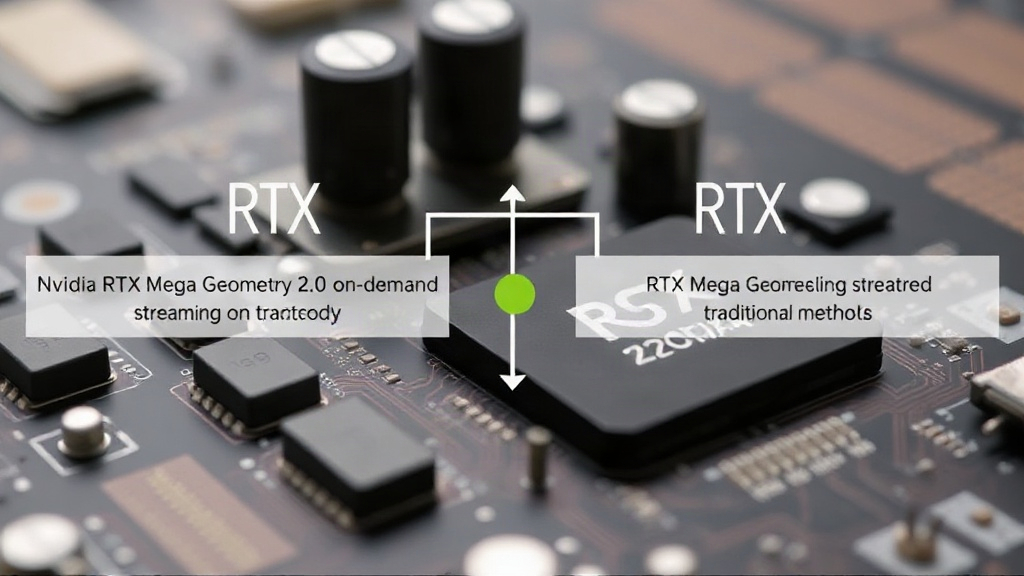
The primary benefit of Mega Geometry 2.0 is the dramatic reduction in VRAM usage. By streaming geometry in chunks, the GPU only needs to hold a subset of the scene's total geometry in its memory at any given time. This frees up VRAM for other critical tasks, such as higher-resolution textures, more complex shaders, and larger frame buffers, all of which contribute to a richer visual experience. Furthermore, this technique avoids the visual artifacts that can arise from aggressive level-of-detail (LOD) systems, where distant objects can appear blocky or simplified. Mega Geometry 2.0 aims to maintain a high level of detail even for objects that are far away or only partially visible, by dynamically loading the required detail only when that geometry is within the ray-tracing pipeline's active view.
This technology is particularly impactful for ray tracing. Ray tracing is inherently computationally expensive and requires access to detailed geometric data to accurately simulate light interactions. With Mega Geometry 2.0, developers can implement ray tracing on scenes with billions of triangles, a scale previously only achievable with rasterization techniques or by severely compromising on geometric complexity. The system works by intelligently culling and prioritizing geometry, ensuring that the GPU is always working with the most relevant and detailed data for the current frame. This can lead to smoother frame rates and a more consistent visual experience, especially in complex, dynamic environments. The inspiration from Nanite is clear: both systems aim to abstract away the limitations of memory and processing power by virtualizing geometry and loading it dynamically.
Developer Adoption and Future Prospects
The RTX Mega Geometry 2.0 SDK is part of the broader RTX Kit 2026.3, suggesting Nvidia is positioning this as a foundational technology for future real-time graphics development. While the exact integration methods and performance benchmarks will depend on specific game engines and developer implementations, the potential is immense. Developers will need to adapt their asset pipelines to leverage this new streaming capability, which may involve creating assets with extremely high polygon counts and ensuring they are properly structured for on-demand loading. The SDK likely provides tools and APIs to manage this process, allowing developers to define streaming budgets and prioritize geometry loading based on various factors.
The success of this technology will hinge on its ease of integration and the tangible benefits it provides to both developers and end-users. If it allows for significantly more detailed and visually stunning worlds without an prohibitive performance cost or a steep learning curve for developers, it could become a standard feature in next-generation games and professional visualization applications. The ability to stream geometry on demand is not just an optimization; it's a paradigm shift that could redefine the boundaries of what is possible in real-time rendering, enabling experiences that were previously confined to pre-rendered cinematics or offline rendering pipelines.
Broader Industry Impact
Nvidia's move with Mega Geometry 2.0 signals a clear trend towards virtualized geometry systems becoming mainstream in real-time graphics. Similar to how Nanite has influenced the Unreal Engine ecosystem, this SDK could drive similar innovations across other engines and development platforms. The implications extend beyond gaming, potentially impacting fields like architectural visualization, automotive design, and virtual reality, where complex, highly detailed models are common. By abstracting VRAM limitations, Nvidia is effectively lowering the barrier to entry for creating incredibly rich and detailed 3D environments, pushing the industry closer to photorealistic real-time experiences.
The challenge for developers will be to balance the infinite potential of ultra-high detail with practical considerations like asset creation workflows, disk space, and network bandwidth for downloadable content. However, the promise of richer, more immersive virtual worlds, rendered with unprecedented geometric fidelity, makes this a development worth watching closely.