Nstrike: Building a Blockchain from the Ground Up
Martial Zinsou has released the Minimum Viable Product (MVP) of Nstrike, a project that meticulously reconstructs a blockchain from fundamental principles. Written entirely in modern C++17, Nstrike stands out by eschewing all external libraries, including cryptography giants like OpenSSL and Boost, and even the widely-used secp256k1 library for elliptic curve cryptography. This approach forces a deep dive into the inner workings of blockchain technology, making it an educational tool and a testament to what can be achieved with pure C++.
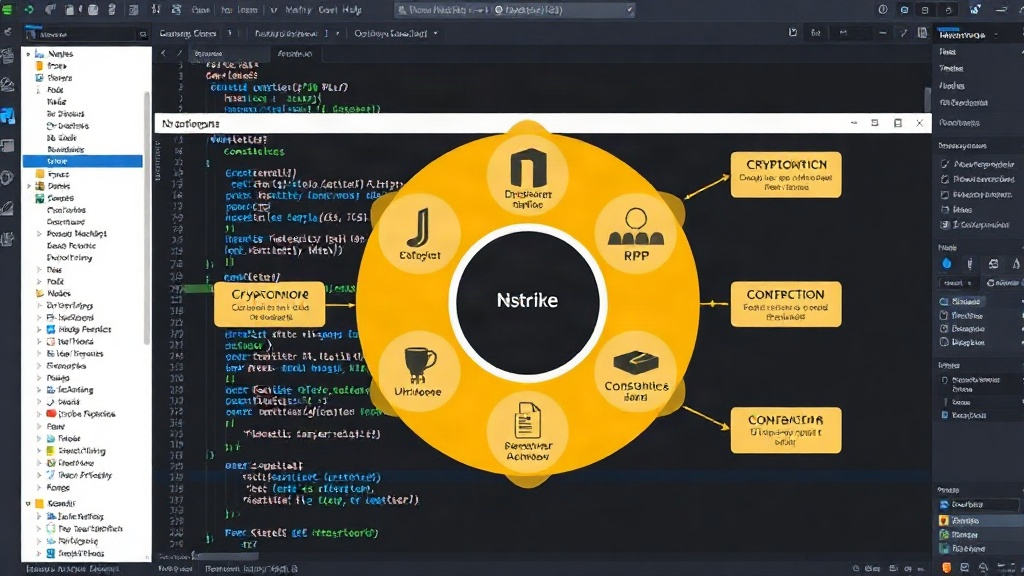
The Nstrike MVP aims to demystify core blockchain concepts. It encompasses essential components such as cryptographic hashing (SHA-256), virtual machines for smart contract execution, Proof-of-Work consensus mechanisms, account management, ERC-20 token standards, and interfaces for interaction via JSON RPC and a Command Line Interface (CLI). This comprehensive feature set, despite its minimal dependencies, positions Nstrike as a valuable resource for developers seeking to understand the foundational layers of a blockchain architecture.
Core Components and Technical Implementation
At its heart, Nstrike implements SHA-256 for hashing, a standard choice for ensuring data integrity and block linking. The virtual machine component is designed to interpret and execute smart contracts, mimicking the functionality of Ethereum's EVM but built from scratch. This allows for the deployment and execution of decentralized applications logic directly on the blockchain.
The consensus mechanism employed is Proof-of-Work (PoW). This means that network participants, or miners, must expend computational effort to solve complex mathematical problems to validate transactions and create new blocks. This process secures the network by making it prohibitively expensive to alter the transaction history. The MVP includes the necessary logic for block creation, block validation, and the PoW puzzle-solving process.
Account management in Nstrike follows a structure similar to Ethereum, dealing with public and private keys, account balances, and nonces. This system is fundamental for tracking ownership of digital assets and managing transactions. The project also supports the creation and management of ERC-20 tokens, a ubiquitous standard for fungible tokens on Ethereum. This enables the development of custom cryptocurrencies and tokenized assets within the Nstrike ecosystem.
Interaction with the blockchain is facilitated through a JSON RPC API. This standard interface allows external applications and services to query blockchain state, submit transactions, and interact with smart contracts. Complementing the RPC API is a CLI tool, providing developers with a direct way to interact with the blockchain, manage nodes, and deploy smart contracts from their terminal.
The Significance of a Dependency-Free Approach
The decision to build Nstrike without any external libraries is a deliberate one, aimed at maximizing educational value and demonstrating a deep understanding of underlying technologies. Traditional blockchain projects often rely on established cryptographic libraries for performance and security. By building these components from scratch, Zinsou highlights the fundamental algorithms and data structures involved. This approach offers several advantages:
- Unparalleled Learning Opportunity: Developers can trace every line of code, understanding precisely how cryptographic primitives, consensus algorithms, and virtual machines function.
- Reduced Attack Surface: Eliminating external dependencies can, in theory, reduce the potential attack surface by removing vulnerabilities that might exist in third-party libraries. However, this also places the entire burden of security on the Nstrike codebase itself.
- Portability and Simplicity: A dependency-free project is easier to compile and deploy across various environments, as it doesn't require managing complex external build systems or library installations.
The author, Martial Zinsou, has licensed the project under MIT, encouraging widespread use, modification, and distribution. The current version, 0.1.0, signifies an MVP, indicating that while core functionality is present, further development and refinement are anticipated.
Beyond the MVP: Future Potential
While the MVP lays a strong foundation, the Nstrike project has the potential to evolve. Future iterations could explore alternative consensus mechanisms, enhance the virtual machine's capabilities, or improve network performance and scalability. The absence of external dependencies presents both a challenge and an opportunity. Security audits would need to be exceptionally thorough, given the self-contained nature of the cryptography and core logic. However, the project's commitment to transparency and foundational understanding remains its strongest asset.
For developers and blockchain enthusiasts, Nstrike offers a rare opportunity to engage with a blockchain implementation that prioritizes clarity and self-sufficiency. It serves as a powerful educational tool, stripping away the layers of abstraction common in more mature blockchain platforms and revealing the intricate engineering beneath. The project's success will hinge on its ability to maintain security and performance without the crutches of external libraries, a challenge that few projects undertake.
What remains to be seen is how Nstrike will address the practical challenges of real-world blockchain deployment, such as achieving robust decentralization, ensuring high transaction throughput, and maintaining long-term security against sophisticated adversaries, all while operating within its strict dependency constraints.