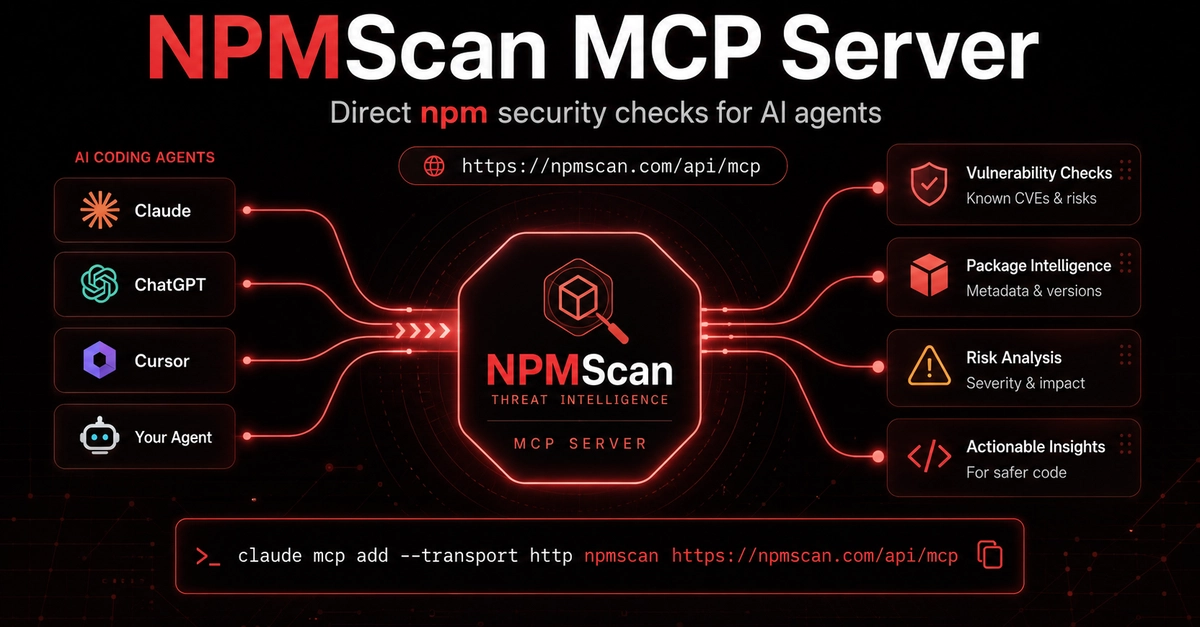
AI Agents Need Better npm Context
AI coding agents are increasingly integrated into developer workflows, often choosing libraries, installing dependencies, and modifying package.json files directly. However, these agents frequently rely on outdated model knowledge, incomplete web searches, or insufficient package information when making decisions. This can lead to agents recommending suboptimal or even insecure packages.
To address this gap, NPMScan has launched a public MCP (Machine Communication Protocol) server. This server provides AI coding agents with direct access to comprehensive npm package metadata. Agents can now query real-time information on package details, installation scripts, maintainer information, known vulnerabilities, and recent security advisories. The goal is to embed NPMScan's capabilities directly within the AI agent's decision-making process.
MCP Endpoint Details
The NPMScan MCP server is accessible via the following public endpoint:
https://npmscan.com/api/mcpThis endpoint is read-only and does not require an API key, making it easily accessible for any compatible AI agent. This openness is crucial for fostering broader adoption and integration within the AI coding ecosystem.
Connecting with Claude Code
The article demonstrates how to connect this new MCP server to Claude Code, an AI coding assistant. By integrating NPMScan's data, Claude Code can make more informed decisions about package selection and dependency management. This integration exemplifies how AI agents can leverage external, real-time data sources to improve their performance and reliability.
The process involves configuring the AI agent to use the NPMScan MCP endpoint for package information retrieval. This allows the agent to bypass its internal, potentially stale knowledge base and query up-to-date data directly from NPMScan. For instance, an agent might query for a package's latest version, its security score, or recent vulnerability disclosures before recommending its inclusion in a project.
The Broader Significance: Explicit Constraints for AI
This development aligns with a broader trend in AI development: the increasing value of explicit constraints. As discussed in related research, AI agents benefit significantly from well-defined contexts and explicit information. Traditional software development often sought to minimize constraints, favoring flexibility and implicit behavior. However, AI changes this dynamic. Every explicit constraint, whether it's a database schema, an OpenAPI specification, or detailed package metadata, becomes valuable context that an AI can use to better understand systems and make more accurate decisions.
In this case, the NPMScan MCP server acts as a provider of such explicit constraints for AI coding agents. It transforms raw npm package data into a structured, machine-readable format that AI can readily consume. This allows agents to go beyond simple keyword matching or outdated dependency graphs. They can now understand the security posture, maintenance status, and potential risks associated with npm packages. This move from implicit knowledge to explicit, queryable data is a critical step in building more robust and trustworthy AI development tools.
Implications for AI Agents and Developers
The introduction of an MCP server for npm package data has several key implications. For AI developers, it offers a standardized way to inject critical context into their agents. This can lead to agents that are not only more efficient but also more secure, reducing the likelihood of introducing vulnerable dependencies into projects. Developers using these AI agents can expect more reliable suggestions and a reduced burden of manually vetting every package recommendation.
Furthermore, this initiative highlights the potential for similar structured data endpoints for other package managers and software components. As AI agents become more sophisticated, the demand for real-time, machine-readable data about the software supply chain will only increase. NPMScan's MCP server is an early example of how this demand can be met, paving the way for more intelligent and secure automated development processes.