The Foundation: Model Context Protocol (MCP)
The Model Context Protocol (MCP) has fundamentally reshaped how Large Language Models (LLMs) and agentic runtimes interact with external systems. By establishing a standardized communication bridge, MCP addresses the pervasive fragmentation issue common in custom agent integrations. This protocol is not merely a technical specification; it's an architectural paradigm shift enabling discoverability, invocation, and seamless interaction between agents and the tools they leverage.
However, the practical implementation of production-grade agentic infrastructure hinges on a critical architectural decision: the transport layer. This layer is the digital conduit through which discrete processes, applications, and distributed nodes communicate. In the Node.js ecosystem, the choice of transport layer is far from a trivial configuration setting. It has profound implications, directly shaping the security boundaries, dictating the latency profiles, influencing the deployment topology, and impacting the overall operational complexity of the system.
Understanding Node.js Transport Layers
At its core, a transport layer is responsible for moving data between two points. In the context of Node.js applications, especially those powering LLM agents, this data can range from simple commands to complex context payloads. The decision between different transport layers is not about choosing a faster pipe; it's about selecting the right tool for a specific job, considering factors like real-time data needs, security requirements, and the environment in which the agent operates.
Stdio: The Local Developer's Workhorse
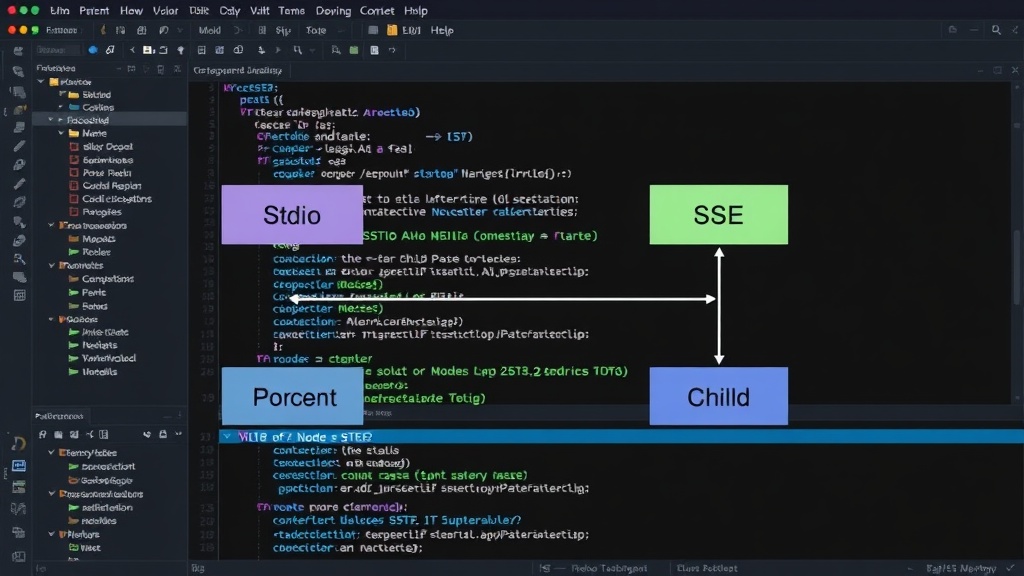
Standard Input/Output (Stdio) is a familiar paradigm for developers, particularly in Unix-like environments. In Node.js, Stdio communication typically involves piping data between processes. A parent process spawns a child process, and they communicate by writing to and reading from each other's standard input and output streams. This method is inherently synchronous and tightly coupled, making it ideal for local development, CLI tools, or tightly integrated microservices where processes are managed within the same host or a closely controlled environment.
The simplicity of Stdio is its greatest strength. Setting up communication is straightforward: the parent process executes the child, and both can `process.stdin.on('data', ...)` and `process.stdout.write(...)`. For LLM agents, this can mean a local LLM engine running as a child process, receiving prompts via stdin and returning completions via stdout. This approach offers low latency because there's no network overhead. However, its coupling also means that if the child process crashes, the parent is directly affected. Scaling Stdio-based communication across multiple machines is also non-trivial, often requiring external orchestration tools.
Security with Stdio is largely managed by the operating system's process isolation. However, sensitive data transmitted over Stdio within a shared environment could theoretically be intercepted if process boundaries are weak. The primary limitation for production systems is its lack of inherent network transparency and its synchronous nature, which can block the main thread if not handled carefully with asynchronous patterns.
Server-Sent Events (SSE): Real-time Push for the Web
Server-Sent Events (SSE) offer a distinct approach, designed for unidirectional communication from a server to a client over a single, long-lived HTTP connection. Unlike traditional polling or WebSockets (which are bidirectional), SSE is optimized for scenarios where the server needs to push real-time updates to clients without the client having to constantly ask for new information. This makes it a compelling choice for LLM agent infrastructures that require continuous streams of output, such as live code generation, interactive chat completions, or status updates.
In a Node.js context, implementing SSE involves setting up an HTTP server that responds to client requests with a specific content type (`text/event-stream`). The server then keeps the connection open, sending events formatted with `data:`, `event:`, `id:`, and `retry:` fields. The client-side can easily consume these events using the native `EventSource` API in browsers or libraries in Node.js environments. This push-based model significantly reduces latency for receiving updates compared to polling and is more lightweight than full-duplex WebSockets when only server-to-client streaming is needed.
SSE's primary advantage for LLM agents is its ability to deliver streaming responses efficiently. An LLM can generate tokens incrementally, and SSE can push each token or chunk of text to the agent's frontend or other services as it becomes available. This provides a more responsive user experience, making the LLM feel faster and more interactive. Security for SSE is managed through standard HTTP security mechanisms, such as TLS/SSL for encryption and authentication headers. The connection is initiated by the client, fitting well into many web-based architectures.
Comparing Stdio and SSE in MCP
The choice between Stdio and SSE for Node.js MCP implementations boils down to the specific use case and deployment environment. Stdio is the pragmatic, low-overhead choice for tightly coupled, local, or CLI-centric agent components. It excels in scenarios where processes are managed together and network latency is not a concern, such as during local development or within a single container.
SSE, on the other hand, shines when real-time, server-to-client streaming is paramount. It's the superior option for web applications, multi-tenant SaaS platforms, or distributed systems where agents need to receive continuous, low-latency updates from LLM providers or other backend services. SSE's reliance on HTTP makes it more network-transparent and easier to integrate into existing web infrastructure, including navigating firewalls and proxies.
Consider an agent that orchestrates multiple LLM calls and external tools. If the LLM is a separate service, and the agent needs to display the LLM's output token-by-token as it's generated, SSE is the clear winner. The agent would act as the SSE client, receiving a stream of text from the LLM service. If, however, the agent is a command-line utility that directly invokes a local LLM binary and expects a single, complete response, Stdio might suffice. The unexpected detail here is that SSE, while seemingly web-focused, can be effectively utilized within Node.js backend services to stream data between microservices, not just to browser clients.
What nobody has fully addressed yet is the optimal strategy for hybrid scenarios, where an agent might need both low-latency local process communication and real-time external service streaming. A robust framework might need to abstract these transport layers, allowing developers to configure the appropriate one based on service discovery and deployment context.
Operational Considerations
Deployment topology is a significant factor. Stdio-based communication is simpler to manage when all involved processes reside on the same machine or within a tightly controlled cluster. Scaling requires careful orchestration. SSE, leveraging standard HTTP, integrates more naturally into cloud-native environments, load balancers, and distributed systems. The operational overhead for managing SSE connections is generally lower in complex, distributed architectures.
Security boundaries are another key differentiator. While Stdio relies on OS-level process isolation, SSE benefits from the robust security features of HTTP, including TLS for encryption and standard authentication and authorization mechanisms. For external-facing services or multi-tenant applications, SSE offers a more secure and manageable approach to data transmission.
Latency profiles also diverge. Stdio offers minimal latency for local communication but can introduce blocking if not handled asynchronously. SSE introduces a small overhead due to HTTP framing but provides efficient, continuous streams with low latency for updates. The developer must weigh the immediate, direct communication of Stdio against the persistent, event-driven nature of SSE.
Conclusion
The selection of a transport layer for Node.js MCP implementations is a critical architectural decision. Stdio provides a simple, low-latency solution for tightly coupled processes, ideal for local development and CLI tools. Server-Sent Events offer a powerful, scalable mechanism for real-time, server-to-client streaming, crucial for interactive LLM agent experiences and distributed systems. Understanding the trade-offs in security, latency, and operational complexity will guide developers in building robust and efficient agentic infrastructures.