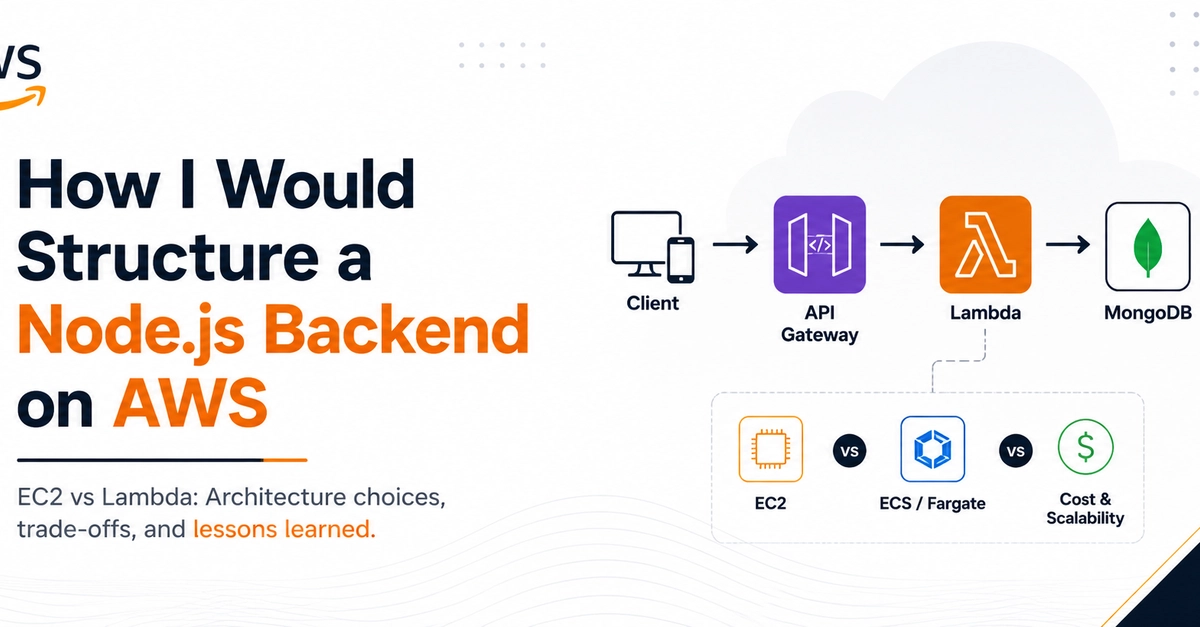
Choosing Your Node.js Compute Foundation on AWS
When architecting a Node.js backend on AWS, the fundamental decision often boils down to the execution environment: traditional virtual servers like EC2 or serverless functions like AWS Lambda. This choice isn't merely about cost; it's a strategic decision that impacts scalability, operational overhead, development velocity, and ultimately, the success of your application. There's no universal answer, as the optimal path depends heavily on specific application requirements, traffic patterns, team familiarity, and operational readiness.
For a typical Node.js backend, common requirements include robust REST APIs, secure authentication and authorization mechanisms, database integration (often with MongoDB or similar), file upload capabilities, asynchronous background processing, comprehensive logging and monitoring, and a reliable deployment pipeline capable of handling fluctuating traffic loads. Understanding these core needs is the first step in evaluating compute options.
EC2: The Traditional Server Approach
Amazon Elastic Compute Cloud (EC2) offers virtual servers that provide a familiar, consistent environment for running Node.js applications. Developers accustomed to managing servers will find EC2 a comfortable transition. You have full control over the operating system, installed software, and network configuration. This level of control is advantageous for applications with specific dependencies, custom networking requirements, or those that need to maintain long-running processes outside the typical request-response cycle.
Pros of EC2:
- Full Control: You manage the OS, runtime, and dependencies.
- Predictable Performance: For consistent workloads, EC2 instances offer stable performance.
- Long-Running Processes: Ideal for tasks that exceed Lambda's execution limits.
- Familiarity: Easier for teams with existing server administration experience.
- Cost-Effective for High, Consistent Traffic: Can be cheaper than Lambda for very high, steady traffic volumes.
Cons of EC2:
- Operational Overhead: Requires management of patching, scaling, load balancing, and instance health.
- Slower Scaling: Auto-scaling can take minutes, not seconds, making it less responsive to sudden traffic spikes.
- Underutilization Costs: You pay for instances even when idle, potentially leading to wasted resources.
- Deployment Complexity: Requires robust CI/CD pipelines for updates and rollbacks.
When using EC2, a common pattern is to run Node.js applications using a process manager like PM2 or using containers orchestrated by ECS or EKS. Load balancers (like AWS ELB) distribute incoming traffic across multiple instances, and auto-scaling groups adjust the number of instances based on demand. This setup offers resilience and scalability but introduces significant operational complexity.

Lambda: The Serverless Alternative
AWS Lambda, coupled with API Gateway, represents the serverless paradigm. Here, your Node.js code runs in ephemeral containers that are spun up on demand to handle individual requests. AWS manages the underlying infrastructure, including servers, operating systems, and scaling. This abstraction significantly reduces operational burden.
Pros of Lambda:
- Zero Operational Overhead: AWS handles all infrastructure management.
- Automatic Scaling: Scales seamlessly from zero to millions of requests per second.
- Pay-Per-Use: You only pay for the compute time consumed, making it cost-effective for variable or low traffic.
- Faster Development Cycles: Developers can focus on writing code, not managing infrastructure.
- Built-in High Availability: Functions are inherently distributed and fault-tolerant.
Cons of Lambda:
- Execution Limits: Functions have time limits (e.g., 15 minutes) and payload size restrictions.
- Cold Starts: Initial requests after a period of inactivity can experience latency.
- Vendor Lock-in Concerns: Tighter integration with AWS services can make migration harder.
- Local Development Challenges: Replicating the cloud environment locally can be complex.
- State Management: Stateless nature requires external services for managing session data or long-term state.
A typical Lambda architecture involves API Gateway to handle HTTP requests, routing them to specific Lambda functions. These functions might interact with other AWS services like DynamoDB, S3, or SQS. For background processing, Lambda can be triggered by SQS queues or other event sources. This event-driven model is powerful but requires a shift in thinking from traditional monolithic or microservice architectures.

The Decision Framework: When to Choose Which
The choice between EC2 and Lambda is not a simple technical preference; it's a business and operational decision. Consider these factors:
Traffic Patterns and Predictability
EC2: Best suited for applications with high, consistent, and predictable traffic. If your load is relatively stable and high, the cost per request on EC2 can be lower than Lambda, and you avoid cold start issues. Managing scaling for predictable peaks is also more straightforward.
Lambda: Ideal for applications with highly variable, spiky, or unpredictable traffic. It excels at handling sudden bursts of requests without manual intervention or pre-provisioning. It's also cost-effective for low-traffic applications, as you pay nothing when the function isn't running.
Workload Characteristics
EC2: Suitable for applications requiring long-running processes, custom background tasks that exceed Lambda's time limits, or those needing direct OS-level access and control. Applications with complex dependencies or specific runtime configurations might also fare better on EC2.
Lambda: Perfect for request-response APIs, event-driven processing, and tasks that can be broken down into short, independent executions. If your workload naturally fits into discrete, short-lived functions, Lambda is a strong contender.
Team Experience and Operational Capacity
EC2: Requires a team comfortable with server management, patching, security hardening, and infrastructure automation. If your team has strong DevOps skills and enjoys managing infrastructure, EC2 offers maximum flexibility.
Lambda: Appeals to teams that want to minimize infrastructure management and focus purely on application logic. It requires a different skillset, emphasizing event-driven design, statelessness, and understanding AWS service integrations. If your team's strength lies in rapid feature development, Lambda can accelerate delivery.
Cost Considerations
EC2: Can be more cost-effective for sustained high traffic. However, costs can escalate with over-provisioning, idle instances, and the added expense of managing the infrastructure (personnel, tooling). Reserved instances or savings plans can further reduce costs for predictable workloads.
Lambda: Often more cost-effective for low to moderate, or highly variable traffic. The pay-per-execution model eliminates costs for idle time. However, very high-throughput applications might see costs rise compared to optimized EC2 instances. It's crucial to model costs based on expected usage patterns.
The Hybrid Approach
It's also important to recognize that these choices are not mutually exclusive. Many modern applications adopt a hybrid approach. You might run your core, high-traffic APIs on EC2 or containers for predictable performance and cost efficiency, while using Lambda for specific background tasks, event processing, or less critical endpoints that benefit from automatic scaling and reduced operational overhead. For instance, a user authentication service might live on EC2, while a notification service triggered by database events could be a Lambda function.
Ultimately, the decision requires a thorough understanding of your application's current and future needs, your team's capabilities, and your tolerance for operational management. Neither EC2 nor Lambda is inherently superior; they are different tools for different jobs.