The JavaScript Paradox: Single Thread, Multiple Tasks
JavaScript is famously single-threaded. This means it can only execute one piece of code at a time. Yet, Node.js applications routinely handle concurrent operations like network requests, file I/O, and timers without grinding to a halt. How is this possible? The answer lies in the Node.js Event Loop, a sophisticated mechanism that orchestrates asynchronous operations behind the scenes.
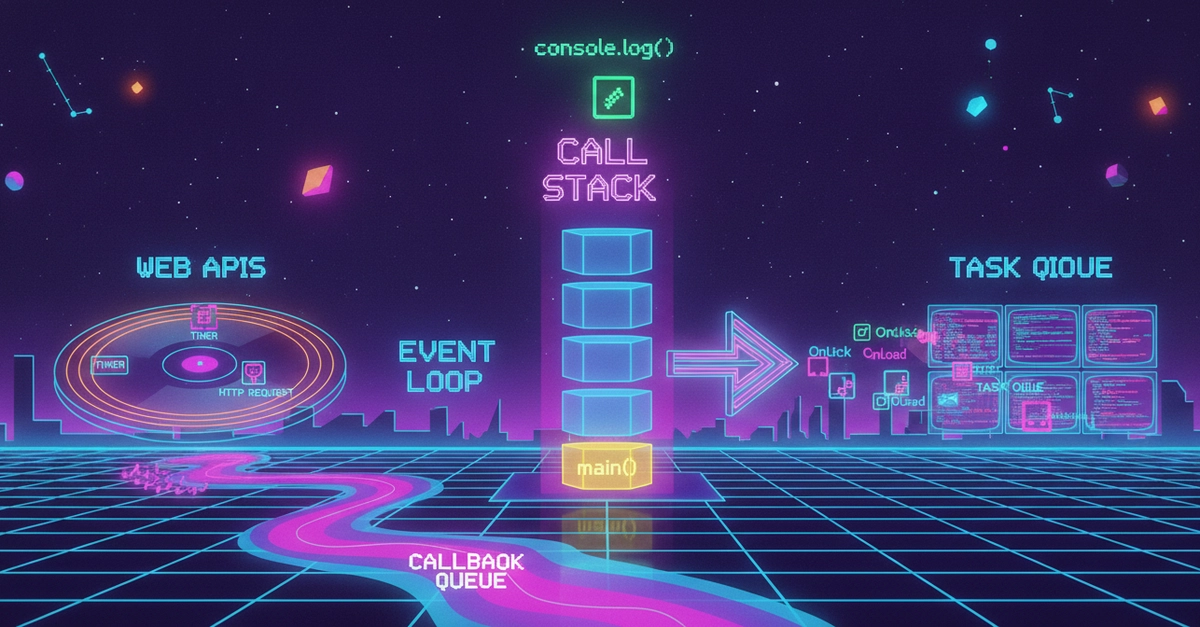
The core of JavaScript execution lives in the call stack. Think of the call stack as a meticulous librarian managing a queue of tasks. When a function is invoked, it’s added to the top of the stack. When a function completes, it’s removed from the stack. This is synchronous execution: tasks are processed strictly in the order they appear on the stack.

The apparent contradiction between single-threaded execution and asynchronous handling is resolved by leveraging external resources and a clever coordination pattern. Node.js offloads time-consuming operations (like reading a large file or making an API call) to the operating system or specialized worker threads. These operations run in the background, freeing up the main JavaScript thread to continue processing other tasks. Once a background operation completes, it signals back, and its result is then processed by the Event Loop.
Beyond the Stack: Web APIs and the Callback Queue
While the call stack manages synchronous code, asynchronous operations are handled differently. When an asynchronous function (like setTimeout, fetch, or file system operations) is called, it doesn’t get stuck on the call stack. Instead, Node.js hands it off to the appropriate system (e.g., the browser’s Web APIs in a browser environment, or Node.js’s libuv library for I/O operations). The JavaScript code continues to execute the next line without waiting for the asynchronous task to finish.
Once the asynchronous operation completes, its result or callback function is not immediately executed. Instead, it’s placed into a callback queue (also known as the task queue or message queue). This queue holds all the completed asynchronous operations that are waiting to be processed.
The Event Loop's primary job is to monitor both the call stack and the callback queue. It continuously checks if the call stack is empty. If it is, the Event Loop takes the first callback function from the callback queue and pushes it onto the call stack for execution. This is how asynchronous results are eventually processed by the single-threaded JavaScript engine.
The Phases of the Event Loop
The Node.js Event Loop is not a single, monolithic process. It operates in distinct phases, each handling specific types of callbacks. Understanding these phases is crucial for optimizing Node.js performance and predicting behavior.
Timers Phase
This phase executes callbacks scheduled by setTimeout() and setInterval(). The loop checks the timers and executes any whose specified delay has passed. It's important to note that these timers are not precise; they are executed as soon as possible after their delay has elapsed, once the loop is in the timers phase.
Pending Callbacks Phase
This phase executes I/O callbacks that were deferred to the next loop iteration. This includes callbacks for completed I/O operations like network requests or file system operations that were initiated in previous iterations.
Idle, Prepare Phase
These phases are used internally by Node.js and are generally not relevant for typical application development.
Poll Phase
This is one of the most critical phases. It is primarily responsible for retrieving new I/O events and executing their associated callbacks. The loop will block here if necessary, waiting for new events. It also checks for timers that might have expired during the poll phase.
Check Phase
This phase executes callbacks scheduled by setImmediate(). These callbacks are executed after the poll phase has completed its work and before the loop continues to the next iteration's timers.
Close Callbacks Phase
This phase handles callbacks for close events, such as when a socket or connection is closed.
Microtasks vs. Macrotasks
A key distinction within the Event Loop mechanism is the difference between microtasks and macrotasks. Macrotasks (or just tasks) are the callbacks processed in each phase of the Event Loop (timers, I/O, `setImmediate`, etc.). Microtasks, on the other hand, are executed after the current macrotask has completed and before the Event Loop moves to the next macrotask or phase. Examples of microtasks include callbacks from Promises (.then(), .catch(), .finally()) and process.nextTick() in Node.js.
The process.nextTick() queue has the highest priority. Its callbacks are executed immediately after the current operation completes, before the Event Loop proceeds to the next phase or even processes other microtasks. This is a powerful, but often misunderstood, feature that can lead to starvation of other tasks if not used judiciously.
Promises, when resolved, add their callbacks to the microtask queue. The Event Loop will process all available microtasks after completing the current macrotask. This ensures that Promise resolutions are handled promptly, before any new macrotasks are picked up.
Practical Implications for Developers
Understanding the Event Loop is not just academic; it directly impacts how you write and optimize your Node.js code. Here’s what you need to know:
- Avoid Blocking the Event Loop: Any synchronous operation that takes a significant amount of time (e.g., complex computations, synchronous file I/O on large files, JSON.parse on massive strings) will block the entire application. This prevents the Event Loop from processing other requests or timers, leading to poor performance and unresponsiveness. Always opt for asynchronous alternatives.
- Understand Callback Order: The order in which callbacks are executed depends on the Event Loop phases and the microtask queue. Knowing that
process.nextTick()runs before other microtasks and before the next phase can help you reason about execution order. - Use
setImmediate()vs.process.nextTick(): Whileprocess.nextTick()executes immediately after the current operation,setImmediate()executes in the subsequent 'check' phase. If you need to break up long-running operations or yield control back to the Event Loop to prevent blocking,setImmediate()is often a safer choice thanprocess.nextTick(), as it prevents potential starvation of I/O callbacks. - Promise Handling: Promises provide a cleaner way to manage asynchronous operations than traditional callbacks. Their microtask nature ensures that their resolutions are handled efficiently.
The Event Loop is the heartbeat of Node.js. By understanding its mechanics—the call stack, the callback queue, its distinct phases, and the priority of microtasks—developers can write more efficient, scalable, and robust applications.