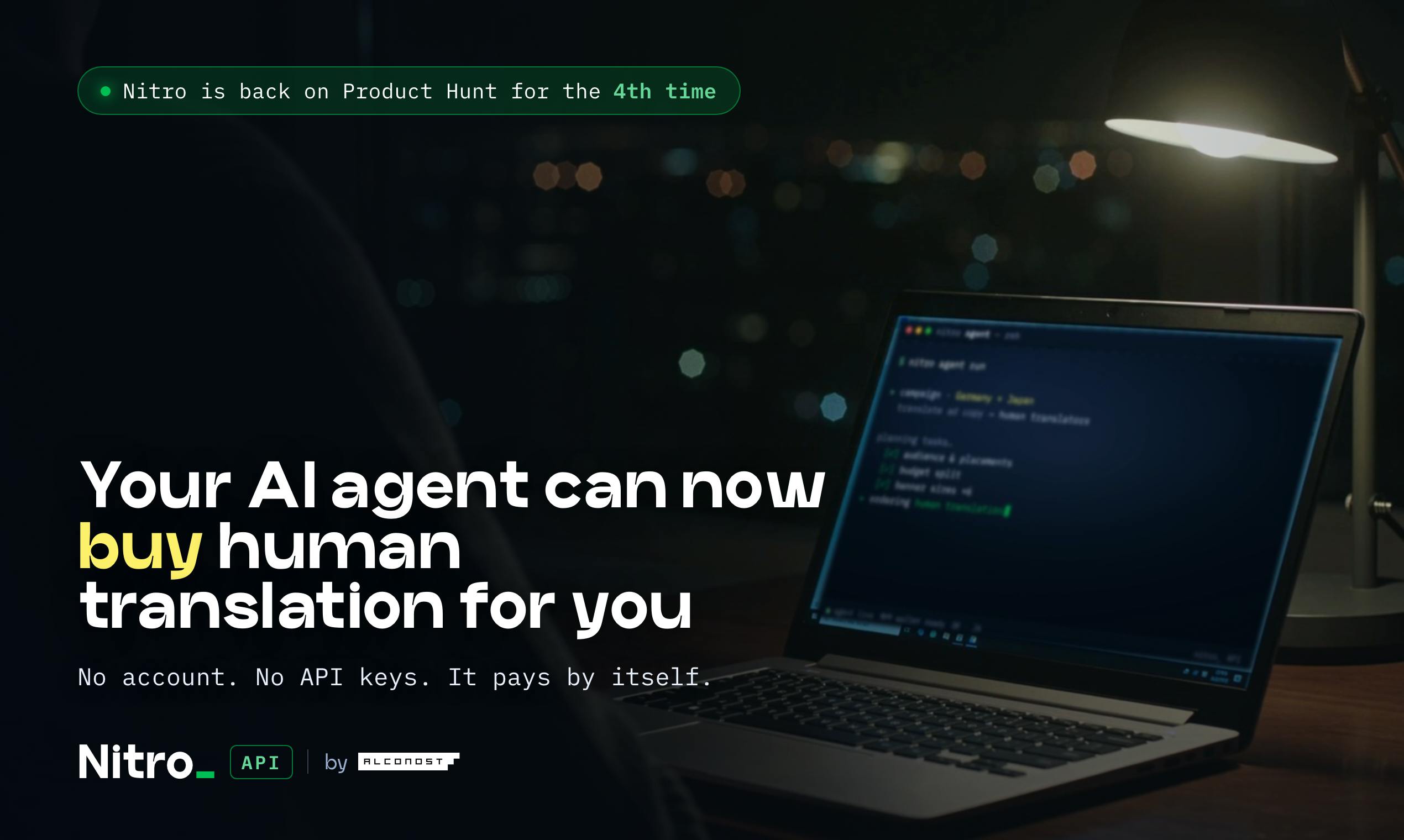
Introducing Nitro 4.0: Bridging Human and AI Translation
Alconost has launched Nitro 4.0, a significant update to its localization platform, with a bold claim: it is the first human translation platform built specifically for AI agents. This positioning suggests a new paradigm in how AI-generated content will be localized, moving beyond traditional human-centric workflows.
The core challenge Nitro 4.0 aims to address is the increasing volume of content produced by artificial intelligence. As AI models become more sophisticated, they generate text, code, and other forms of communication at an unprecedented scale. While AI can draft content rapidly, ensuring its accuracy, cultural appropriateness, and nuance often still requires human oversight and refinement. Nitro 4.0 seeks to streamline this process by integrating human translators directly into the AI content pipeline.
Traditionally, localization platforms have been designed for human translators to pick up projects, work on them, and deliver translations. This typically involves project managers assigning tasks, translators working within specific interfaces, and a review process. However, AI agents operate differently. They can generate content dynamically, require rapid feedback loops, and may need to manage vast, ever-changing datasets. Nitro 4.0’s architecture is purportedly designed to accommodate these unique demands.
Key Features and Workflow Integration
While specific technical details of Nitro 4.0's AI agent integration are not fully elaborated in the initial announcement, the platform's focus on AI agents implies several key functionalities. These likely include:
- API-First Design: To interact seamlessly with AI agents, Nitro 4.0 must offer robust APIs that allow for programmatic content submission, status updates, and translation retrieval. This enables AI systems to request translations, receive them, and potentially even trigger human review based on predefined confidence scores or complexity thresholds.
- Automated Workflow Triggers: AI agents can be programmed to initiate translation requests based on specific events, such as the generation of new content, updates to existing materials, or changes in user interaction patterns. Nitro 4.0 likely provides mechanisms to hook into these triggers.
- Contextual Information for Translators: AI-generated content can sometimes lack the rich context that human translators rely on. Nitro 4.0 might offer features that automatically bundle relevant contextual data – such as source material, previous translations, style guides, and AI model parameters – to provide translators with a more complete understanding of the task.
- AI-Assisted Human Review: The platform may incorporate AI tools to assist human translators. This could involve pre-translating content, suggesting terminology, flagging potential inconsistencies, or identifying areas where human judgment is critical. This is distinct from fully automated machine translation, focusing instead on augmenting the human element.
- Scalability for High Volumes: AI agents can produce content in volumes that far exceed human capacity. Nitro 4.0 must be engineered to handle this scale, efficiently managing large numbers of translation requests and large volumes of text without performance degradation.
The platform's approach appears to be one of augmentation rather than replacement. Instead of relying solely on machine translation, which can falter with nuance and cultural context, Nitro 4.0 places human translators at the core, but equips them with tools and workflows that can keep pace with AI-driven content creation. Think of it less like a traditional translation agency and more like a high-performance pit crew for AI-generated text, where speed, precision, and seamless integration are paramount.
Implications for the Localization Industry
The introduction of Nitro 4.0 signals a potential shift in the localization landscape. As AI continues to permeate content creation across industries – from marketing copy and software documentation to gaming and customer support – the demand for rapid, high-quality localization will only intensify. Traditional localization models, often characterized by longer turnaround times and manual project management, may struggle to meet these new demands.
Alconost's move suggests that the future of localization involves a hybrid approach, where AI and human expertise are not viewed as competing forces but as complementary components of a single, integrated system. For companies leveraging AI for content generation, this platform could offer a way to maintain quality and global reach without being bottlenecked by localization processes. It addresses the growing need to translate not just static documents, but dynamic, AI-generated streams of information.
What remains to be seen is how effectively Nitro 4.0 can abstract the complexities of AI agent interaction into a user-friendly interface for human translators. The success of the platform will hinge on its ability to simplify the technical integration and provide a clear, efficient, and rewarding experience for the human linguists who are essential to its operation. The challenge lies in making the invisible AI workflows feel intuitive to the human users.
Furthermore, the competitive landscape for localization solutions is fierce. Companies like Phrase, Lokalise, and Smartling offer sophisticated platforms. Nitro 4.0's differentiator is its explicit focus on AI agents, a niche that is rapidly emerging. If Alconost can execute on this vision, it could carve out a significant position in the market by serving a growing need before competitors fully adapt.