Beyond Admin Panels: A Kawaii GUI with Nim and SDL3
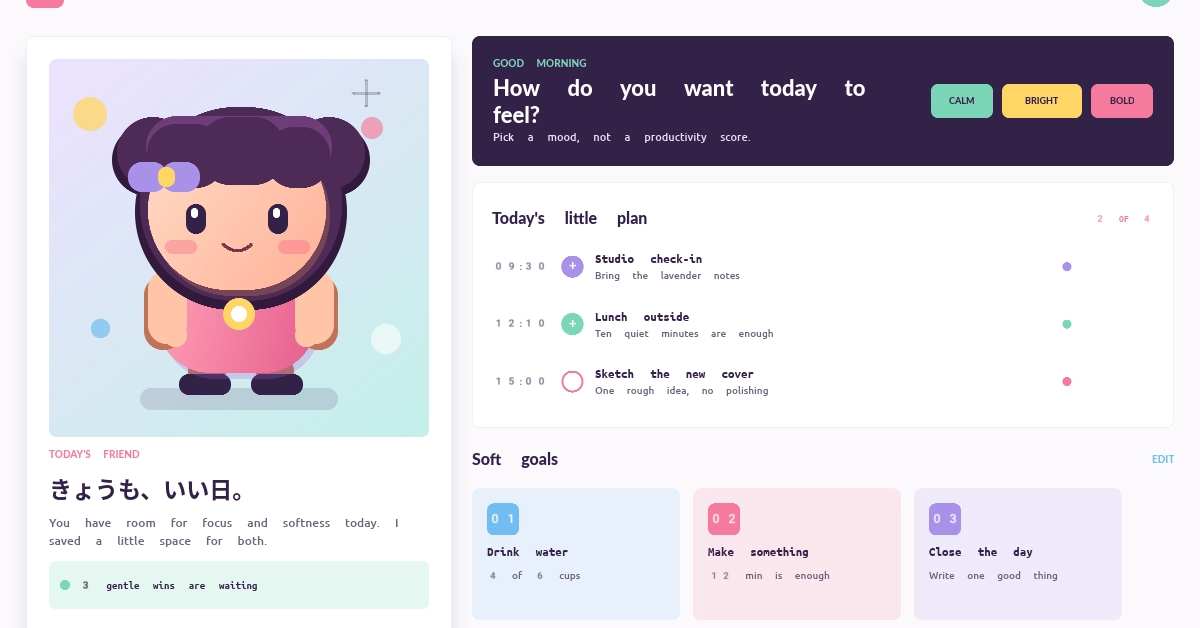
Native GUI development often defaults to functional interfaces. Think administrative dashboards, settings panels, or collections of standard controls. These applications are vital, but they don't always explore the full expressive potential of native UI toolkits. Can these same foundations support a more playful, consumer-facing visual language? The Kawaii Companion demo, built with Nim and SDL3, answers with a resounding yes.
This project, part of the Clay Board Style System (CBSS) v0.5.0 release, ventures into uncharted territory. It renders a complete daily-companion concept within a standard SDL3 window. The visual design employs a soft color palette, a blend of Japanese and English text, and familiar UI elements like cards and progress indicators. Crucially, a character, standing two heads tall, is drawn directly using retained Canvas commands, not pre-rendered assets.
What sets this demo apart is its fundamental construction. There's no hidden browser engine or WebView at play. The character isn't a static PNG, a scalable SVG, or a complex 3D model. Instead, every visual element is meticulously assembled from the same core primitives intended for general CBSS applications: Box, Text, Canvas, Style, layout, and retained-rendering commands. This approach demonstrates that sophisticated, expressive UIs are achievable using only the building blocks designed for standard native applications.
Technical Foundation: Nim and SDL3
The choice of Nim as the programming language is significant. Nim compiles to C, C++, or JavaScript, offering performance comparable to C while providing high-level abstractions that enhance developer productivity. Its clean syntax, powerful metaprogramming capabilities, and efficient garbage collection make it an attractive option for systems programming and application development where performance and expressiveness are key.
SDL3, the successor to the widely used Simple DirectMedia Layer, provides a cross-platform abstraction layer for low-level access to audio, keyboard, mouse, joystick, and graphics hardware via OpenGL and Vulkan. Unlike traditional GUI toolkits that abstract away drawing operations, SDL provides direct access to rendering surfaces. This allows developers fine-grained control over every pixel, which is essential for custom rendering like the character in the Kawaii Companion demo. Building a GUI system atop SDL3 means managing windowing, input events, and rendering pipelines from a lower level than one might with frameworks like Qt or GTK.
Clay Board Style System: The Engine Behind the Aesthetics
The Clay Board Style System (CBSS) is the architectural framework enabling this novel GUI. It's designed to be a flexible and powerful system for building user interfaces. The system's primitives—Box, Text, Canvas, Style, layout, and retained-rendering—form the bedrock of its capabilities. These components are not tied to a specific aesthetic; rather, they provide the tools to construct any visual style. The Kawaii Companion demo leverages these primitives to achieve its distinctive look.
The retained Canvas commands are particularly noteworthy. In a retained graphics model, the system maintains an internal representation of the scene graph. When changes occur, only the affected parts of the scene are re-rendered. This is efficient for complex scenes and dynamic updates. For the Kawaii Companion, this means the character and other graphical elements are drawn and updated directly within the application's rendering loop, offering complete control over animation and appearance without relying on external image files.
The soft color palette and mixed-language text are stylistic choices that demonstrate CBSS's adaptability. The system is not opinionated about color schemes or typography; it empowers the developer to implement them. This flexibility is crucial for creating UIs that resonate with specific audiences or brand identities, moving beyond the generic look often associated with native applications.
Implications and Future Directions
The Kawaii Companion demo challenges the conventional wisdom that native GUIs are limited to utilitarian designs. It proves that with the right tools and a creative approach, developers can craft highly stylized, engaging, and playful user experiences using the same underlying native technologies. This opens up possibilities for a wider range of applications, from games and entertainment software to consumer-facing productivity tools that prioritize personality and user delight.
For developers familiar with Nim and SDL, this project offers a compelling case study. It demonstrates a practical application of retained graphics and custom styling within a native environment. The project highlights how to achieve unique visual identities without resorting to web technologies or heavy external dependencies. The question it implicitly answers is: what if your native application could look and feel as distinctive as your brand demands?
The broader implication for the GUI development landscape is a reminder that innovation often comes from pushing the boundaries of existing toolkits. By combining a powerful language like Nim with a low-level graphics library like SDL3 and a flexible UI framework like CBSS, developers can unlock new aesthetic and functional possibilities. The success of this demo suggests a future where native applications can be as visually diverse and expressive as their web counterparts, offering performance and integration benefits that web technologies often struggle to match.