
The Internet's Essential Intermediaries
The internet, often perceived as a direct conduit, is in reality a complex ecosystem populated by numerous intermediaries. These 'middlemen' perform vital functions, from routing requests and establishing trust to facilitating seamless communication. In the realm of cloud infrastructure, two such indispensable figures are Nginx and SSH. While often discussed in isolation, their collective role in securing and managing server access and traffic is paramount for any developer or system administrator.
For many, networking concepts learned in college—protocols, IP addresses, theoretical models—often felt abstract and detached from practical application. However, the moment one begins managing their own servers for hosting applications, these once-dormant concepts spring to life with urgent relevance. The transition from theoretical understanding to practical implementation reveals the profound importance of these underlying mechanisms.
Nginx: The Reverse Proxy Powerhouse
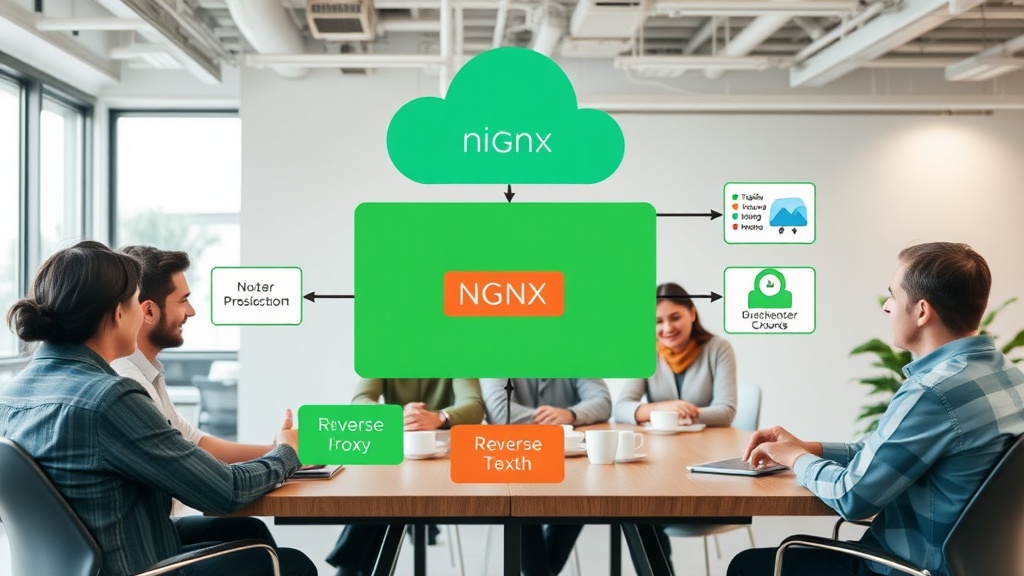
Nginx has emerged as a de facto standard for web server and reverse proxy functionalities. Its power lies in its ability to sit between the end-user's browser and the backend services running on a server. This strategic positioning allows Nginx to manage incoming traffic, distribute it efficiently, and, crucially, enhance security.
Exposing application services directly to the internet by opening their specific ports is a practice fraught with risk. Each open port represents a potential entry point for malicious actors, significantly increasing the attack surface. Nginx mitigates this by acting as a single point of contact. It receives all incoming requests on standard ports (like 80 for HTTP and 443 for HTTPS) and then intelligently forwards them to the appropriate backend service running on a different, often non-public, port. This not only simplifies management but drastically reduces the exposure of internal services.
The configuration of Nginx involves defining 'server blocks' or 'virtual hosts' that map specific domain names or IP addresses to particular backend applications. For instance, a single Nginx instance can host multiple websites or serve different microservices, each with its own domain or subdomain, all while using a single IP address and standard ports. This is achieved by inspecting the 'Host' header of incoming HTTP requests and routing them accordingly. Furthermore, Nginx excels at load balancing, distributing traffic across multiple instances of a backend application to prevent overload and ensure high availability. It can perform health checks on backend servers, automatically removing unhealthy ones from the rotation until they recover.
Beyond proxying, Nginx is renowned for its performance in serving static content directly and its ability to handle SSL/TLS termination. By offloading the encryption and decryption of HTTPS traffic, it frees up backend application servers to focus on their core logic, improving overall performance and scalability. This makes Nginx an indispensable tool for modern web architectures, providing a robust, efficient, and secure front door to any set of online services.
SSH: The Secure Gateway to Servers
While Nginx handles external web traffic, SSH (Secure Shell) is the backbone for secure remote access to servers. It provides an encrypted channel for command-line logins and other network services between two networked computers. Without SSH, managing servers remotely would either be insecure (using protocols like Telnet) or require complex VPN setups for basic access.
SSH operates on a client-server model. The SSH client initiates a connection to an SSH server, which typically listens on port 22. The protocol negotiates a secure, encrypted session using public-key cryptography. This means that even if the network traffic is intercepted, the data remains unintelligible to unauthorized parties. This cryptographic handshake is fundamental to establishing trust between the client and server, ensuring that the user is indeed communicating with the intended machine and vice versa.
The primary use of SSH is for remote command-line access. Administrators can log into servers, execute commands, manage files, and perform system administration tasks as if they were physically present. This is crucial for deploying code, monitoring system performance, troubleshooting issues, and configuring software on remote machines. Beyond command execution, SSH also supports secure file transfers via protocols like SCP (Secure Copy) and SFTP (SSH File Transfer Protocol), providing a secure alternative to FTP.
A more advanced use of SSH is port forwarding, also known as SSH tunneling. This feature allows users to create encrypted tunnels for other network protocols. For example, one can forward a local port on their machine to a port on a remote server, or even chain multiple hops through different servers. This is incredibly useful for accessing internal services that are not directly exposed to the internet, such as databases or internal dashboards, by tunneling traffic through a secure SSH connection to a machine that has access to them. This capability effectively extends the secure boundary of the SSH connection to other services, making it a versatile tool for network security and management.
The Synergy of Nginx and SSH
The true power of these 'middlemen' is often realized when they work in concert. Nginx secures the public-facing web traffic, filtering requests and directing them efficiently. SSH provides the secure, encrypted pathway for administrators and automated processes to manage the very servers Nginx is fronting, as well as the backend applications themselves.
Consider a typical deployment: A user requests a webpage. The request hits Nginx, which might serve static assets directly or proxy the request to a backend Python/Node.js/Go application. This backend application might, in turn, need to query a database. If that database is running on a separate server and not exposed publicly, an administrator would use SSH to connect to the database server, configure its firewall to allow connections *only* from the application server's IP, and then use SSH tunneling from the application server to securely connect to the database. Simultaneously, developers might use SSH to deploy new versions of the application code to the servers managed by Nginx.
The internet is not just a collection of endpoints; it is a network of secure pathways and controlled access points. Nginx and SSH, though serving different primary functions, are fundamental to building and maintaining this secure, functional infrastructure. They are the quiet enablers, the essential middlemen that abstract complexity and provide the necessary layers of security and control that developers and businesses rely on daily. Understanding their mechanics and interplay is not just about learning protocols; it's about mastering the art of building robust, secure, and scalable cloud environments.