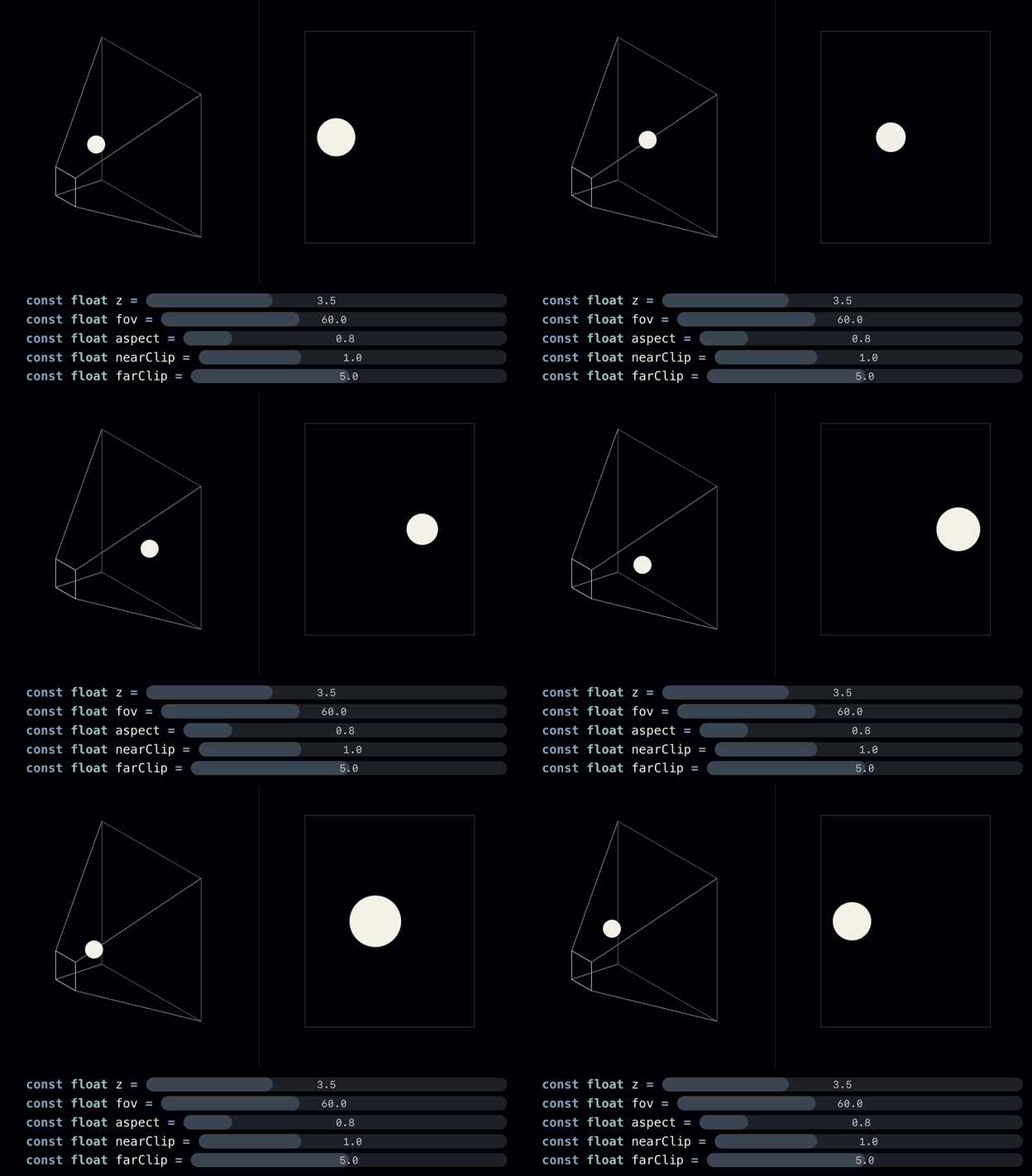
The 'Divide by Depth' Algorithm Unveiled
A new method dubbed 'Divide by Depth' is set to transform how we create 3D assets. Developed by Gabriel Oc, this technique allows for the generation of three-dimensional models from a single two-dimensional image, a feat previously requiring complex multi-view photogrammetry or manual modeling. The core innovation lies in its sophisticated depth estimation, which reconstructs the scene's depth information to infer the third dimension.
Traditionally, generating 3D models from 2D images has been a computationally intensive and often imperfect process. It typically involves either multiple images from different viewpoints to triangulate points in space or relies on AI models trained on vast datasets to predict depth, a process that can still yield artifacts or inaccuracies, especially with single-image inputs. 'Divide by Depth' appears to streamline this by focusing on a more robust single-image depth prediction that directly informs the 3D reconstruction.
The implications are far-reaching. For game developers, this could mean a dramatic acceleration in asset creation pipelines. Instead of painstakingly modeling every object, developers might be able to generate base 3D models from concept art or photographs, which can then be refined. Similarly, architects and designers could quickly visualize concepts in 3D from sketches or existing 2D plans. The technology also opens doors for augmented reality (AR) and virtual reality (VR) applications, enabling the rapid population of virtual environments with 3D objects derived from real-world imagery.
The project's author, Gabriel Oc, has made the concept and initial findings publicly available, sparking considerable interest on platforms like Hacker News. While full technical details and a public API are still emerging, the underlying principle is elegant: by accurately predicting the depth of each pixel in an image, the algorithm can effectively 'unflatten' the 2D representation into a 3D mesh. This is akin to looking at a flat photograph and, through an AI's understanding of perspective, light, and object recognition, being able to mentally (or in this case, computationally) reconstruct the scene's spatial layout.

Technical Underpinnings and Potential Challenges
At its heart, 'Divide by Depth' builds upon recent advancements in neural network architectures for depth estimation. These models, often based on convolutional neural networks (CNNs) or transformer architectures, are trained to predict a depth map – an image where each pixel's value corresponds to its distance from the camera. The key differentiator for Oc's approach likely lies in how this depth map is integrated into a coherent 3D mesh and how it handles occlusions and complex geometries that are inherently ambiguous in a single 2D view.
One significant challenge for any single-image 3D reconstruction method is inherent ambiguity. A 2D image is a projection of a 3D world onto a 2D plane, losing depth information. For example, a small object close to the camera can appear the same size as a large object far away. AI models infer depth based on learned cues like texture gradients, shading, and object size priors. 'Divide by Depth' must possess a sophisticated understanding of these cues to generate accurate and plausible 3D geometry.
Another hurdle is the generation of clean, usable 3D meshes. Raw depth maps often result in point clouds or noisy surfaces. The process of converting these into manifold meshes suitable for rendering engines or 3D modeling software requires algorithms for surface reconstruction, hole filling, and simplification. The success of 'Divide by Depth' will depend not only on the accuracy of its depth prediction but also on the quality of its subsequent mesh generation pipeline.
The project's author has highlighted that the method is still in its early stages. Feedback from the developer community on Hacker News suggests a strong interest in understanding the specific neural network architectures used, the datasets employed for training, and the performance benchmarks against existing single-image 3D reconstruction techniques. Questions are also arising about its ability to handle transparent or reflective surfaces, which are notoriously difficult for depth estimation algorithms.
Impact Across Industries
The potential impact of 'Divide by Depth' spans multiple sectors. For the gaming industry, it offers a shortcut to populating vast game worlds. Imagine a developer taking a photograph of a real-world prop, running it through 'Divide by Depth,' and instantly having a usable 3D asset for their game. This could significantly reduce development time and costs, especially for indie studios with limited resources.
In architecture and real estate, the technology could revolutionize virtual tours and design visualization. Presenting a 2D floor plan or an artist's rendering as an interactive 3D model generated instantaneously would offer clients a much richer understanding of a space. This could also extend to historical preservation, allowing for quick 3D documentation of artifacts or sites from existing photographs.
For creators on platforms like TikTok or Instagram, this could unlock new forms of augmented reality filters and 3D content creation. Users could, in theory, point their phone at an object, and the app could generate a 3D version of it for them to share or integrate into AR experiences. This democratizes 3D content creation, moving it away from specialized software and into the hands of everyday users.
The research community is also watching closely. If 'Divide by Depth' proves robust and accurate, it could serve as a powerful new tool for computer vision research, particularly in the areas of scene understanding and generative modeling. It also raises the question of how this technology will evolve: will it become a standalone tool, or will it be integrated into existing creative suites and game engines?
The Future of 3D Content Creation
The advent of 'Divide by Depth' signals a potential paradigm shift in 3D content creation. By reducing the friction associated with generating 3D assets from readily available 2D images, it lowers the barrier to entry for countless applications. While challenges related to accuracy, handling complex materials, and mesh quality remain, the core concept is compelling.
If this technology matures, we could see a future where 3D modeling is no longer solely the domain of skilled artists with specialized software. Instead, it could become an accessible feature for anyone with a camera and an idea. This democratization of 3D could lead to an explosion of new applications and creative content across the digital landscape.
The next steps will likely involve the release of more comprehensive documentation, potential open-sourcing of the code, and benchmarks demonstrating its performance. The developer community is eager to experiment and identify its limitations and strengths. For now, 'Divide by Depth' represents a significant leap forward in making 3D content creation more immediate and accessible.