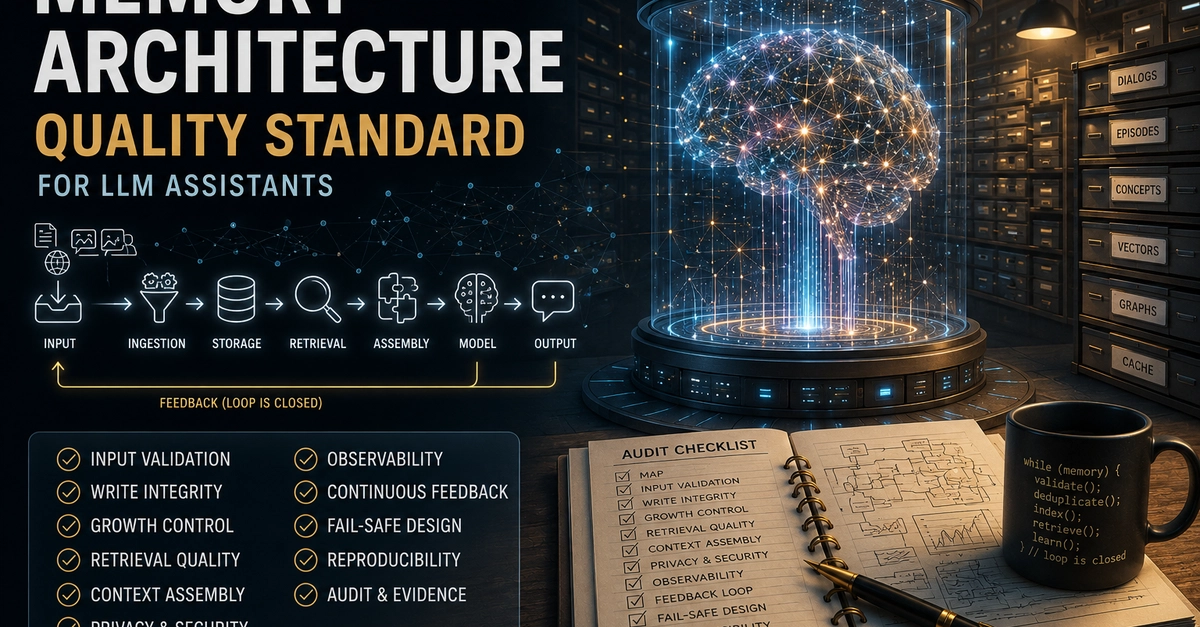
The burgeoning field of AI assistants, particularly those leveraging large language models (LLMs), hinges on their ability to maintain context and recall information over time. Without effective memory, these assistants remain brittle, repeating mistakes and failing to build coherent, long-term interactions. To address this, a new quality standard, presented as an audit checklist, has emerged to guide the evaluation and enhancement of memory architectures in LLM-based assistants and agents.
The Memory Loop: A Generalized Framework
Version 1.1 of the "Memory Architecture Quality Standard for LLM Assistants" (dated 2026-08-21) proposes a generalized memory loop as the foundational model for auditing. This framework applies to any LLM-based assistant or agent that incorporates long-term memory, whether it's dialog, episodic, semantic, vector, graph, or multimodal memory, irrespective of the underlying technology stack or platform. The standard breaks down the memory process into distinct stages:
- INPUT: Data originating from users, files, the web, images, other agents, or external models.
- INGESTION: Processing input through validation, meaning extraction, and importance scoring.
- STORAGE: Persisting information in various forms, including messages, episodes, concepts, vectors, graphs, and caches.
- RETRIEVAL: Accessing stored information based on relevance, freshness, importance, and defined boundaries.
- ASSEMBLY: Preparing retrieved information for the LLM through formatting, compression, injection, and adherence to budget constraints (e.g., token limits).
- MODEL / LLM: The core LLM processing the assembled input.
- OUTPUT: The final response generated by the LLM, which may then loop back into the INPUT stage for subsequent interactions.
Each item in the audit checklist is designed to map directly to a specific node or edge within this reference loop, ensuring a systematic and comprehensive review.
Key Audit Areas and Considerations
The checklist delves into critical aspects of each stage, prompting developers to verify specific quality attributes. For instance, under INGESTION, checks might include verifying that the system correctly identifies and extracts key entities and relationships, scores the importance of incoming information relative to the assistant's goals, and handles data validation to prevent corruption of the memory store. The STORAGE phase requires auditing the consistency and integrity of different memory types; for vector stores, this could involve checking embedding quality and update strategies, while for graph memories, it might focus on the accuracy of relationship representation.
RETRIEVAL is a particularly complex area. The standard mandates checks for the effectiveness of retrieval mechanisms, ensuring that the most relevant, fresh, and important information is surfaced while respecting privacy boundaries and avoiding the retrieval of outdated or irrelevant data. This includes evaluating the precision and recall of retrieval algorithms, especially in systems employing techniques like RAG (Retrieval-Augmented Generation).
The ASSEMBLY stage scrutinizes how retrieved information is prepared for the LLM. This involves verifying efficient formatting, appropriate compression techniques to manage context window limitations, and the correct injection of retrieved data into the LLM prompt. Adherence to token budgets is paramount here, ensuring that the LLM receives the most critical information without exceeding its processing capacity, which can lead to performance degradation or increased costs.
Finally, the standard addresses the OUTPUT stage, which often feeds back into the memory loop. Audits here might focus on how the assistant’s responses are logged or summarized to update its memory, ensuring that the output itself contributes to a richer, more informed future state. It also considers how the assistant handles ambiguity or uncertainty in its output, and whether it can self-correct based on user feedback or new information.
Beyond the Loop: Broader Quality Attributes
While the loop model provides structure, the standard also emphasizes broader quality attributes crucial for robust LLM assistants:
- Reliability: Consistent performance across various scenarios and user inputs. Does the memory system reliably recall and utilize information?
- Scalability: The ability of the memory architecture to handle increasing volumes of data and user interactions without performance degradation.
- Security: Protecting sensitive information stored in memory, preventing unauthorized access, and ensuring compliance with privacy regulations. This includes checks on data encryption, access controls, and anonymization techniques.
- Maintainability: The ease with which the memory system can be updated, debugged, and evolved. This involves clear documentation, modular design, and effective testing strategies.
- Cost-Effectiveness: Balancing performance and capability with operational costs, particularly concerning storage, retrieval, and LLM inference.
The standard provides specific, actionable items for each of these attributes. For security, for example, it might ask if sensitive user data is encrypted at rest and in transit, or if access controls are granular enough to prevent different agents or components from accessing data they shouldn't. For scalability, it might prompt checks on database indexing strategies, caching mechanisms, and load balancing for retrieval services.
Implications for Developers and the AI Ecosystem
This quality standard represents a significant step toward professionalizing the development of AI assistants. By offering a concrete, itemized checklist, it moves beyond anecdotal best practices to provide a verifiable framework for quality assurance. Developers can use this standard not only to audit their existing systems but also to inform the design of new memory architectures. For founders, it provides a benchmark against which to measure the maturity and robustness of their AI products, potentially influencing investor confidence and customer trust.
The existence of such a standard also signals a maturation of the AI development landscape. As LLM assistants become more integrated into business processes and daily life, the reliability and security of their memory systems become paramount. This checklist offers a path to achieving that reliability, pushing the industry towards more dependable and trustworthy AI agents. The surprise here is not the complexity of memory systems, but the very concrete, almost analog, approach of a checklist that could tame that complexity. It suggests that even the most advanced AI challenges can benefit from rigorous, systematic, and human-readable quality control.
What remains to be seen is how widely this standard will be adopted and whether it will evolve into a formal certification or industry benchmark. The next version might include more detailed guidance on evaluating multimodal memory inputs and outputs, or specific metrics for assessing the 'coherence' of episodic memory over very long interaction histories.