The Lighthouse Score Lottery
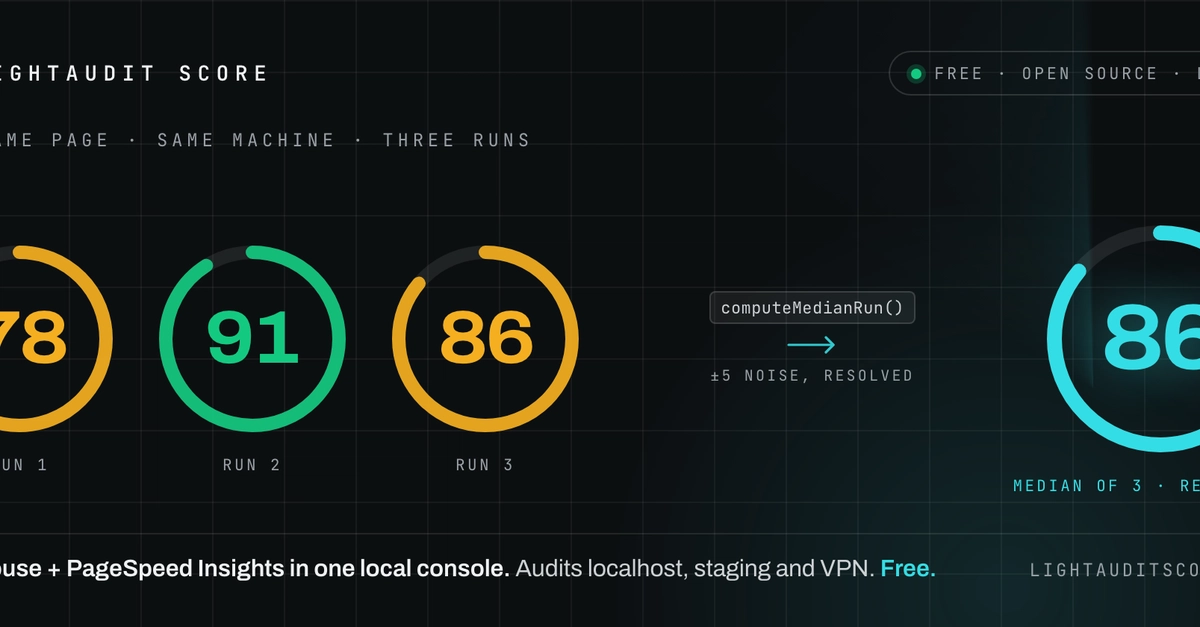
Developers know the drill. You optimize a page, run Lighthouse, and get a score. You run it again, with no changes, and the number jumps or plummets. This isn't a bug; it's a feature of how performance metrics, particularly Total Blocking Time (TBT), are measured. TBT, which accounts for a significant portion of the Lighthouse Performance score, is CPU-sensitive. Background processes on your machine—a Slack notification, a background build task, or even Spotlight reindexing—can subtly shift your laptop's processing power, leading to score fluctuations of ±5 points on identical runs.
A single run is an anecdote, not a reliable data point. While tools like PageSpeed Insights offer more stable, real-world performance analysis, they require a public URL, making them unsuitable for auditing pages still under local development.
This common frustration led Simon to build LightAudit Score, a free, local console designed to provide stable and defensible performance scores during development. The goal is to eliminate the score lottery and give developers a reliable benchmark they can trust.

Introducing LightAudit Score: Stability for Local Audits
LightAudit Score addresses this by providing a consistent environment for running Lighthouse audits locally. Unlike the browser's built-in Lighthouse panel, which is subject to the whims of your operating system and other running applications, LightAudit Score aims to isolate the auditing process. This isolation is key to achieving stable, repeatable results.
The tool essentially acts as a dedicated environment for performance analysis. By controlling the variables that typically cause score fluctuations, it offers a more predictable outcome. This is critical for developers who need to track performance improvements accurately over time, especially when making iterative changes to a codebase. The ability to run multiple audits and see a consistent trend, rather than a chaotic series of numbers, provides a much clearer picture of optimization efforts.
The implications for the development workflow are significant. Instead of debating which of three wildly different scores to report in a pull request, developers can point to a single, stable number. This fosters better communication within teams and provides a more objective measure of performance regressions or improvements. It shifts the focus from chasing a specific number to understanding the underlying performance characteristics of the application.
Defensible Scores for Your Pull Requests
The core value proposition of LightAudit Score is its ability to generate defensible scores. When a developer can demonstrate that running an audit multiple times yields a consistent result, that score carries more weight. This is particularly important in agile development environments where performance is a key consideration throughout the product lifecycle.
For founders, this translates to more reliable performance data influencing product decisions. For engineering managers, it means clearer metrics for team performance and code quality. For security professionals, understanding consistent performance baselines can also help identify unusual resource consumption that might indicate performance-related vulnerabilities or issues.
The tool's local nature also means that sensitive code or unfinished features can be audited without exposing them to the public internet. This is a crucial advantage for companies working on proprietary technology or in early development stages. The focus remains on internal metrics and continuous improvement, without the need for external deployment.
The Future of Local Performance Benchmarking
LightAudit Score is positioned as a pragmatic solution to a long-standing developer pain point. By focusing on stability and repeatability, it moves beyond the anecdotal nature of single Lighthouse runs. The promise is a more scientific approach to local performance benchmarking, enabling developers to build faster, more reliable web experiences.
While the current iteration focuses on stabilizing Lighthouse scores, the underlying principle—creating controlled environments for objective measurement—has broader applications. As web performance continues to be a critical factor in user experience and search engine rankings, tools that provide reliable, actionable data during the development process will become increasingly valuable. LightAudit Score represents a step in that direction, offering a practical solution for developers seeking to move beyond the Lighthouse score lottery.