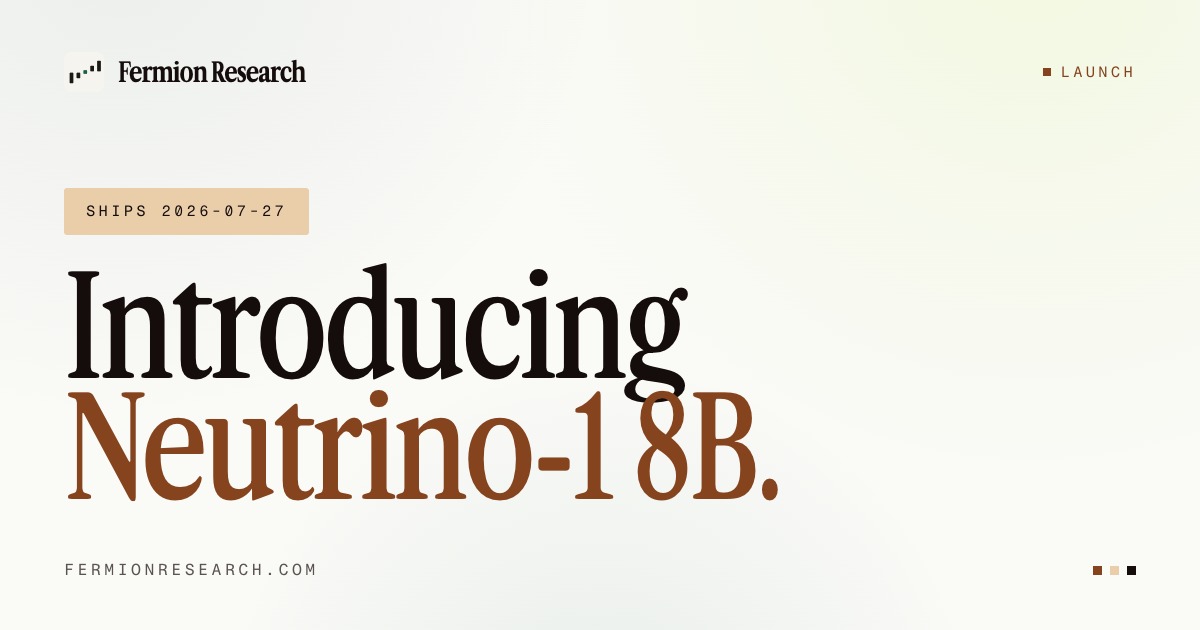
Neutrino-1 8B: A New Contender in Open-Source LLMs
Fermion Research has launched Neutrino-1 8B, an 8-billion parameter large language model, entering the increasingly competitive open-source LLM landscape. The model is positioned to offer a compelling balance of performance and efficiency, aiming to be accessible for a wide range of applications and research endeavors. This release signifies a growing trend towards democratizing advanced AI capabilities, allowing developers and smaller research teams to leverage powerful models without the prohibitive costs associated with proprietary solutions.
Neutrino-1 8B is built on a foundation designed for versatility. While specific architectural details are not extensively detailed in public releases, the emphasis appears to be on optimizing inference speed and reducing memory footprint. This is crucial for deployment on less powerful hardware, enabling on-device AI applications or more cost-effective cloud deployments. The 8-billion parameter size places it in a sweet spot, offering capabilities beyond smaller models while remaining more manageable than models with tens or hundreds of billions of parameters.
Performance and Efficiency Focus
The primary differentiator for Neutrino-1 8B appears to be its focus on efficient inference. This is critical for real-world applications where latency and computational cost are significant factors. For developers, this means the potential to integrate sophisticated natural language processing tasks into their applications with lower hardware requirements and faster response times. This could unlock new use cases for chatbots, content generation tools, code completion assistants, and data analysis platforms that were previously constrained by the resource demands of larger models.
While exact benchmark figures are typically released alongside model evaluations, the stated goal of efficient inference suggests that Neutrino-1 8B would perform competitively against other models in its parameter class on tasks such as text generation, summarization, and question answering. The ability to run inference efficiently is not just about speed; it directly translates to lower operational costs for businesses and researchers. This makes it an attractive option for those exploring the capabilities of LLMs without a massive budget for GPU clusters.
Open-Source Philosophy and Community Impact
The decision to release Neutrino-1 8B as an open-source model underscores a commitment to fostering innovation within the AI community. Open-source LLMs are vital for transparency, reproducibility, and collaborative development. Researchers can dissect the model, understand its inner workings, and build upon its architecture. Developers can freely integrate it into their projects, experiment with fine-tuning for specific domains, and contribute back improvements to the community. This collaborative approach accelerates progress in AI research and application development.
The availability of such models also plays a role in leveling the playing field. Larger tech companies often have exclusive access to state-of-the-art models, creating a barrier for smaller startups and academic institutions. By providing powerful, open-source alternatives like Neutrino-1 8B, Fermion Research contributes to a more equitable AI ecosystem. This allows a broader range of individuals and organizations to participate in the development and deployment of AI technologies, leading to a more diverse and innovative set of applications.
Potential Applications and Future Development
Neutrino-1 8B is poised to be a versatile tool. Its efficient nature makes it suitable for edge computing scenarios where processing must occur on local devices. Imagine a smart assistant that can understand and respond to complex queries without needing to send data to the cloud, enhancing privacy and reducing reliance on network connectivity. In the realm of creative tools, it could power more responsive writing assistants or generate sophisticated textual content for games and interactive media.
For data scientists and analysts, Neutrino-1 8B could facilitate more accessible natural language interfaces for querying databases or summarizing large volumes of text. Fine-tuning the model on domain-specific data could yield highly specialized assistants for fields like medicine, law, or finance, providing expert-level insights derived from vast textual corpora. The journey for Neutrino-1 8B is likely to involve community-driven fine-tuning, performance optimizations, and exploration of its capabilities across a multitude of tasks.
What remains to be seen is how the community will adopt and extend Neutrino-1 8B. Will it become a foundational model for a new generation of specialized AI agents? How will its performance compare to other 8B parameter models as they mature? The open-source nature ensures that these questions will be answered through collective effort and experimentation, driving the evolution of LLM technology forward.