
Comparing .NET Lambda Performance: SnapStart vs. Native AOT
Developers building on AWS Lambda with .NET often face a critical decision: leverage SnapStart for reduced cold starts or adopt Native AOT to eliminate the .NET runtime. Both promise faster function execution, but real-world performance and cost implications vary. This article details tests comparing these two approaches on identical 128 MB Lambda function configurations, examining cold starts, warm latency, and projected AWS costs.
The core of the comparison lies in how each technology addresses the overhead of initializing a .NET application within the constrained environment of AWS Lambda. SnapStart aims to mitigate cold starts by pre-initializing the function and caching its state. Native AOT, on the other hand, compiles .NET code directly to native machine code, bypassing the Just-In-Time (JIT) compilation and runtime overhead associated with traditional .NET execution.
The testing methodology involved running a series of requests against two Lambda function configurations: one utilizing SnapStart and the other compiled with Native AOT. Both functions were provisioned with the same memory allocation (128 MB). The tests included one-off samples for initial measurement, followed by two distinct batch tests. The first batch simulated typical cold start scenarios, involving five cold requests for each configuration. The second batch focused on warm latency, executing up to twelve warm requests to measure sustained performance after initial invocation.
Performance Benchmarks: Cold Starts and Warm Latency
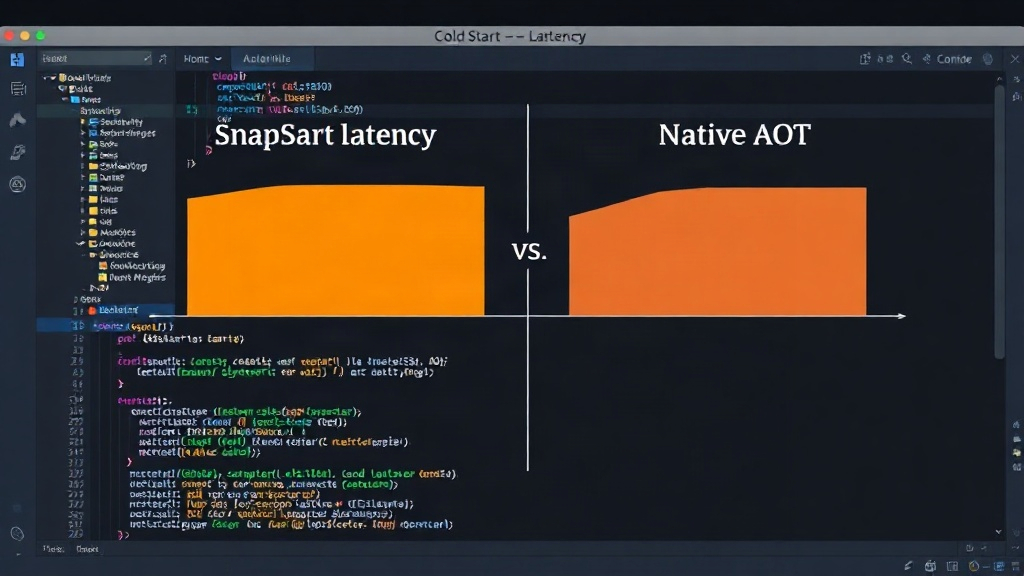
The results reveal a clear winner in cold start performance. Native AOT consistently demonstrated significantly lower cold start times compared to SnapStart. This is attributable to its compilation strategy, which produces a self-contained executable that loads and runs directly, without the need for runtime initialization or state caching that SnapStart relies on.
Interestingly, when it came to warm latency, the performance difference between Native AOT and SnapStart was negligible. Both configurations performed comparably once the function was initialized and warmed up. This suggests that for applications experiencing high invocation rates where cold starts are infrequent, the warm performance might be a more critical factor. However, SnapStart's advantage in reducing cold start duration was not enough to overcome its inherent startup overhead.
The surprising detail here is not just that Native AOT won on cold starts, but by how much. The overhead of SnapStart's pre-initialization and state caching, while intended to help, still introduces a measurable delay compared to a fully native executable. The tied warm latency indicates that once the runtime is up and running (or the native code is loaded), the actual execution of the application logic is similarly efficient across both approaches, assuming comparable function configurations.
Cost Analysis: AWS Lambda Billing
Beyond raw performance, the economic impact is a crucial consideration for any cloud deployment. AWS Lambda pricing is primarily based on invocation count and execution duration (measured in GB-seconds). A longer execution duration directly translates to a higher AWS bill.
The tests incorporated AWS's published pricing to project the cost at scale. Because Native AOT achieved lower cold start durations and comparable warm durations, its overall execution time was less. This directly translated into a lower projected AWS bill. SnapStart, despite its attempts to mitigate cold starts, still incurred higher costs due to its longer initial execution phases and the underlying runtime it still relies on.
For organizations running .NET workloads on AWS Lambda, the cost savings associated with Native AOT can be substantial, especially at high volumes. The ability to reduce both latency and expenditure makes it a compelling choice for optimizing cloud spend. The data suggests that for teams prioritizing efficiency and cost-effectiveness, Native AOT presents a more advantageous path forward.
Caveats and Considerations
It is important to note a critical distinction in the testing parameters: SnapStart is not compatible with the Native AOT managed runtime. This means the comparison is between SnapStart on the standard .NET runtime versus Native AOT compiled functions. The tests were conducted on the same 128 MB function shape. Results may vary with different memory allocations, function complexity, and specific .NET versions.
Furthermore, adopting Native AOT involves a different build and deployment process. It requires a build pipeline capable of producing native executables, which can introduce complexity and potentially longer build times. Developers must also be aware of potential compatibility issues with certain .NET libraries that may not fully support Native AOT compilation. Thorough testing of all dependencies is essential before migrating.
If you run a .NET application on AWS Lambda, and you're looking to optimize both performance and cost, this data strongly suggests evaluating a migration to Native AOT. The benefits in cold start latency and reduced AWS bills appear significant, even if warm performance is similar. The trade-off involves a potentially more complex build process and careful dependency management.
What nobody has addressed yet is the long-term maintenance overhead of managing Native AOT builds across a large microservices architecture, particularly as .NET evolves and new runtime features are introduced. Developers will need robust CI/CD pipelines to ensure compatibility and performance are maintained.