The Privacy Imperative in AI Automation
Companies increasingly seek AI-powered automation for tasks like document parsing, lead scoring, and internal workflow optimization. However, transmitting sensitive data—financial records, legal contracts, or personally identifiable information (PII)—to public AI APIs like OpenAI presents significant compliance risks and security vulnerabilities. This has created a strong demand for privacy-first, self-hosted solutions.
The answer lies in building fully automated, privacy-centric workflows that keep data within an organization's control. This article details how to construct such an engine using n8n for orchestration and Local LLMs managed by Ollama for intelligent processing.
Architecture: n8n and Ollama Working Together
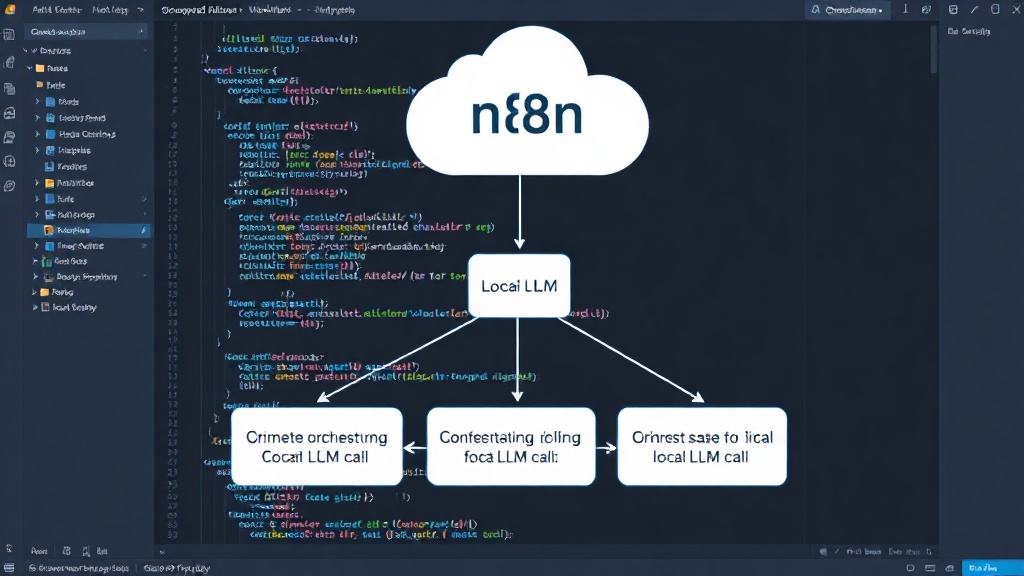
This setup leverages two key components to create a robust and secure automation pipeline:
1. The Orchestrator: n8n
n8n serves as the central workflow automation tool. Unlike cloud-dependent and often expensive alternatives like Zapier, n8n can be deployed entirely on-premises or within a private cloud environment using Docker. This self-hosting capability ensures that all data processed by n8n remains within the organization's Virtual Private Cloud (VPC). It seamlessly connects to local databases, CRMs, email servers, and other internal systems without data ever leaving the secured network boundary.
n8n's visual editor allows users to design complex workflows by connecting various nodes, each representing an action or data transformation. For this use case, n8n will manage the flow of documents, extract relevant information, trigger local LLM processing, and then ingest the results back into other systems.
2. The Intelligence Engine: Ollama and Local LLMs
Ollama provides a straightforward way to run large language models (LLMs) locally. By installing Ollama, organizations can deploy powerful models like Llama 3, Mistral, or others directly onto their own infrastructure. This eliminates the need to send data to external API endpoints, thereby preserving data privacy and enhancing security. For optimal performance, especially with larger models, a GPU-enabled instance is recommended, though CPU-only configurations are also possible.
The integration works by n8n making HTTP requests to the Ollama API endpoint, which is exposed locally. This allows n8n to send prompts and data to the LLM and receive the generated text or structured output back. This local execution ensures that sensitive enterprise data is never exposed to third-party servers.
Building a Privacy-First Lead Generation Workflow
Let's walk through a practical example: automating lead generation and processing. This workflow aims to ingest new leads, enrich their data using an LLM, and update a CRM system, all while maintaining data privacy.
Step 1: Ingesting Lead Data
The workflow begins with a trigger, such as a new entry in a company database, a form submission, or an incoming email containing lead information. n8n listens for this trigger and initiates the workflow.
Step 2: Data Extraction and Preprocessing
n8n nodes can parse incoming data, clean it, and format it appropriately. For instance, if lead information arrives in an unstructured email body, n8n can extract key fields like name, company, and contact details.
Step 3: LLM-Powered Enrichment with Ollama
Here, n8n sends the extracted lead data to a locally running LLM via Ollama. A carefully crafted prompt instructs the LLM to perform specific tasks. For example, the prompt might ask the LLM to:
- Analyze the lead's company website for key technologies used.
- Determine the lead's potential industry based on their role and company description.
- Score the lead's potential based on predefined criteria (e.g., budget, authority, need, timeline - BANT).
- Summarize the lead's stated needs or pain points.
The LLM processes this information locally and returns the results to n8n in a structured format, such as JSON. This is where the privacy benefit is most pronounced; sensitive details about potential clients or their challenges are not sent to external services.
Step 4: Updating CRM and Notification
n8n receives the enriched data from Ollama. It then uses its connectors to update the organization's CRM (e.g., Salesforce, HubSpot) with the new information and the LLM-generated insights. Finally, n8n can send notifications to the sales team via email or Slack, alerting them to the new, enriched lead and providing a summary of the LLM's analysis.
Why This Approach Matters
The combination of n8n and local LLMs via Ollama offers several critical advantages for enterprises:
- Data Privacy and Security: All data processing occurs within the organization's controlled environment, mitigating risks associated with PII, financial, or legal data exposure. This is crucial for compliance with regulations like GDPR, CCPA, and HIPAA.
- Cost-Effectiveness: Running LLMs locally, especially with optimized hardware, can be more cost-effective in the long run than paying per-token fees for cloud-based AI APIs, particularly for high-volume tasks.
- Customization and Control: Organizations have complete control over the LLM models used, their configurations, and the prompts. This allows for fine-tuning AI behavior for specific business needs and ensuring consistent output.
- Reduced Latency: Local processing can often result in lower latency compared to API calls over the internet, leading to faster workflow execution.
- Offline Capability: Workflows can continue to function even with intermittent internet connectivity, as the core AI processing is local.
Implementation Considerations
Deploying this solution requires careful planning:
- Hardware: A robust server with sufficient RAM and, ideally, a powerful GPU is necessary for running LLMs efficiently.
- Model Selection: Choosing the right LLM for the task is important. Smaller, fine-tuned models might be sufficient and more performant for specific tasks than larger, general-purpose models.
- Prompt Engineering: The quality of the LLM's output heavily depends on the quality of the prompts. Iterative prompt engineering is essential to achieve desired results.
- n8n Management: Ensuring n8n is properly configured, secured, and monitored is vital for workflow reliability.
By embracing self-hosted automation tools like n8n and local LLM runtimes like Ollama, enterprises can unlock the power of AI without compromising their critical data security and compliance requirements. This approach represents a significant step towards truly private and scalable AI-driven business processes.