The Phantom Problem of Concurrent Data Access
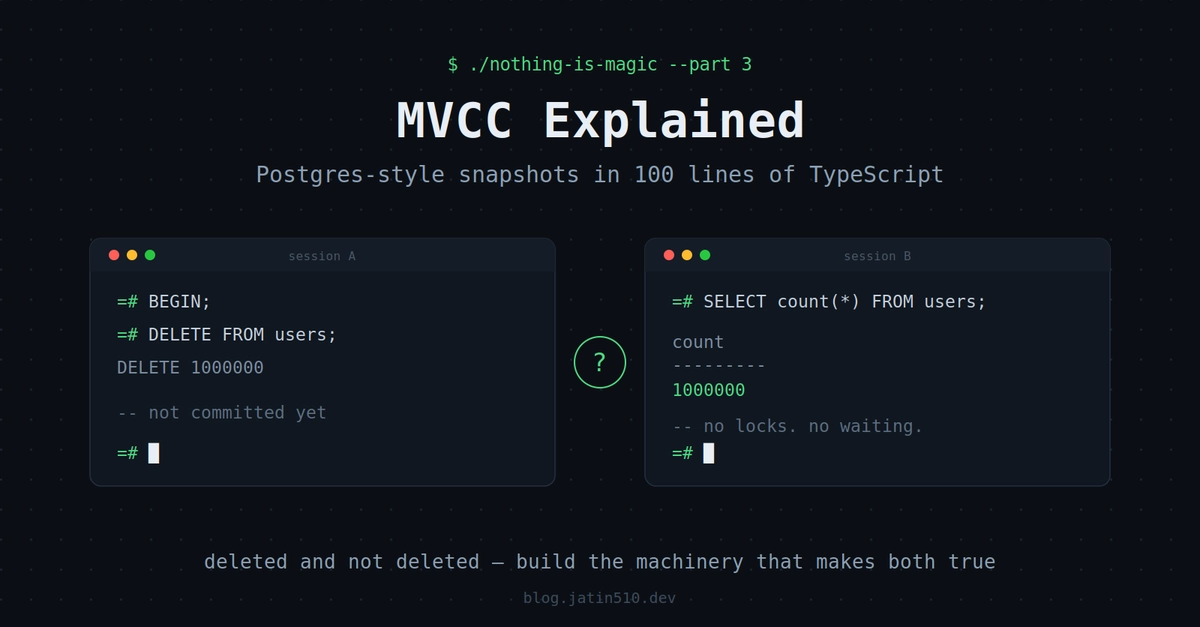
Imagine this scenario: two users are accessing a database simultaneously. User A is performing a lengthy delete operation, removing millions of records. At the exact same moment, User B queries the same table. Logically, User B should see zero records. But what if User B sees the original million records, unaffected by User A's ongoing transaction? This is the magic of Multi-Version Concurrency Control (MVCC), a system that allows readers and writers to coexist without blocking each other, ensuring data consistency across different transaction views. PostgreSQL is a prime example of a database that leverages MVCC effectively.
The core challenge MVCC solves is the conflict between concurrency and consistency. Traditional locking mechanisms, where a transaction locks data it modifies, can lead to deadlocks and poor performance as other transactions wait for locks to be released. MVCC sidesteps this by not modifying data in place. Instead, when data is updated or deleted, new versions are created, and old versions are retained for a period. Each transaction sees a consistent snapshot of the database as it existed when the transaction began, or at a specific point in time.
This approach means that a read operation can proceed without being blocked by a write operation, and vice versa. The database doesn't need to wait for a write to complete before allowing reads; it simply serves the read from the appropriate, existing version of the data. This is particularly beneficial in read-heavy workloads or complex analytical queries that might otherwise stall an entire system.
Building MVCC: A TypeScript Snapshot
To demystify MVCC, let's explore a simplified implementation. The goal is to create a system where multiple transactions can operate concurrently, each viewing a consistent snapshot of the data. We'll use TypeScript to build a proof-of-concept that mimics the snapshot isolation behavior seen in databases like PostgreSQL, all within approximately 100 lines of code.
Our simplified MVCC system will manage data as a collection of versions. When a transaction starts, it receives a unique transaction ID (TXID). When a transaction reads data, it needs to see the version of the data that was committed before its TXID and is still visible to it. When a transaction writes data, it creates a new version associated with its TXID.
A key component is the concept of visibility. A transaction can see a version of a data item if:
- The version was committed before the transaction's start time (or TXID).
- The version is not part of a transaction that is still ongoing or has been aborted.
- The version is not newer than the current transaction's TXID.
For deletions, a transaction marks a data item as deleted. Other transactions that started before this deletion occurred will still see the data item, while newer transactions will not.
The Code: A Minimalist MVCC Engine
Let's outline the core components of our TypeScript implementation:
- Data Store: A simple key-value store where each key maps to a list of versions. Each version will contain the data payload, a TXID indicating when it was created, and a status (e.g., committed, aborted, active).
- Transaction Manager: This component assigns TXIDs and tracks the state of active transactions.
- Read Operation: When a transaction reads a key, it iterates through the versions, finding the latest committed version that is visible to the current transaction's TXID.
- Write Operation: When a transaction writes a value for a key, it appends a new version to the key's version list, tagged with the transaction's TXID and marked as active.
- Commit/Abort: During a commit, active versions are marked as committed. During an abort, active versions are marked as aborted or simply discarded.
The beauty of this system lies in its simplicity and the inherent concurrency. Reads never block writes, and writes create new versions without interfering with existing ones. This is analogous to how PostgreSQL handles concurrent operations, allowing multiple sessions to read and write data simultaneously without explicit table locks for most operations.
Consider the example from dev.to: Session A begins a transaction and deletes all rows from the users table. Session B, which started its transaction earlier or at the same time, queries the users table. Because MVCC ensures Session B sees a snapshot of the database as it existed when its transaction began, it will see the full million rows, even though Session A has logically removed them from its own view. Session A's deletion only affects new transactions that start after its commit.
Implications and Limitations
This 100-line implementation is a conceptual demonstration. Real-world MVCC systems are far more complex, dealing with garbage collection of old versions (vacuuming in PostgreSQL), transaction isolation levels beyond snapshot isolation (like serializable), and handling of complex data types and indexes. The primary challenge is managing storage bloat caused by retaining old versions and the overhead of version management.
However, the core principle remains: by providing multiple, consistent views of data, MVCC significantly enhances concurrency and performance. It allows developers to reason about data consistency within their transactions without the pervasive fear of locks and deadlocks that plague simpler concurrency models. For developers building systems that require high throughput and predictable read behavior, understanding MVCC is crucial. It's the engine under the hood that makes modern, high-performance databases capable of handling the relentless demands of concurrent users and applications.
The surprise here is how elegantly the core MVCC concept can be distilled. What appears as complex database behavior is, at its heart, a clever versioning strategy that decouples readers from writers. This allows for a truly concurrent environment where operations don't contend for the same data locks, leading to smoother performance and fewer transaction failures.