The SIGKILL Blind Spot in Mutation Testing
Mutation testing aims to verify the effectiveness of your test suite by introducing small, deliberate changes (mutations) to your codebase. The goal is for your existing tests to fail when these mutations occur, indicating that your tests are robust enough to catch regressions. However, a fundamental vulnerability exists: what happens when the process designed to break your code is itself terminated abruptly?
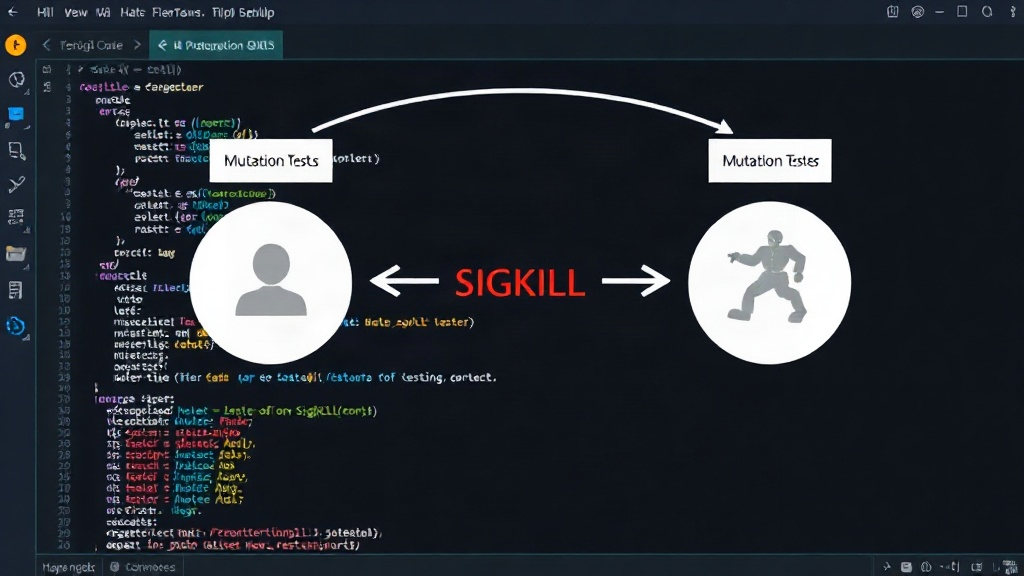
This is precisely the problem identified with mutation testing frameworks. When a mutation harness, the script responsible for applying these code breaks, is terminated by a SIGKILL signal—most commonly due to a timeout—it bypasses all standard termination handling. This includes cleanup routines, error reporting, and importantly, the final state reporting that indicates a mutation was applied and, ideally, caught by a test.
The SIGKILL signal, unlike other signals such as SIGTERM, cannot be caught, blocked, or handled by the process. It's an immediate, forceful termination. This means that any code within a finally block or any other cleanup mechanism designed to execute upon process exit is never reached. Consequently, if a mutation harness is SIGKILLed, it leaves the codebase in a mutated state without properly recording the outcome. The mutation effectively goes unnoticed, creating a false sense of security.
This vulnerability is particularly relevant in automated environments like CI/CD pipelines. These systems often impose strict time limits on jobs. When a mutation testing job exceeds its allocated time, the CI runner will typically send a SIGKILL signal to terminate the process. The outcome is identical to a manual timeout: the mutation is applied, but the harness fails to report it, leaving the original, broken code undetected by the test suite.
The assay tool, developed by Megapixel99, audits mutation harnesses for seven specific properties designed to detect such failure modes. However, its own README acknowledges a critical gap: SIGKILL. This signal renders the checks moot, as the harness's ability to report success or failure is bypassed entirely.
How Timeouts Undermine Mutation Testing
Consider the typical workflow of a mutation testing framework. It generates a mutated version of the source code, then runs the test suite against this mutated version. If all tests pass, the mutation is considered "survived," indicating a potential weakness in the test suite. If any test fails, the mutation is "killed," confirming the test's efficacy for that specific code change.
The problem arises when this process takes too long. Many systems, including CI runners and even programmatic execution using functions like Python's subprocess.run(..., timeout=...), are configured with timeouts. These timeouts are essential for preventing runaway processes from consuming excessive resources. However, when a mutation harness hits such a timeout, the system doesn't gracefully ask it to stop; it forcibly terminates it using SIGKILL.
Imagine a scenario where a mutation harness successfully applies a mutation to a file. Before it can signal back to the orchestrator that the mutation occurred and that tests were run (regardless of their outcome), the CI runner's timeout kicks in. The harness process is abruptly terminated. The mutation remains in the codebase, but the system that was supposed to record this event—the harness itself—is dead. It cannot report that the mutation happened, nor can it report whether the tests passed or failed against it. The orchestrator might interpret the abrupt termination as a failure of the harness itself, but it doesn't inherently know that the code was left in a mutated state.
This creates a dangerous blind spot. Developers might believe their tests are effective because the mutation testing process completed without explicit errors flagged by the orchestrator. In reality, the tests may have never been run against the actual mutated code, or if they were, the outcome wasn't reliably reported due to the forced termination. The mutated code effectively acts as a silent regression, potentially making its way into production.
The Implications for Code Quality and Security
The integrity of mutation testing hinges on the reliable execution and reporting of every mutation. When a framework can be silently bypassed by a timeout, its core promise is broken. This has significant ramifications:
- False Confidence: Teams may believe their test suite is more robust than it is, leading to a reduction in vigilance and potentially shipping code with undetected regressions.
- Incomplete Audits: Security audits or code quality reviews that rely on mutation testing results will be based on incomplete data, missing critical vulnerabilities that would have been exposed by the surviving mutations.
- CI/CD Pipeline Vulnerabilities: Automated pipelines that integrate mutation testing must account for this timeout issue. A simple timeout mechanism in the CI runner can inadvertently disable the effectiveness of the mutation testing stage.
The root cause is the uncatchable nature of SIGKILL. Unlike other signals, it offers no opportunity for graceful shutdown. This means that any mechanism relying on standard process exit procedures—like try...finally blocks in Python or similar constructs in other languages—will not execute if the process is SIGKILLed. The state of the mutation, and the results of the tests against it, are lost.
What remains unaddressed is the practical solution for mutation testing frameworks. Simply increasing timeout values is not a sustainable fix; it merely shifts the problem to longer-running jobs and doesn't address the fundamental SIGKILL vulnerability. Developers building mutation testing tools must consider alternative strategies for detecting and reporting on these abrupt terminations, perhaps through external monitoring or more resilient inter-process communication that can survive even a forceful kill signal, though the latter is technically challenging given the nature of SIGKILL.