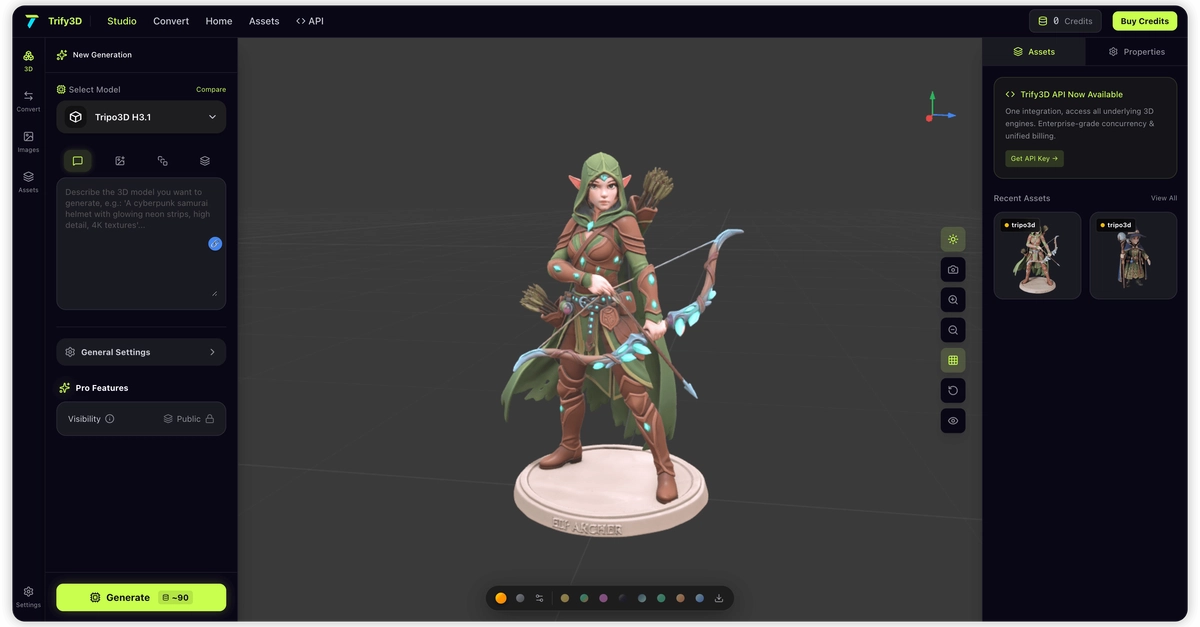
The Problem: AI 3D Engine Blind Spots
Every AI 3D generation engine has inherent weaknesses. Tripo3D excels at hard-surface props, completing generations in about 48 seconds, but struggles with organic detail, often flattening it. Meshy, while better at characters and creatures with cleaner topology, takes around 76 seconds and can produce messy results on hard surfaces. Rodin offers the highest fidelity PBR textures, but at 90 seconds, it is the slowest and most expensive option. Users wanting the best possible output often need to juggle multiple accounts, subscriptions, and credit pools across these disparate services, manually comparing results.
This fragmentation creates a poor user experience and limits the potential of AI-driven 3D content creation. Developers building applications that rely on 3D generation are faced with either choosing a single engine and accepting its limitations or building complex, multi-service integrations themselves.
The Solution: A Unified API Layer
Trify3D’s new API addresses this by acting as a universal router and manager for multiple AI 3D generation engines. The core concept is to allow a single input to be processed by several engines simultaneously or sequentially, presenting users with a comparative view of the outputs. This unified approach simplifies the workflow for developers and end-users alike.
The API design focuses on several key components:
Provider Routing
The system intelligently routes user requests to the most appropriate engine based on the input type or user preference. For instance, a request for a character model might be prioritized for Meshy, while a request for a mechanical part could go to Tripo3D. This routing logic can be dynamic, adapting to the strengths of each engine to maximize output quality.
Asynchronous Job Management
3D generation is an inherently time-consuming process. To handle this, Trify3D employs an asynchronous job management system. Users submit a generation request and receive an immediate acknowledgment, typically with a job ID. The actual generation happens in the background. Services like Trigger.dev are used to manage these long-running background tasks, ensuring reliability and scalability. This prevents the API from being tied up with long-running requests and allows users to continue interacting with the application.
Idempotency for Credit Safety
Managing credits across multiple services is a critical challenge. To prevent accidental double-billing or incorrect credit deductions, the API implements strict idempotency. By using unique request IDs, the system ensures that a specific generation request is processed only once. If a request is retried, the API recognizes the existing job and either returns the result of the original job or a status indicating it's already in progress, safeguarding user credits and preventing duplicate charges.
Webhook Delivery for Results
Once a generation job is complete, the results need to be delivered back to the user or application. Instead of relying on constant polling, Trify3D utilizes webhooks. When a job finishes, the API sends an HTTP POST request to a predefined callback URL provided by the user. This payload contains the output data, including links to the generated 3D models, textures, and any relevant metadata. This push-based notification system is more efficient and provides real-time updates to the requesting application.
Technical Implementation Details
The API is built with a focus on robustness and developer experience. The routing logic can be configured to balance speed, cost, and quality, offering flexibility to application developers. The use of Trigger.dev for managing background jobs simplifies the complexities of distributed task execution. Idempotency is achieved through careful handling of request identifiers and state management, ensuring that each billable action occurs precisely once. Webhook delivery is implemented using standard HTTP POST requests, with payloads designed to be informative and easy to parse, including URLs for accessing generated assets and status updates.
Benefits for Developers and Users
For developers building 3D applications, this API abstracts away the complexities of integrating with multiple 3D generation services. They can offer users a superior experience by providing access to the best-in-class capabilities of different AI models without the overhead of managing individual accounts and billing. Users, in turn, benefit from the ability to compare outputs from various engines, leading to higher quality final assets and a more efficient creative process. The asynchronous nature and webhook delivery ensure a smooth, responsive user interface.
The Future of Multi-Engine Generation
Trify3D's approach paves the way for more sophisticated AI orchestration platforms. As new AI 3D generation models emerge, the API can be extended to incorporate them, further expanding the available options and improving the quality and diversity of generated 3D assets. The underlying principles of intelligent routing, robust job management, credit protection, and efficient delivery are becoming essential for any platform leveraging multiple specialized AI services.