The Rise of Agentic AI in Finance
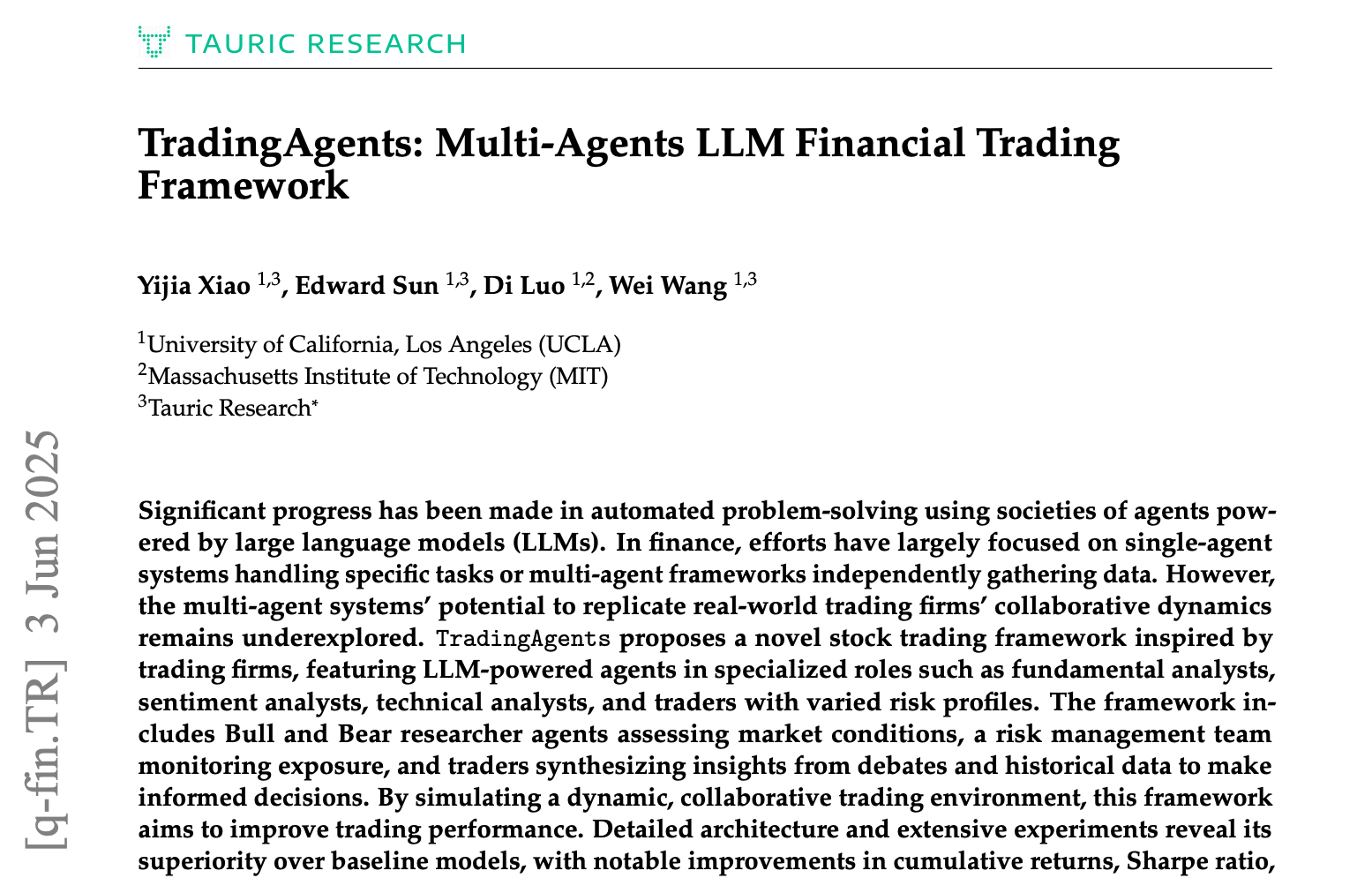
The financial trading landscape is increasingly complex, demanding sophisticated strategies and rapid execution. While algorithmic trading has been dominant for years, the advent of advanced Large Language Models (LLMs) is opening new avenues for automation and strategy development. A new open-source project, TradingAgents, spearheaded by TauricResearch, explores this frontier by proposing a framework that leverages multiple LLMs as autonomous agents to navigate financial markets.
This initiative moves beyond single-model applications by orchestrating a swarm of specialized LLM agents. Each agent is designed to perform a distinct role within the trading ecosystem, from market analysis and news sentiment interpretation to strategy generation and execution. The core idea is to mimic, and potentially surpass, the capabilities of human trading desks by distributing tasks among AI entities with diverse, yet complementary, skill sets.
The framework aims to address several key challenges in algorithmic trading. Traditional systems often rely on rigid, rule-based logic or complex statistical models that can struggle with the nuanced, often qualitative, information present in financial markets, such as breaking news or shifts in market sentiment. By employing LLMs, TradingAgents can process and interpret unstructured data, identify subtle patterns, and adapt strategies in near real-time. This approach is akin to assembling a high-performance trading team where each member brings unique expertise – one might be a seasoned analyst, another a risk manager, and a third a rapid executor. The system then allows these AI 'team members' to collaborate and make decisions collectively.
The project's GitHub repository provides a glimpse into the architecture and potential applications. It suggests a modular design where agents can be plugged in and out, allowing for customization and experimentation with different trading philosophies and market conditions. This flexibility is crucial in a field where adaptability is paramount. The initial focus appears to be on creating a robust environment for research and development, enabling practitioners to build, test, and deploy sophisticated LLM-driven trading strategies.
Deconstructing the Multi-Agent Approach
At its heart, the TradingAgents framework is built on the principle of agent decomposition. Instead of a single monolithic LLM attempting to handle all aspects of trading, the system divides the problem into smaller, manageable sub-tasks, each assigned to a specialized agent. This division of labor is a fundamental concept in complex system design and is now being applied to AI agent orchestration.
Consider the workflow for a hypothetical trading decision. A 'Market Analyst Agent' might be responsible for processing real-time price data, identifying trends, and flagging potential opportunities. Simultaneously, a 'News Sentiment Agent' would scour news feeds, social media, and financial reports, distilling sentiment and its potential impact on specific assets. A 'Strategy Generation Agent' could then take the inputs from these analytical agents and formulate potential trading strategies, perhaps considering factors like volatility, risk tolerance, and market liquidity. Finally, an 'Execution Agent' would translate the chosen strategy into actual trades, managing order placement, monitoring execution, and adjusting parameters as needed.
This architecture offers several advantages. Specialization allows each agent to be optimized for its specific task, potentially leading to higher accuracy and efficiency than a general-purpose model. For instance, an agent fine-tuned on sentiment analysis data might outperform a general LLM at interpreting the nuances of financial news. Furthermore, the modularity enables easier debugging and improvement. If a specific part of the trading strategy is underperforming, developers can focus on refining or replacing the relevant agent without overhauling the entire system.
The project's open-source nature is also a significant factor. It invites collaboration from the broader AI and finance communities, accelerating development and fostering innovation. By sharing the codebase, TauricResearch is enabling researchers and developers to build upon their work, test new agent configurations, and contribute to the evolution of LLM-driven trading systems. This collaborative approach is vital for tackling the inherent complexities and risks associated with financial markets.
Referenced Sources
- verified