Google's AI Threat Tracker Uncovers Sophisticated Credential Harvesting Campaign
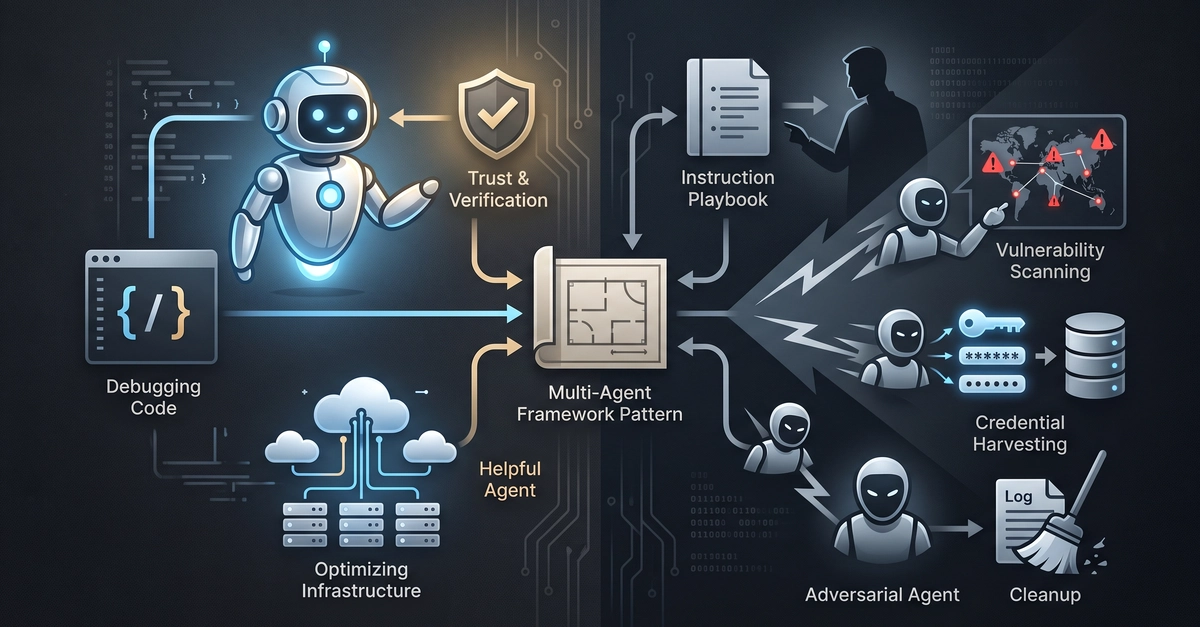
Google's Threat Intelligence Group (GTIG) has documented a concerning new trend in cybercrime: the use of sophisticated multi-agent frameworks for large-scale credential harvesting. In their Q3 2026 AI Threat Tracker report, GTIG detailed a campaign that successfully stole thousands of user credentials in under six hours, operating with minimal human intervention. This campaign leverages the same design principles that power helpful AI agents, demonstrating a disturbing symmetry between constructive and malicious AI development.
The attacker behind this operation ran a complete lifecycle of reconnaissance, exploitation, and cleanup using an automated framework. This approach marks a significant evolution from traditional, more manually driven cyberattacks. Instead of relying on individual phishing emails or fragmented malware, this attacker deployed a coordinated system of agents designed to work autonomously towards a common goal: credential theft.
How the Multi-Agent Framework Operates
The framework functions by deploying multiple AI agents, each with a specific role. These agents communicate and collaborate to achieve the overarching objective. The process typically begins with a reconnaissance agent. This agent surveys target systems, identifies vulnerabilities, and gathers information about potential entry points. Unlike traditional reconnaissance which might involve manual scanning and analysis, this agent automates the discovery phase, rapidly identifying high-value targets.
Once targets are identified, exploitation agents take over. These agents are designed to breach defenses and gain access to systems. This could involve exploiting known software vulnerabilities, leveraging leaked credentials for lateral movement, or employing social engineering tactics at scale. The multi-agent approach allows for parallel exploitation attempts across numerous targets, drastically accelerating the pace of the attack.
Following successful exploitation, data exfiltration agents are deployed. Their sole purpose is to locate and extract sensitive data, primarily user credentials, from compromised systems. This data is then consolidated and prepared for exfiltration. The framework's design ensures that even if one agent is detected or neutralized, others can continue their tasks, maintaining the attack's momentum.
Finally, cleanup agents are responsible for removing traces of the intrusion. This includes deleting logs, uninstalling malicious software, and attempting to cover the attacker's tracks. This automated cleanup is crucial for evading detection and prolonging the attacker's ability to operate undetected, making attribution incredibly difficult.
The Symmetry of Agent Design
The most striking aspect of this campaign, according to GTIG, is the direct parallel between the attacker's framework and legitimate multi-agent systems used for productive purposes. Developers building helpful AI agents often employ similar architectural patterns: modularity, agent communication protocols, task delegation, and autonomous decision-making. The attacker has effectively repurposed these sophisticated AI design concepts for malicious ends.
This symmetry presents a dual-use dilemma. The same techniques that enable AI to automate complex tasks for businesses can also be used to automate criminal activities. The barrier to entry for sophisticated, automated attacks is lowering as these design patterns become more accessible and understood. What was once the domain of highly skilled, state-sponsored actors is now within reach of financially motivated cybercriminals.
The speed at which this particular campaign operated—thousands of credentials stolen in under six hours—underscores the efficacy of this automated approach. Human-led attacks, even sophisticated ones, are inherently limited by the time and resources a human operator can dedicate. A multi-agent system, however, can operate continuously and in parallel, scaling its efforts exponentially.
Broader Implications for Cybersecurity
This development signals a paradigm shift in the threat landscape. Traditional security measures that focus on individual malware signatures or single-point vulnerabilities may become less effective against coordinated, autonomous agent-based attacks. Defenders will need to adopt more holistic strategies that focus on detecting anomalous behavior, understanding complex agent interactions, and building resilient systems capable of withstanding multi-pronged, automated assaults.
The implications extend beyond just technical defenses. The ease with which these frameworks can be developed and deployed raises concerns about the proliferation of sophisticated attack tools. As AI development tools become more democratized, so too do the means for creating advanced cyber weapons. This necessitates a broader conversation about responsible AI development and the ethical considerations surrounding the creation of powerful, autonomous systems.
For organizations, the takeaway is clear: the threat is no longer just about individual phishing emails or unpatched servers. It's about sophisticated, automated systems that can execute complex attack chains with unprecedented speed and efficiency. Proactive security measures, robust monitoring, and a deep understanding of attacker methodologies are no longer optional but essential for survival in this evolving digital battlefield.
The attackers are not merely using AI; they are building AI systems that conduct attacks. This shift demands a commensurate evolution in our defensive strategies, moving from reactive patching to proactive, intelligence-driven security architectures capable of understanding and countering autonomous adversarial agents.