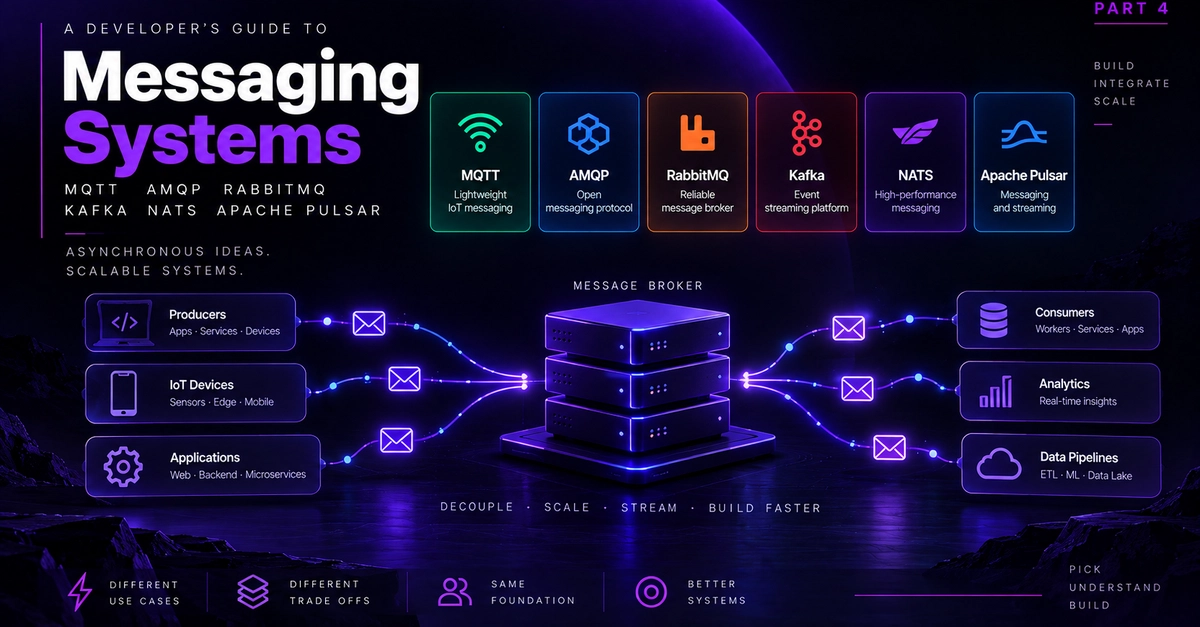
What are Messaging Systems?
Messaging systems are the invisible plumbing that allows distributed applications to communicate. Instead of direct, synchronous calls where one service waits for another, messaging systems use intermediaries. These brokers and queues receive, store, route, and deliver messages. This decoupling is essential for building resilient systems that can handle network failures, unexpected load spikes, and independent evolution of services.
The core benefit is asynchronous communication. Producers send messages without needing to know if consumers are online or ready. Consumers can process messages at their own pace. This makes systems more robust and scalable.
Key Messaging Protocols and Systems
MQTT (Message Queuing Telemetry Transport)
MQTT is a lightweight, publish-subscribe messaging protocol designed for constrained devices and low-bandwidth, high-latency networks. It excels in Internet of Things (IoT) scenarios where devices may have limited processing power and intermittent connectivity.
Key Features:
- Publish-Subscribe Model: Clients publish messages to topics, and brokers deliver messages to subscribed clients.
- Quality of Service (QoS): MQTT defines three levels of service:
- QoS 0 (At most once): Messages are delivered at most once, with no guarantee of delivery. Fastest but least reliable.
- QoS 1 (At least once): Messages are guaranteed to be delivered at least once. May result in duplicates.
- QoS 2 (Exactly once): Messages are guaranteed to be delivered exactly once. Most reliable but slowest.
- Last Will and Testament (LWT): A message that a client can pre-configure to be sent by the broker if the client disconnects unexpectedly.
- Retained Messages: The broker can store the last message published to a topic and deliver it to new subscribers.
Use Cases: IoT sensor data, mobile notifications, machine-to-machine communication.
AMQP (Advanced Message Queuing Protocol)
AMQP is an open standard application layer protocol for message-oriented middleware. It is designed for reliable, interoperable message queuing. Unlike MQTT, AMQP is a more feature-rich and complex protocol, often used in enterprise environments for application integration.
Key Features:
- Complex Routing: Supports sophisticated routing logic through exchanges, bindings, and queues.
- Reliability: Offers features like message acknowledgment, persistence, and transaction support to ensure delivery.
- Interoperability: As an open standard, it facilitates communication between diverse applications and platforms.
- Broker-centric: Typically requires a dedicated AMQP broker.
Use Cases: Enterprise application integration, financial trading systems, inter-service communication requiring high reliability.
RabbitMQ
RabbitMQ is a popular open-source message broker that implements protocols like AMQP, MQTT, and STOMP. It provides a robust and flexible platform for message queuing and delivery.
Key Features:
- Protocol Support: Implements AMQP 0-9-1, AMQP 1.0, MQTT, and STOMP.
- Flexible Routing: Offers various exchange types (direct, topic, fanout, headers) for intricate message routing.
- Management UI: Provides a web-based interface for monitoring and managing queues, exchanges, and connections.
- Clustering and High Availability: Supports clustering for scalability and redundancy.
- Developer Experience: Strong community support and client libraries for many languages.
Use Cases: Task queues, asynchronous processing, microservices communication, decoupling applications.
Apache Kafka
Apache Kafka is a distributed event streaming platform. It's designed for high-throughput, fault-tolerant, and scalable real-time data feeds. Kafka treats messages as a log of records, making it ideal for stream processing, event sourcing, and high-volume data pipelines.
Key Features:
- Distributed Commit Log: Messages are appended to ordered, immutable logs (topics/partitions).
- High Throughput: Optimized for sequential disk I/O, enabling very high read and write speeds.
- Durability: Messages are persisted to disk and replicated across brokers for fault tolerance.
- Consumer Groups: Allows multiple consumers to read from a topic, with each message being delivered to only one consumer within a group.
- Stream Processing: Integrates with stream processing frameworks like Kafka Streams and ksqlDB.
Use Cases: Real-time analytics, log aggregation, website activity tracking, event sourcing, microservices communication.
NATS
NATS is a simple, high-performance messaging system designed for cloud-native applications. It emphasizes simplicity, speed, and ease of use, offering publish-subscribe, request-reply, and queueing semantics.
Key Features:
- Simplicity: Minimalistic design and protocol, making it easy to understand and deploy.
- Performance: Extremely low latency and high throughput due to its efficient design.
- At-most-once and At-least-once Semantics: Supports different levels of delivery guarantees.
- NATS Streaming (JetStream): Provides persistence and exactly-once semantics for more robust use cases.
- Lightweight: Small footprint, suitable for edge computing and microservices.
Use Cases: Microservices communication, IoT data ingestion, real-time data streaming, distributed systems coordination.
Apache Pulsar
Apache Pulsar is a distributed pub-sub messaging system designed for high throughput, low latency, and durability. It combines the benefits of traditional message queues and streaming platforms, offering a unified messaging model.
Key Features:
- Tiered Storage: Separates serving (brokers) from storage (BookKeeper), allowing for independent scaling and cost-effective long-term storage.
- Unified Messaging: Supports both streaming (like Kafka) and queuing (like RabbitMQ) semantics.
- Multi-tenancy: Built-in support for isolating tenants, namespaces, and topics.
- Geo-replication: Enables replication of topics across multiple data centers for disaster recovery and global availability.
- Schema Registry: Manages schemas for message payloads to ensure data compatibility.
Use Cases: Real-time data pipelines, event streaming, IoT, microservices communication, enterprise messaging.
Choosing the Right System
The selection of a messaging system depends heavily on your specific requirements:
- IoT and Embedded Devices: MQTT is the clear choice due to its lightweight nature and low overhead.
- High-Throughput Streaming and Event Sourcing: Kafka excels with its distributed log architecture and scalability. Pulsar also offers strong capabilities here.
- Enterprise Integration and Complex Routing: AMQP, often implemented by RabbitMQ, provides the robustness and flexibility needed for complex enterprise workflows.
- Simplicity and Performance for Microservices: NATS offers a compelling combination of speed, simplicity, and low latency, with JetStream adding durability.
- Unified Messaging and Tiered Storage: Pulsar provides a modern, unified approach with advanced features like multi-tenancy and geo-replication.
Consider factors like throughput requirements, latency sensitivity, delivery guarantees (at-most-once, at-least-once, exactly-once), persistence needs, operational complexity, and existing infrastructure when making your decision. Each system has its strengths, and understanding these nuances is key to building efficient and reliable distributed systems.