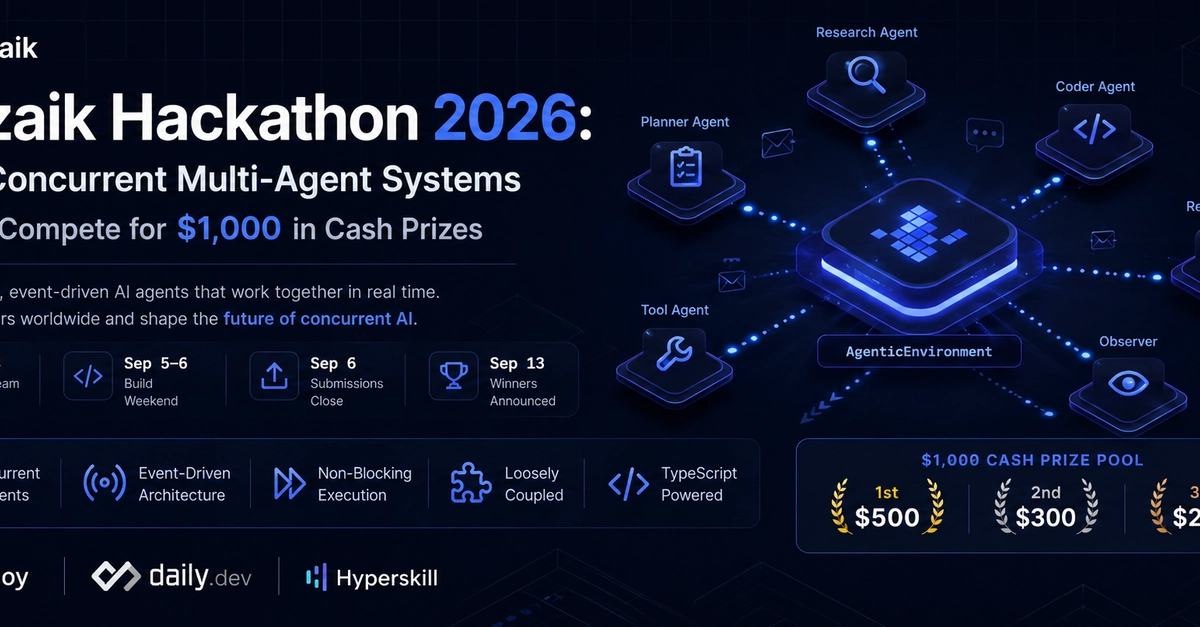
The Challenge of Concurrent Agents
Building multi-agent systems often sounds straightforward on paper. You define agents, assign tasks, add oversight, and connect tools. This creates an agentic workflow. However, the complexity escalates significantly when these agents must operate simultaneously, rather than in a strict sequence.
Sequential workflows impose a rigid order: one agent completes its task, the next begins, and all subsequent agents wait. While this model is easy to understand, it becomes a bottleneck as systems grow and agents need to react dynamically to new information. This is where Mozaik steps in with a different architectural paradigm.
Introducing Mozaik: An Event-Driven Framework
Mozaik is an open-source framework built with TypeScript. It’s designed for creating reactive agents within an event-driven environment. Unlike traditional workflow managers, Mozaik allows agents to work concurrently, respond to events in real-time, and coordinate their actions without relying on a central, predefined workflow to dictate every interaction. This event-driven, reactive approach is key to unlocking true concurrency in multi-agent systems.
The framework aims to simplify the development of complex agent interactions by abstracting away the complexities of inter-agent communication and state management in a concurrent setting. Developers can define agents as independent modules that emit and listen to events. When an event occurs, any agent subscribed to that event type can react, potentially triggering further events and subsequent agent actions. This creates a dynamic, decentralized system where agents can collaborate and adapt fluidly.
Mozaik’s architecture is fundamentally about decoupling. Agents don't need direct knowledge of each other's existence or internal workings. They only need to understand the events they produce and consume. This loose coupling makes systems more resilient, scalable, and easier to maintain. Adding or modifying an agent becomes less disruptive to the overall system.
The Mozaik Hackathon 2026
To encourage exploration and adoption of this architecture, Mozaik is hosting a hackathon. The event challenges developers to build concurrent multi-agent systems using the Mozaik framework. Participants will have the opportunity to experiment with Mozaik's capabilities and contribute to the growing ecosystem of agentic workflows.
The hackathon provides a practical, hands-on environment to test the boundaries of concurrent agent design. Developers can explore scenarios where multiple agents might simultaneously attempt to access shared resources, respond to external stimuli, or perform complex sub-tasks that benefit from parallel execution. The goal is to move beyond simple sequential agent chains and build systems that exhibit emergent behavior through concurrent interaction.
The competition offers a total of $1,000 in cash prizes, incentivizing participants to create innovative and robust solutions. This prize pool aims to attract skilled developers and foster a competitive yet collaborative atmosphere. Prizes will likely be awarded based on criteria such as the system's concurrency handling, innovativeness, robustness, and adherence to the Mozaik framework's principles.
Specific challenges or themes for the hackathon are expected to be announced, guiding participants toward particular application areas or problem types that showcase the strengths of concurrent multi-agent systems. These could range from real-time data processing and automated trading bots to sophisticated simulation environments or complex AI-driven game agents.
Why Concurrent Multi-Agent Systems Matter
The shift towards concurrent multi-agent systems is driven by the increasing demand for AI that can handle complex, dynamic, and real-world problems. Many real-world scenarios are not strictly sequential. For instance, a team of autonomous vehicles needs to react to traffic conditions, other vehicles, and pedestrian movements simultaneously. An AI assistant managing a user’s schedule might need to simultaneously process incoming emails, update calendar entries, and respond to urgent messages, all without blocking other operations.
Traditional sequential agent models struggle with these scenarios. They introduce latency and can lead to missed opportunities or delayed responses. Concurrent systems, on the other hand, can process multiple inputs and execute multiple actions in parallel, leading to more responsive, efficient, and intelligent behavior. This is particularly relevant in fields like robotics, IoT, game development, and complex simulation.
Mozaik’s event-driven approach is well-suited for this. It mirrors how many real-world systems operate, where events trigger responses across distributed components. By providing a structured yet flexible way to build these systems, Mozaik aims to lower the barrier to entry for developers looking to create sophisticated agentic applications. The hackathon serves as a vital proving ground, allowing developers to discover the practical challenges and rewards of this architectural style.
The success of the hackathon will not only highlight Mozaik's capabilities but also contribute valuable insights into the best practices for building and deploying concurrent multi-agent systems. The projects developed during the event could serve as blueprints for future applications, demonstrating the power of reactive, event-driven coordination among intelligent agents.