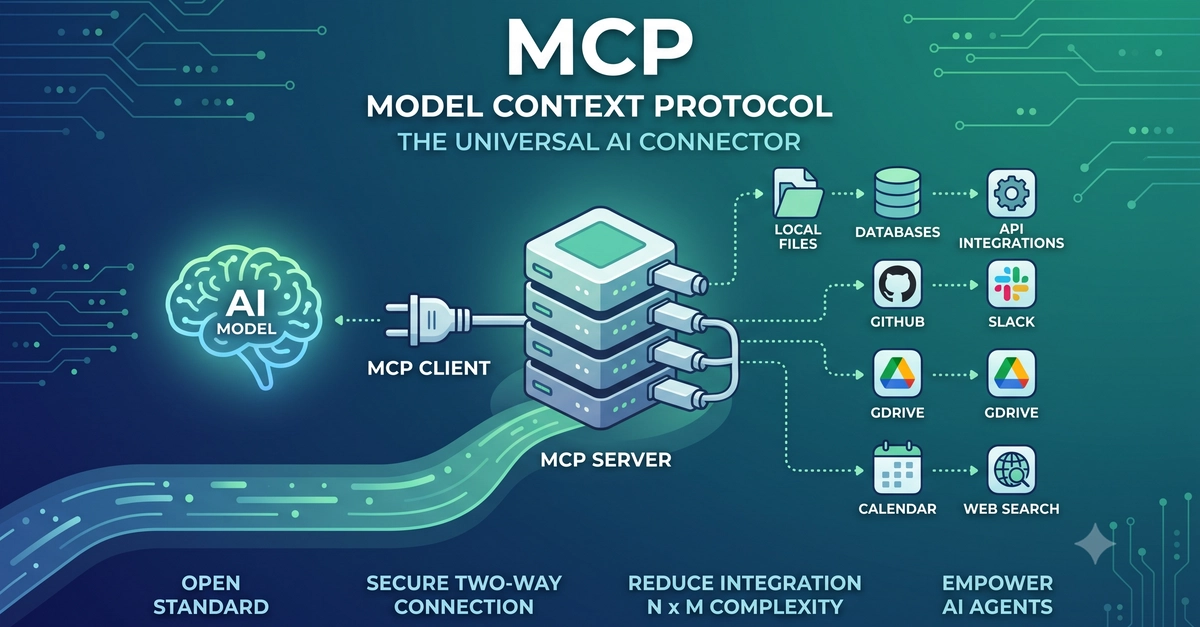
The Problem: A Drawer Full of AI Connectors
Remember the era when every phone, camera, and gadget had its own special charger? A drawer full of incompatible cables, and the one you needed was never there. Then USB (and later USB-C) arrived, and suddenly one port charged everything. The magic wasn't a better cable, it was an agreed-upon standard that every device and every charger followed.
AI tools were living in that pre-USB drawer. Every time you wanted an AI assistant to talk to a new system, your files, a database, a ticketing tool, someone had to hand-build a custom connector for that specific pairing. Ten AI apps times ten tools meant a hundred bespoke integrations. The Model Context Protocol (MCP) is the USB-C moment for AI: one standard so any AI app can talk to any tool.
MCP abstracts away the complexities of connecting AI models to external data sources and tools. Historically, integrating an AI model with a specific application, database, or API required custom development for each connection. This meant significant engineering effort for every new integration, leading to a fragmented ecosystem where interoperability was a major bottleneck. MCP aims to solve this by providing a universal protocol that allows AI models and external systems to communicate seamlessly, much like USB standardized peripheral connections for computers.
The core idea behind MCP is to establish a common language and structure for how AI models receive context and how external tools provide it. This allows developers to build integrations once, and have them work across any AI application that supports the MCP standard. This dramatically reduces the development overhead for both AI application providers and tool developers.
How MCP Works: A Universal Translator for AI
MCP operates by defining a standardized format for context data. This context can include anything an AI model needs to perform a task: user queries, historical data, documents, user preferences, or real-time information from external APIs. The protocol specifies how this context should be structured, encoded, and transmitted to the AI model.
Crucially, MCP also defines how external tools and data sources can expose their capabilities and data in a way that AI models can understand. This involves defining standardized interfaces and data schemas for common tasks like searching databases, retrieving documents, or executing actions within an application. When an AI model needs to interact with an external system, it sends a request formatted according to MCP. The external system, if it supports MCP, can then understand the request, retrieve the necessary information or perform the action, and send the results back to the AI model, also in an MCP-compliant format.
Think of it less like a database and more like a very organized friend who happens to remember everything you told them in 2019 and can also fetch you the latest news headlines on demand. This friend speaks a universal language that any other friend (AI model) can understand, and they know how to ask other specialized friends (tools) for specific information using that same language.
The Benefits: Speed, Scale, and Simplicity
The implications of a universal standard like MCP are vast. For AI developers, it means faster iteration and deployment. Instead of spending weeks or months building custom connectors for each new tool or data source, they can leverage existing MCP-compliant integrations. This allows them to focus on improving the AI model itself and the user experience of their application.
For tool developers, MCP opens up their systems to a much wider range of AI applications. Instead of building individual integrations for every AI chatbot or assistant, they can build one MCP-compliant adapter. This adapter then becomes available to any AI application that supports MCP, significantly expanding their reach and utility. This network effect is what made USB so successful.
MCP aims to democratize AI integration by lowering the barrier to entry. Smaller companies and individual developers can create powerful AI applications without needing extensive resources for integration engineering. Similarly, providers of specialized tools or data can make their offerings accessible to the AI ecosystem more easily.
The protocol is designed to be flexible and extensible, capable of handling various types of context and tool interactions. This ensures that it can adapt to the evolving landscape of AI and external systems. Future versions could easily incorporate new data formats, new types of tools, and more complex interaction patterns.
What Nobody Has Addressed Yet: Governance and Evolution
While the technical promise of MCP is clear, what nobody has addressed yet is the governance and long-term evolution of the protocol itself. Standards bodies like the USB Implementers Forum or the W3C have established processes for managing the evolution of their respective standards, ensuring backward compatibility, and resolving disputes. It remains to be seen how MCP will be managed. Will it be driven by a single company, a consortium, or an open-source community? The success of MCP hinges not only on its technical design but also on its ability to foster a collaborative and transparent ecosystem around its development and adoption.
Another critical aspect is ensuring security and privacy. As AI models gain access to more external data and systems, robust security measures must be built into the MCP framework. This includes authentication, authorization, and data encryption to protect sensitive information and prevent misuse. The protocol needs to define clear guidelines for handling data access and permissions.
Ultimately, MCP represents a significant step towards a more interconnected and efficient AI ecosystem. By providing a universal standard for context and tool integration, it has the potential to unlock new capabilities and accelerate innovation across the entire field.