
The Problem with JMeter's Random Data
Load testing is only as good as your test data. Using JMeter's built-in random functions to simulate critical data like credit card numbers or bank account identifiers is a common but flawed practice. When you generate values like ${__Random(1000000000000000,9999999999999999)} for credit cards or TR${__Random(10,99)}0001234567890123456789 for IBANs, you are creating data that will fail validation long before it reaches your application's core business logic. This means your load tests aren't accurately reflecting real-world user interactions or potential system failures under realistic conditions.
These seemingly random numbers often fail crucial algorithmic checks. For instance, credit card numbers generated this way will not pass the Luhn checksum algorithm. Similarly, generated IBANs might not adhere to country-specific formatting rules or checksum calculations, rendering them invalid from the outset. This fundamentally undermines the integrity of your load testing, as the system is being tested with data that would never realistically be submitted.
The consequence is a false sense of security. Your application might appear to handle a high volume of requests, but it's handling requests with syntactically invalid data. This can mask underlying issues related to data processing, validation logic, and error handling that would surface under a load of truly valid, albeit mocked, data.
Introducing Mock Jutsu
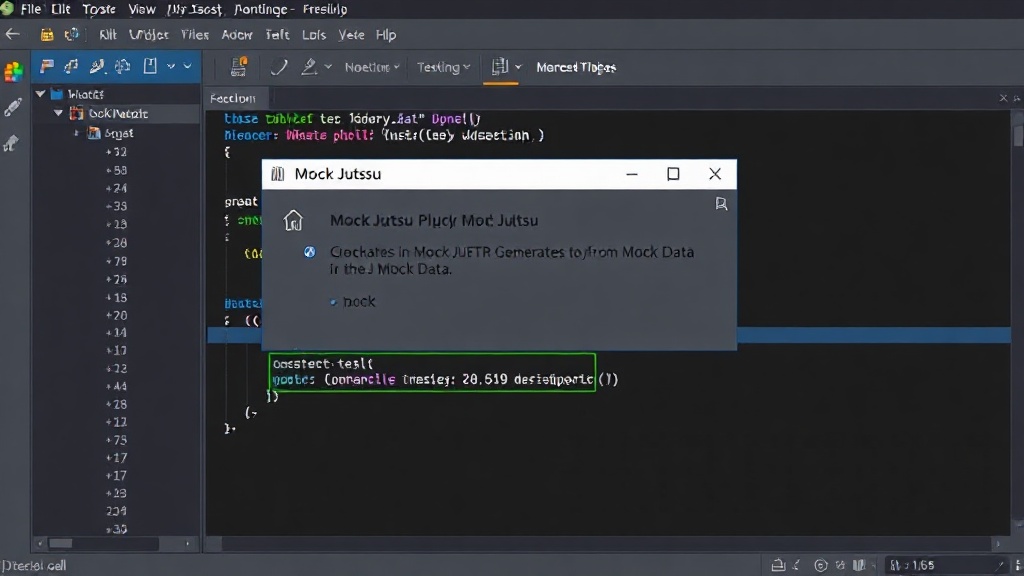
Mock Jutsu is a new, free, and zero-dependency JMeter custom functions plugin designed to solve this exact problem. It allows you to generate algorithmically correct mock data directly within your JMeter test plans. This eliminates the need for external scripts, complex preprocessing steps, or reliance on separate services to generate your test data.
The plugin provides a suite of functions that mimic real-world data generation logic. Instead of relying on broad random number generation, Mock Jutsu implements specific algorithms and formats for common data types. This ensures that the mock data not only looks realistic but also adheres to the structural and validation rules of the data it represents.
Think of it like this: using ${__Random(...)} for a credit card number is like trying to build a house with random planks of wood. You might end up with something that looks vaguely like a house, but it won't be structurally sound. Mock Jutsu, on the other hand, provides you with pre-cut, industry-standard lumber, ready to be assembled into a valid structure. It understands the 'rules' of the materials it's working with.
The primary advantage is the integration. All data generation happens within JMeter itself. This simplifies test plan management, reduces external dependencies, and makes your load tests more self-contained and portable. You can define sophisticated data generation logic directly in your JMX files, making them easier to version control and share among team members.
Key Features and Functions
Mock Jutsu offers a range of functions tailored for generating valid mock data. While the specifics of each function are detailed in the plugin's documentation, the general principle is to provide functions that understand the underlying algorithms and formats required for common data types.
For example, instead of a generic random number for a credit card, Mock Jutsu might offer a function like ${MockJutsu.creditCardNumber()} which generates a 16-digit number that passes the Luhn checksum. Similarly, for IBANs, it could provide a function that generates valid numbers based on country codes and checksum rules, ensuring regional compliance.
This level of algorithmic correctness is crucial for comprehensive load testing. When your test data is valid, your application's validation layers are properly exercised. This means you can identify issues in how your system handles valid data under load, including performance bottlenecks in data processing, potential errors in data transformation pipelines, and the robustness of your error-handling mechanisms when dealing with realistic, albeit simulated, user inputs.
The zero-dependency nature of the plugin is a significant benefit. It means you don't need to install additional libraries or frameworks on your JMeter instances or agent machines. Simply drop the plugin JAR file into your JMeter's `lib/ext` directory, and the new functions become available for use in your test plans. This drastically simplifies setup and maintenance, especially in distributed testing environments.
Implications for Load Testing
The adoption of tools like Mock Jutsu signals a maturing approach to load testing. It moves beyond simply simulating volume to simulating realistic scenarios. When your load tests use data that passes initial validation, you gain deeper insights into your system's behavior under conditions closer to production.
This allows for the discovery of more subtle bugs. Instead of failing at the first validation hurdle, the data progresses through your application's pipeline. This exposes issues that might arise from complex business logic, database interactions, or integration points that are only triggered by valid data. For instance, performance degradation might only appear when the system is actively processing and storing valid entries, not when it's rejecting invalid ones.
Furthermore, using algorithmically correct data improves the diagnostic capabilities of your load tests. When a test fails, you can be more confident that the failure is related to your application's performance or logic, rather than a fundamental issue with the test data itself. This saves valuable debugging time and leads to more accurate performance assessments.
The broader implication is that load testing becomes a more effective tool for ensuring application quality and reliability. By ensuring the data used in tests is as close to real-world data as possible, teams can build more confidence in their system's ability to handle production traffic. This is particularly important for applications dealing with financial transactions, personal identifiable information, or any domain where data integrity and validation are paramount.
What remains to be seen is how extensively other testing tools will adopt similar built-in algorithmic data generation capabilities. While Mock Jutsu addresses a specific need within JMeter, the broader trend towards more realistic and intelligent test data generation is likely to influence the development of load testing frameworks across the board.
For teams relying on JMeter for performance and load testing, integrating Mock Jutsu is a straightforward way to significantly increase the fidelity and effectiveness of their tests. It's a small change that yields substantial improvements in the quality of insights derived from load testing efforts.