
Demystifying MLP Training with Custom NumPy Implementation
Understanding the internal mechanics of a Multilayer Perceptron (MLP) during training can be opaque, even for experienced machine learning practitioners. To demystify this process, a developer has built an educational tool from the ground up using only NumPy. This project, shared on r/MachineLearning, provides a tangible way to inspect an MLP's inner workings as it learns. The goal is to offer insights for those teaching and learning machine learning, moving beyond black-box model behavior.
The core of this project is a small MLP implemented entirely in plain NumPy, eschewing automatic differentiation libraries. This forces a deep engagement with the fundamentals of neural network training. The developer has manually implemented backpropagation, Stochastic Gradient Descent (SGD) with momentum, L2 regularization, dropout, cosine decay for learning rate, and four common activation functions. On the MNIST dataset, this custom implementation achieves an accuracy of approximately 98.5% when trained on the full dataset, demonstrating its efficacy.
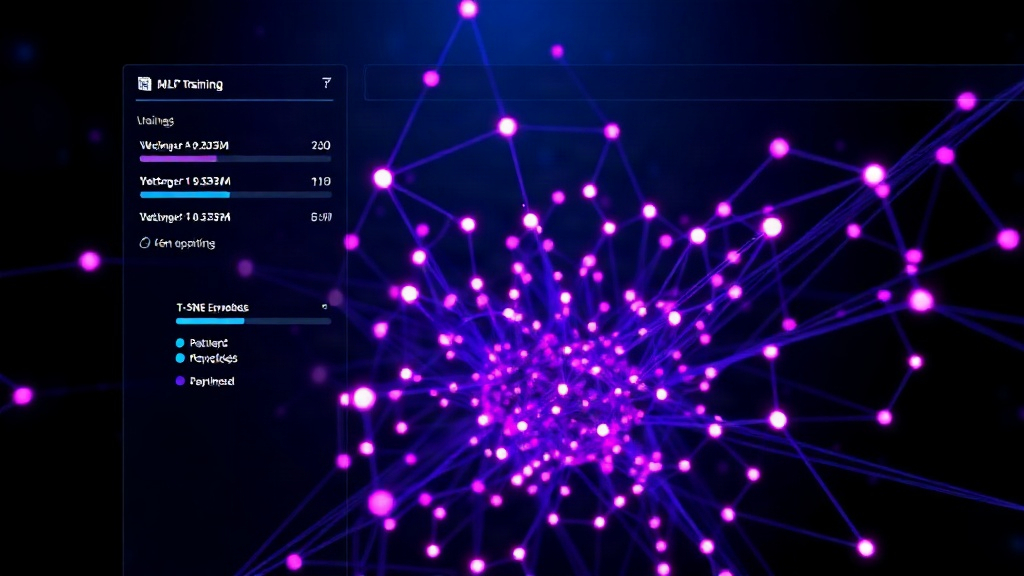
Interactive Visualization During Training
What sets this project apart is its accompanying graphical user interface (GUI). This GUI runs concurrently with the training process, offering real-time visualizations of critical internal states. Users can observe the distribution of weights across different layers, gaining an intuitive grasp of how parameters evolve. This helps to understand phenomena like vanishing or exploding gradients, or how different layers specialize.
Furthermore, the tool incorporates t-SNE (t-distributed Stochastic Neighbor Embedding) projections for each layer. t-SNE is a dimensionality reduction technique that maps high-dimensional data into a low-dimensional space, typically 2D or 3D, for visualization. By applying t-SNE to the activations or feature representations within each layer, users can see how the network is abstracting and clustering data. This visual feedback can reveal whether the network is learning meaningful representations or if it's struggling to separate classes.
Probing Neuron Functionality with Ablation
Beyond passive observation, the tool enables active experimentation through neuron ablation. Neuron ablation involves systematically deactivating individual neurons or groups of neurons and observing the impact on the network's performance. This technique helps to identify which neurons are critical for specific tasks or representations. For instance, if ablating a particular neuron causes a significant drop in accuracy for a specific digit in MNIST, it suggests that neuron plays a crucial role in recognizing that digit.
The ability to perform neuron ablation interactively during training provides a powerful pedagogical tool. It allows learners to directly test hypotheses about neuron function and network architecture. Instead of just reading about the importance of specific neurons, they can see the consequences of their removal firsthand. This hands-on approach can significantly deepen understanding of how complex behaviors emerge from the interplay of simpler units.
Educational Value and Broader Implications
The project's emphasis on a pure NumPy implementation is deliberate. It strips away the abstractions provided by high-level frameworks like TensorFlow or PyTorch, forcing users to confront the mathematical underpinnings of neural networks. This approach is invaluable for educators seeking to build a solid foundational understanding in their students. It's akin to learning to drive a manual transmission car before an automatic; you understand the clutch, gears, and engine more intimately.
While the MLP itself is small and achieves respectable performance on MNIST, the true value lies in the visualization layer. It bridges the gap between theoretical concepts and practical application. For developers and researchers, this tool can serve as a sandbox for exploring architectural variations or regularization techniques without the overhead of setting up complex training pipelines. The surprise here is not the performance of the MLP, but the depth of introspection provided by such a lean implementation.
What remains to be seen is how this visualization approach scales to larger, more complex architectures like Convolutional Neural Networks (CNNs) or Transformers. Adapting these techniques to visualize the intricate feature maps of CNNs or the attention mechanisms of Transformers would be a significant undertaking but could unlock unprecedented understanding of these powerful models. For now, this NumPy MLP visualizer offers a clear, accessible window into the learning process.