The Double-Edged Sword of AI in Research
Artificial intelligence is not just generating low-quality, "slop" research. It's also dramatically accelerating the pace of genuine, high-quality scientific contribution. This acceleration, driven by agentic tools and advanced AI assistance, is creating an unprecedented challenge for the academic conference review infrastructure, particularly in machine learning. While AI can automate tedious coding tasks, refactor complex documents like LaTeX papers, and even aid in proving mathematical conjectures, its impact extends to the core of ML theory research. This means the volume of novel, impactful work submitted to top-tier conferences is poised to skyrocket, far outpacing the current capacity of human reviewers.
The recent surge in submissions to conferences like ICLR 2027 is a stark indicator. This influx isn't just more of the same; it's a blend of both low-effort submissions and significant, genuine advancements. The problem is that the systems designed to filter and validate this research – the peer review processes of academic conferences – were built for a pre-AI era. They were calibrated for a rate of progress that is rapidly becoming obsolete. The critical question is no longer *if* AI will increase research output, but *how* the academic community will adapt its review mechanisms to handle this new reality.
Straining the Seams: Conference Review Infrastructure
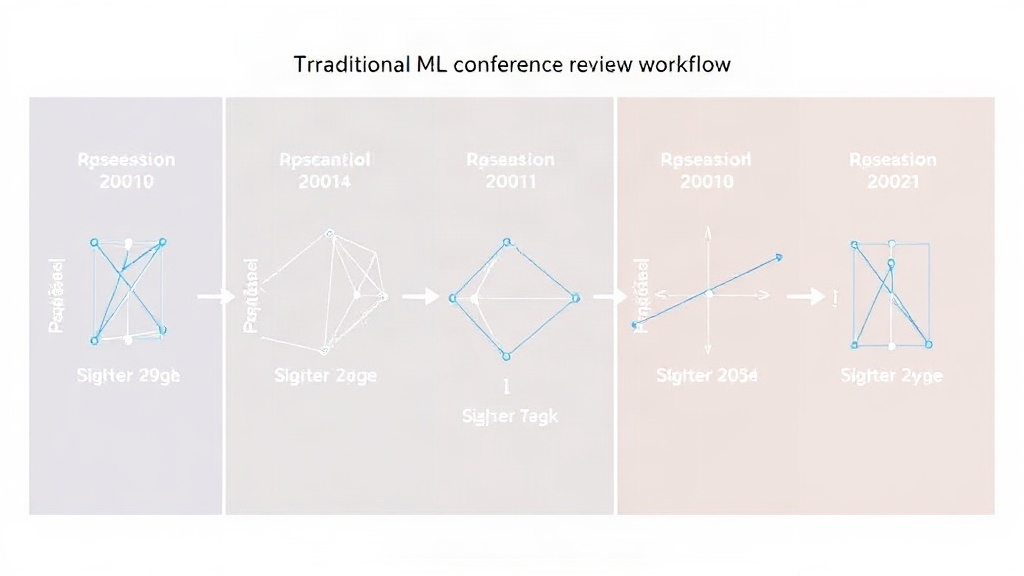
Academic conferences, the traditional gatekeepers of cutting-edge research, operate on a model that has remained largely unchanged for decades. A typical cycle involves a call for papers, submission deadlines, a period of rigorous peer review by domain experts, and finally, acceptance or rejection. This process, while intended to ensure quality and rigor, is inherently labor-intensive and time-constrained. Reviewers, who are typically active researchers themselves, volunteer their time, often juggling review duties with their own research, teaching, and other professional obligations.
The increasing volume of submissions, even without the AI acceleration, has already placed significant strain on this system. Reviewers are often overloaded, leading to rushed reviews, potential biases, and an increased likelihood of overlooking novel contributions. The introduction of agentic tools amplifies this problem exponentially. If a single researcher can now produce the equivalent of weeks or months of prior work in a matter of hours, the number of viable research papers submitted could easily double or triple within a few conference cycles. This isn't a hypothetical future; it's a present challenge that many conferences are already grappling with. The current infrastructure, relying on a finite pool of overworked human reviewers, is simply not designed to scale to this new level of output.
The Need for Agentic Reviewers?
The most direct, albeit controversial, proposed solution is to equip reviewers with similar agentic tools. If researchers can leverage AI to accelerate their work, perhaps reviewers can leverage AI to accelerate their evaluation. This could involve AI assistants that can summarize papers, identify potential flaws or strengths, check for novelty against a vast corpus of existing work, and even flag potential plagiarism or data fabrication. Such tools could significantly reduce the time required for each review, allowing reviewers to process a larger volume of papers.
However, this approach raises a host of new questions and challenges. How do we ensure the AI reviewers are unbiased and accurate? What is the threshold for AI-assisted review to be considered sufficient? If AI tools become standard for reviewers, does this create an arms race where researchers must also use AI to anticipate AI-driven reviews? Furthermore, the very nature of peer review often involves nuanced understanding, intuition, and critical thinking that current AI may struggle to replicate. Relying too heavily on AI for review could inadvertently filter out truly novel, out-of-the-box ideas that don't conform to predictable patterns. The human element of critical appraisal, the spark of insight that comes from deep engagement with a paper, risks being diminished.
Beyond Agentic Review: Systemic Overhaul
The challenge of scaling conference reviews is not merely a technical problem solvable by a new tool; it's a systemic issue that may require a fundamental rethinking of how research is validated and disseminated. One avenue is to explore alternative publication and review models. Pre-print servers like arXiv have already become de facto publication venues, with many conferences acting more as curated collections of work already circulating. Perhaps the future lies in more fluid, continuous review processes, where papers are published and reviewed asynchronously, rather than in massive, concentrated batches.
Another consideration is the incentive structure for reviewers. If reviewing is to remain a human-centric process, the academic community must find ways to properly acknowledge and reward the significant time and effort involved. This could involve greater institutional support, dedicated funding for review processes, or even a shift towards a more professionalized review system, albeit one that carefully guards against commoditization and the loss of deep expertise. Ultimately, the current infrastructure is being tested by a wave of innovation it was not designed to withstand. Adapting will require more than incremental changes; it demands a proactive, potentially radical, reimagining of the academic validation process to keep pace with the accelerating engine of research.
What nobody has addressed yet is what happens to the thousands of developers who built their tooling and workflows around the established research dissemination cycles. A sudden shift in how papers are accepted or reviewed could render years of investment in specific submission formats or review-preparation tools obsolete overnight.