The Peril of the Missing WHERE Clause
In the world of B2B Software-as-a-Service (SaaS), security is paramount. Yet, a seemingly minor oversight – a missing WHERE clause in a SQL query – can lead to catastrophic data breaches. This isn't about malicious actors breaking into systems; it's about legitimate users inadvertently accessing data belonging to other customers. Imagine a user logging into their dashboard and seeing another company's invoices, financial reports, or sensitive operational data. This scenario, far from being theoretical, highlights a critical vulnerability that authentication alone cannot prevent.
The core issue lies in how multi-tenant applications manage data. When a single instance of an application serves multiple customers (tenants), robust isolation mechanisms are essential. Simply verifying a user's credentials doesn't guarantee they are only seeing data relevant to their own organization. A flaw in data retrieval logic can expose an entire dataset to an unauthorized, albeit authenticated, user.
This problem is particularly acute in B2B SaaS where data privacy and compliance are non-negotiable. The consequences of such a breach can range from severe reputational damage and loss of customer trust to hefty regulatory fines. Developers must implement architectural patterns and rigorous coding practices to prevent such exposures.
Architectural Choices for Tenant Isolation
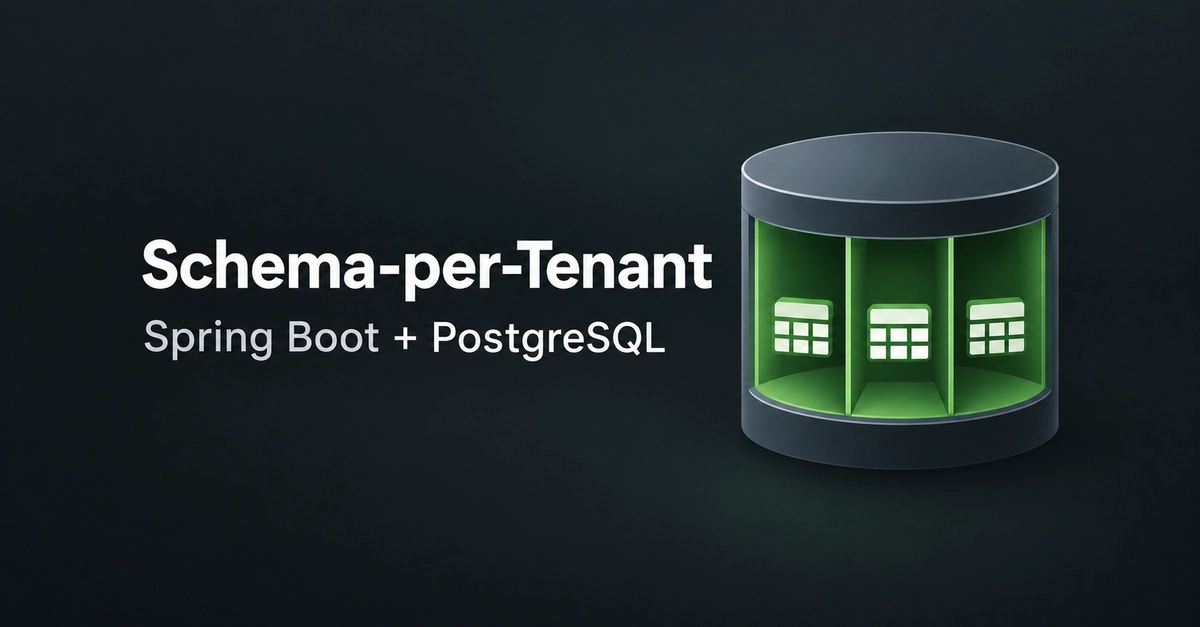
To combat this risk, developers must make deliberate architectural decisions. For applications like BootSaaS, built with Spring Boot, PostgreSQL, and Liquibase, a schema-per-tenant architecture offers a strong baseline for data isolation. This approach dedicates a separate database schema for each customer. While it introduces operational overhead, it provides a clear boundary between tenant data.
In this model, each customer's data resides in its own schema within a shared PostgreSQL instance. This contrasts with other common patterns like row-level security within a shared schema or a completely separate database per tenant. Schema-per-tenant strikes a balance, offering logical separation without the full infrastructure cost of dedicated databases for every client, while still providing a robust defense against the missing WHERE clause vulnerability.
A tenant, in this context, is defined as a customer organization or workspace. Each user is associated with a specific tenant. The application logic must ensure that any data query, whether for user profiles, financial records, or application settings, is strictly scoped to the requesting user's tenant. This means that even if a query *could* technically access data from another tenant's schema, it must be prevented by design.
The Technical Flaw: A Query Without Boundaries
The vulnerability arises when data retrieval functions fail to enforce tenant boundaries. Consider a simplified scenario where an application needs to fetch all invoices for a given customer. A typical query might look like this:
SELECT * FROM invoices WHERE customer_id = 'current_customer_id';
If the customer_id is not correctly supplied or if the WHERE clause is mistakenly omitted entirely, the query could return all invoices in the database, not just those belonging to the authenticated user's tenant. In a schema-per-tenant model, this translates to a query that might accidentally query across schemas if not properly constructed and executed within the context of the correct schema.
The application layer plays a crucial role here. It must dynamically determine the correct tenant context for every incoming request and ensure that all database operations are executed within that context. This involves:
- Tenant Identification: Reliably identifying the tenant associated with the authenticated user. This is often derived from the user's session, JWT token, or subdomain.
- Schema Context Management: For schema-per-tenant architectures, setting the active PostgreSQL schema for the database connection before executing queries.
- Query Construction: Ensuring that all data-fetching queries include the necessary tenant-specific filters. This is where the missing WHERE clause becomes critical.
When using frameworks like Spring Boot with PostgreSQL, developers often leverage Liquibase for database schema management. Liquibase changelogs can be designed to create and manage schemas per tenant. However, the application code that interacts with these schemas must be meticulously audited for security flaws, especially around data access patterns.
Mitigation Strategies: Beyond Basic Authentication
Preventing data exposure requires a multi-layered approach:
1. Strict Schema-Per-Tenant Implementation
As discussed, this architecture inherently isolates data. Each tenant's schema is a distinct namespace. Application code must explicitly select the correct schema for all operations. This is often managed by setting the search_path in PostgreSQL for the duration of a request or connection.
SET search_path TO tenant_schema_name;
SELECT * FROM invoices;
The critical part is ensuring tenant_schema_name is always correctly determined and that no queries are executed outside of this bounded context. If a query were to accidentally access a table in the public schema or another tenant's schema, it would be a severe misconfiguration or bug.
2. Robust Authorization Checks
Even within a tenant's schema, not all users should have access to all data. Implement granular authorization checks. This means verifying not just that the user belongs to Tenant A, but also that User X within Tenant A is permitted to view Invoice Y.
3. Automated Security Testing
Incorporate security testing into the CI/CD pipeline. This includes:
- Static Application Security Testing (SAST): Tools that scan code for common vulnerabilities, including potential SQL injection and data leakage patterns.
- Dynamic Application Security Testing (DAST): Tools that probe the running application for vulnerabilities.
- Integration Tests: Write specific tests that attempt to access data from other tenants under various authentication/authorization scenarios. These tests should simulate the missing WHERE clause scenario.
4. Code Reviews and Peer Programming
Mandatory code reviews for any data access logic are essential. Having a second pair of eyes scrutinize queries and data handling code can catch oversights that automated tools might miss. Pair programming on critical data access functions can also preemptively catch such errors.
5. Principle of Least Privilege
Ensure that database users and application roles are granted only the minimum necessary permissions. This limits the potential damage if an account or process is compromised or misconfigured.
The Unanswered Question: What About Legacy Systems?
While new B2B SaaS applications can be architected with robust tenant isolation from the start, a significant challenge remains for established platforms. Many legacy systems were built on simpler architectures, perhaps using a shared schema with a tenant ID column for every table. Migrating these systems to a more secure model like schema-per-tenant is a massive undertaking, fraught with risk and cost. What is the most effective strategy for refactoring existing codebases to prevent the accidental exposure of customer data without a complete, disruptive overhaul?
The responsibility falls squarely on engineering teams to prioritize security. A missing WHERE clause is not just a bug; it's a potential breach. By adopting appropriate architectures, implementing rigorous testing, and fostering a security-conscious development culture, B2B SaaS providers can protect their customers' sensitive information.