The All-Python Pitfall
When architecting the Maternity HL7-to-FHIR Pipeline, the initial impulse was to handle everything within a single Python FastAPI service. The envisioned flow was straightforward: receive a message via MLLP, parse the HL7 data using a Python library, map fields, validate against FHIR standards, and persist. This approach seemed clean and simple, but as development progressed, its limitations became starkly apparent. The architecture looked like this:
Hospital System --MLLP--> Python Script --> HAPI FHIR ServerLibraries like python-hl7 offer functionality to split messages based on delimiters like the pipe symbol (|) and identify fields by their positional index. For a single ADT^A01 (patient admission) message, this might suffice. Extracting patient name from PID-5, MRN from PID-3, or gender from PID-8 and constructing a basic FHIR resource seemed manageable. However, the reality of healthcare data exchange is far more complex.
Encountering HL7's Nuances
HL7 v2 messages, while standardized in structure, exhibit significant variability in practice. Different hospital systems implement message structures with subtle deviations. Fields might be optional, repeating, or contain complex sub-components. Attempting to parse these variations directly in Python, field by field, quickly devolves into a maintenance nightmare. Each new message type, or even a slightly different implementation of an existing type, requires custom Python code. This brittle approach makes the system difficult to scale and prone to errors. Imagine trying to build a universal translator by memorizing every possible grammatical quirk of every human language – it’s an impossible task. HL7 parsing in Python, without a dedicated middleware, often feels like that.
Enter Mirth Connect: A Dedicated Integration Engine
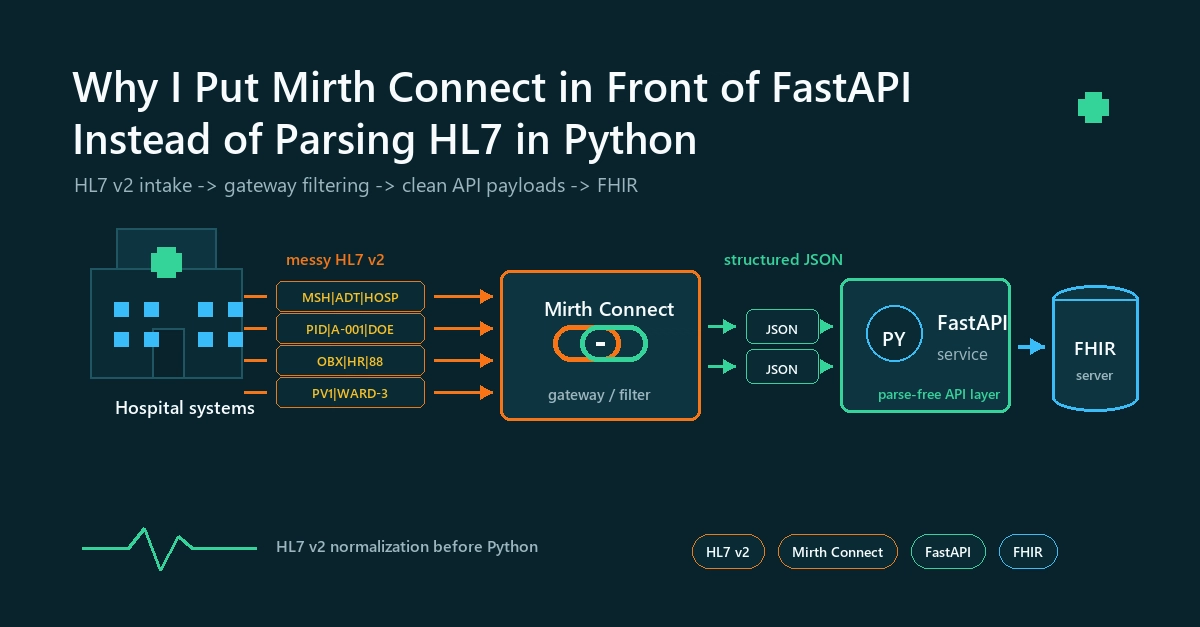
Mirth Connect emerged as the solution. It’s an open-source healthcare integration engine designed specifically for handling disparate healthcare data formats, including HL7 v2, CDA, and FHIR. By placing Mirth Connect in front of FastAPI, the architecture shifts:
Hospital System --MLLP--> Mirth Connect --> FastAPI Service --> HAPI FHIR ServerMirth Connect excels at message transformation and routing. Its graphical interface allows developers to visually map data, define transformation rules, and manage message flows without writing extensive custom code for every scenario. It handles the complexities of HL7 parsing—segment identification, field extraction, sub-component handling, and data type validation—out of the box. This offloads the burden from the application layer (FastAPI) and allows it to focus on its core responsibilities: serving FHIR resources and business logic.
The Benefits of Decoupling
This architectural change offers several key advantages:
- Robust Parsing: Mirth Connect is built for HL7. It understands message boundaries, segment terminators, field separators, and component separators inherently. This dramatically reduces the risk of parsing errors caused by unexpected message variations.
- Simplified Transformation: Mirth Connect provides a rich set of tools for data mapping and transformation. Developers can use JavaScript within Mirth channels to perform complex logic, but the fundamental parsing and extraction are handled by the engine itself. This is far more manageable than writing custom Python parsers for every HL7 field.
- Message Queuing and Reliability: Mirth Connect includes built-in capabilities for message queuing, error handling, and retries. If the downstream FastAPI service is temporarily unavailable, Mirth Connect can hold messages and attempt to resend them, ensuring data is not lost. This is critical in healthcare environments where data integrity is paramount.
- Protocol Handling: Mirth Connect natively supports protocols like MLLP, essential for HL7 communication. This avoids the need to implement or manage low-level network protocols within the application.
- Maintainability: By abstracting the complex HL7 parsing and transformation logic into Mirth Connect, the FastAPI service becomes simpler and easier to maintain. Developers can focus on building FHIR APIs and business logic, rather than debugging intricate HL7 parsing code. The separation of concerns is a fundamental software engineering principle that Mirth Connect helps enforce.
What About the FHIR Conversion?
While Mirth Connect handles the HL7 parsing and initial transformation, the final conversion to FHIR resources can still be managed by FastAPI. This hybrid approach leverages the strengths of both tools. Mirth Connect acts as the robust data gateway and pre-processor, ensuring clean, structured data is passed to FastAPI. FastAPI then takes this processed data and, using libraries like HAPI FHIR (or equivalent Python FHIR libraries), constructs the final FHIR resources. This allows for specialized logic in FHIR resource creation, validation, and persistence within the Python application, while the messy HL7 wrangling happens upstream.
The Surprising Efficiency of Dedicated Tools
The surprising detail here is not that a dedicated tool outperformed a general-purpose language for a specialized task, but the sheer scale of the complexity Mirth Connect abstracts away. What initially seemed like a few lines of Python code to extract patient demographics quickly revealed itself to be a deep dive into the chaotic, yet critical, world of HL7 implementation variations. Relying solely on Python for this would mean building a mini-HL7 engine from scratch, a task that is both time-consuming and error-prone. Mirth Connect, as an established integration engine, has already solved these problems, offering a battle-tested framework that significantly accelerates development and improves system reliability. It’s less about the speed of parsing and more about the speed of development and the long-term maintainability of the integration.
Conclusion: A Pragmatic Choice for Healthcare Integration
For projects involving HL7 data integration, especially those aiming for standards like FHIR, adopting a dedicated integration engine like Mirth Connect is a pragmatic and highly effective strategy. It allows development teams to build more robust, scalable, and maintainable systems by leveraging specialized tools for specialized tasks. The FastAPI service can then focus on its strengths, leading to a cleaner architecture and faster development cycles. This layered approach ensures that the complexities of healthcare data exchange are managed efficiently, allowing the application to serve its core purpose without getting bogged down in the intricacies of message parsing.