
The Unseen Engine of AI Art
For millions of users, Midjourney is a black box that transforms text prompts into stunning visual art. But what powers this generative alchemy? A recent video offers an unprecedented peek behind the curtain, showcasing the physical infrastructure and intricate software stack that underpins Midjourney’s powerful image generation capabilities. It’s not just about algorithms; it’s about meticulously managed hardware, optimized networking, and a deep understanding of computational bottlenecks.
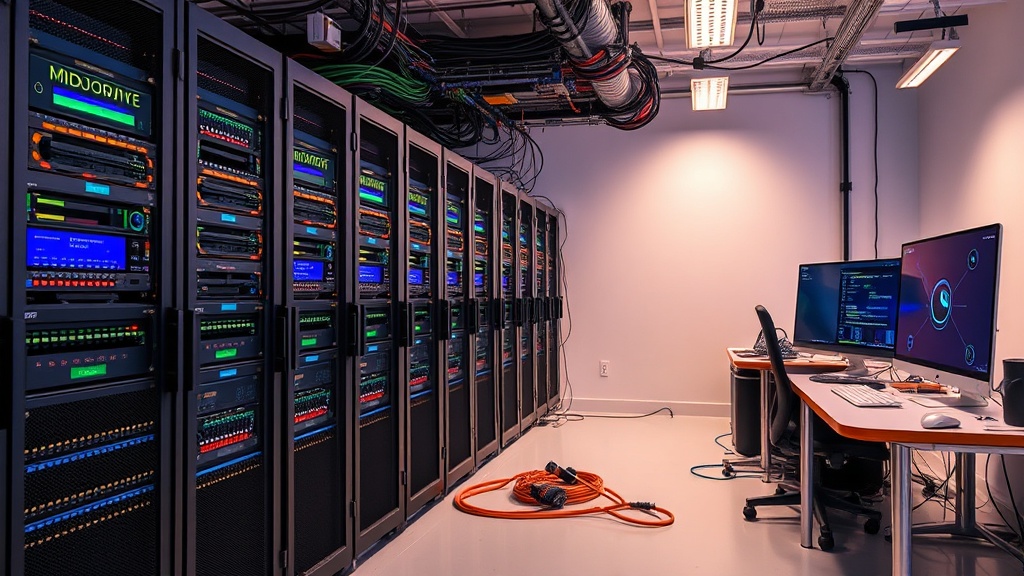
The footage, shared via a YouTube link originating from a Hacker News discussion, demystifies the process. It reveals rows upon rows of high-performance computing hardware, humming in a data center environment. This isn't a cloud service being accessed; it's the tangible reality of the computational might required to train and run massive diffusion models like those powering Midjourney. The sheer scale suggests a significant investment in dedicated infrastructure, a stark contrast to the abstract, ethereal nature of the art it produces.
Hardware Deep Dive: Beyond the GPU
While GPUs are the undisputed workhorses of AI training and inference, the Midjourney setup highlights that they are only one piece of a much larger puzzle. The video reveals dense arrays of NVIDIA GPUs, likely the latest generations, interconnected with high-speed networking fabrics such as InfiniBand. This is critical for distributed training and efficient inference, allowing multiple GPUs to communicate and share data with minimal latency. Without this high-bandwidth interconnect, the training process for models of Midjourney's complexity would be prohibitively slow.
Beyond the GPUs, the system also requires robust CPU clusters, massive amounts of RAM, and fast, local storage. These components are essential for data preprocessing, model loading, and managing the complex workflows involved in generating images. The video implicitly points to the challenge of balancing these different hardware components to avoid creating new bottlenecks. It’s akin to a high-performance race car; you can have the most powerful engine, but if the tires or transmission can’t keep up, the overall performance suffers.
Software Orchestration: The Art of the Possible
Running such a large-scale operation requires sophisticated software orchestration. While the video doesn't delve into specific software names, it implies the use of distributed computing frameworks, containerization technologies (like Docker or Kubernetes), and custom-built scheduling systems. These tools are necessary to manage job queues, allocate computational resources dynamically, monitor hardware health, and ensure the smooth flow of requests from users to the processing units and back.
The complexity of managing thousands of concurrent image generation requests, each with unique parameters and resource demands, is immense. The software stack must handle everything from parsing user prompts and selecting appropriate model checkpoints to rendering the final images and delivering them to the user’s Discord interface. This level of operational efficiency is what allows Midjourney to serve a global user base with relatively quick turnaround times, despite the computationally intensive nature of the task.
The Cost and Commitment of AI Art
This behind-the-scenes look provides a tangible understanding of the significant capital expenditure and operational expertise required to run a leading AI image generation service. It’s not merely about having brilliant AI researchers; it’s about building and maintaining a sophisticated, high-performance computing cluster. This infrastructure is the bedrock upon which the creative capabilities are built. The sheer amount of power and cooling required, not to mention the ongoing maintenance and upgrades, represents a substantial ongoing operational cost.
What remains unaddressed by this glimpse is the specific strategy Midjourney employs for scaling. Are they building out their own data centers, or are they heavily leveraging specialized cloud providers? The video suggests a significant on-premise footprint, which could offer greater control and potentially lower costs at scale, but also introduces the challenges of managing physical hardware, power, and cooling. This infrastructure investment also signals a long-term commitment to the generative AI space, moving beyond experimental phases into robust, production-grade service delivery.
Implications for the Generative AI Landscape
The existence and visible operation of such dedicated hardware infrastructure by Midjourney has several implications. Firstly, it underscores the reality that cutting-edge generative AI, at scale, is an infrastructure-heavy business. This could present a barrier to entry for smaller startups or those relying solely on general-purpose cloud compute, which may not be optimized or cost-effective for sustained, high-volume AI inference. Secondly, it suggests a strategic decision to control a critical part of their value chain, potentially leading to better performance, lower costs, and greater flexibility than a fully outsourced cloud model.
For users, this means that the speed and quality of the art they receive are directly tied to the physical limitations and operational efficiency of this complex hardware and software system. It also highlights the environmental considerations of running such compute-intensive operations, though the video itself does not touch upon these aspects. The transparency, however limited, is a valuable insight into the real-world engineering that makes AI art a reality, moving the conversation beyond just the models themselves to the engines that power them.