
Benchmarking Generative Image Models
Meta recently launched its Muse Image model, a new contender in the rapidly evolving field of generative AI for image editing. To understand its capabilities, a user on Reddit's r/artificial community conducted an informal benchmark, pitting Muse Image against established models from OpenAI (gpt-image-2) and Google (Nano Banana 2). The experiment focused on a series of progressive image manipulation tasks, starting with simple edits and escalating to more complex challenges.
The core of the test involved a single source image: a duck. This image was subjected to a consistent sequence of eight editing instructions across all models. The sequence was designed to progressively increase in difficulty, testing the models' ability to maintain context, accurately apply edits, and handle nuanced requests. The instructions were:
- Unchanged (base image)
- Edit to blue
- Turn face away
- Add glasses
- Render as wireframe
- Place a hat on the ball
- Add the text "FRENZY"
- Place the duck on a mirror with a correct reflection
Each model was run three times to account for potential variability in output. The results were then evaluated using a fixed 27-point scoring rubric. The critical question posed by the user was simple: can you identify which row of results belongs to Meta's new Muse Image model?
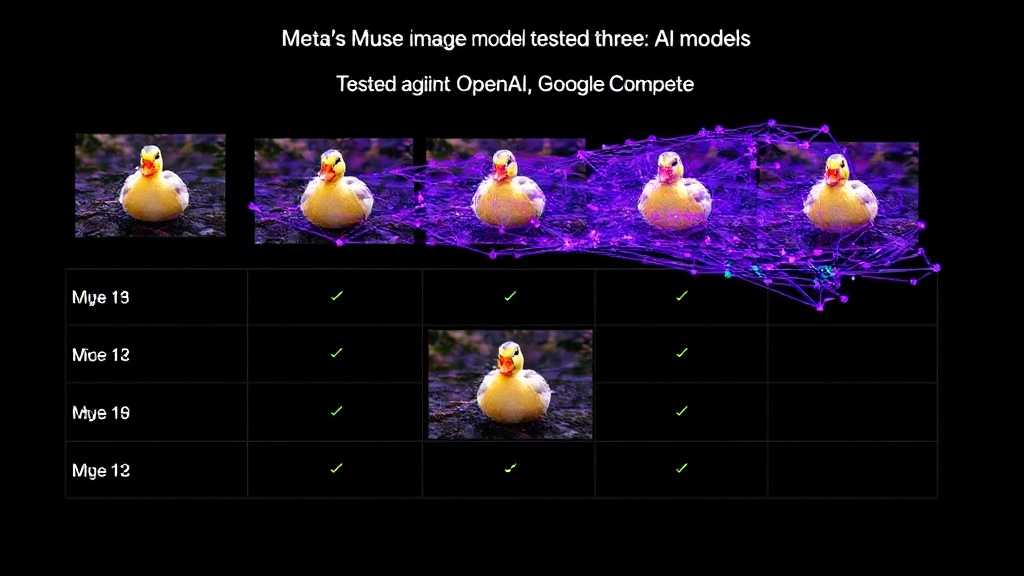
The Challenge of Progressive Editing
Generative image models excel at various tasks, from creating novel imagery to performing specific edits. However, their ability to handle complex, multi-step editing sequences is a key differentiator. The difficulty increases with each step for several reasons. First, the model must accurately interpret the instruction and apply it to the existing image. Second, subsequent edits must build upon the previous modifications without undoing or corrupting them. For example, adding glasses to a duck whose face has already been turned away requires understanding the new orientation and perspective.
The instruction to add the text "FRENZY" tests the model's text rendering capabilities within an image, a task many models still struggle with, often producing distorted or nonsensical characters. Finally, the request for a duck standing on a mirror with a correct reflection combines object placement, perspective, and the complex physics of reflection. This final step is a rigorous test of spatial reasoning and photorealism.
The 27-point rubric likely assessed various aspects of each edit, such as accuracy of application, fidelity to the original image's style where appropriate, and the overall coherence of the final image. Points could be awarded for correctly executing each step, for the quality of the generated elements (like the text or glasses), and for the plausibility of the final scene. The progressive nature of the edits means that errors compound; a failure at an early stage can make subsequent steps impossible to execute correctly.
This type of comparative testing is invaluable for developers and users alike. It moves beyond qualitative descriptions of model capabilities and provides a more objective measure of performance on specific, challenging tasks. For Meta, understanding where Muse Image falls short compared to competitors like OpenAI's and Google's offerings is crucial for future development and for setting user expectations.
Implications for Generative Image Technology
The performance of these models on such a structured benchmark reveals insights into their underlying architectures and training methodologies. Models that perform well on complex, sequential edits often demonstrate a better understanding of image context and a more robust internal representation of objects and scenes. The ability to correctly render reflections, for instance, suggests a sophisticated grasp of geometry and light.
The reveal of which model belongs to whom will offer a clearer picture of Meta's progress in this domain. If Muse Image performs exceptionally well, it signals a significant leap forward for Meta's AI research. Conversely, if it lags behind, it highlights areas where further innovation is needed. The competition in generative AI is fierce, with companies constantly pushing the boundaries of what's possible. Benchmarks like this, even informal ones, provide a vital snapshot of the current state of the art and the direction of travel.
What remains to be seen is how Muse Image scales beyond these specific editing tasks. Its ability to generate entirely new images from text prompts, its speed, and its computational requirements are all critical factors for its adoption. This duck test, however, provides a focused look at its fine-tuning and editing prowess. The user's initiative in setting up this controlled experiment underscores the community's role in evaluating and understanding these powerful new tools.