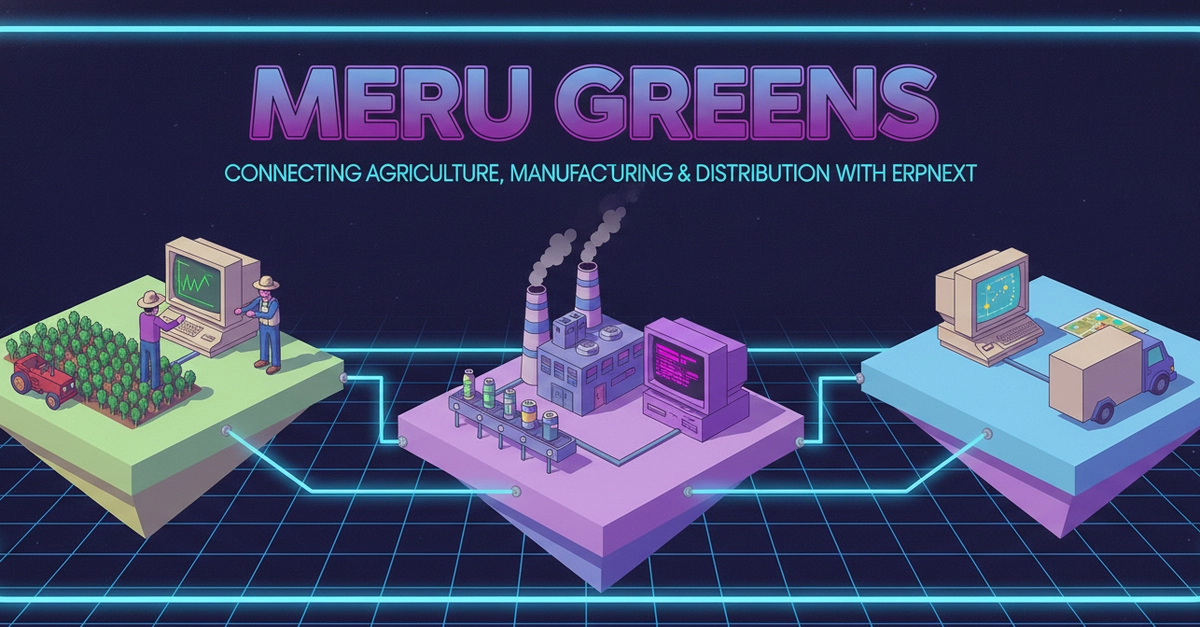
Bridging the Gap: From Farm to Fork with ERPNext
Agricultural businesses, especially at scale, face a complex web of interconnected operations. What appears as a simple cycle of planting, harvesting, and selling quickly escalates into intricate processes involving hundreds of farmers, multiple growing regions, diverse crop cycles, precise input management, stringent quality inspections, extensive warehousing, multi-stage manufacturing, customer-specific product variations, detailed sales orders, and demanding export regulations. Meru Greens Horticulture, a Kenyan agricultural enterprise, offers a compelling real-world case study of how these disparate elements can be unified. Their implementation of ERPNext, spearheaded by Kenyan partner Navari, successfully integrated agriculture, supply chain, manufacturing, quality control, sales, inventory, accounting, and HR functions into a cohesive operational system.
The challenge for businesses like Meru Greens is not just managing individual tasks but ensuring seamless data flow and visibility across the entire value chain. Without a unified system, information silos emerge, leading to inefficiencies, errors, and a lack of real-time insight. This can manifest as inventory discrepancies, delayed order fulfillment, poor quality control, and difficulties in financial reconciliation. For an export-oriented business, these operational gaps can have significant consequences, impacting compliance, customer satisfaction, and profitability.
The decision to adopt an Enterprise Resource Planning (ERP) system like ERPNext was driven by the need to address these complexities directly. ERPNext, an open-source ERP solution, provided Meru Greens with a flexible and customizable platform capable of handling the unique demands of their industry. The implementation focused on bringing together critical modules to create a single source of truth for the business.
Integrating Core Agricultural Operations
At the heart of Meru Greens' operation is its agricultural production. The ERPNext implementation focused on digitizing and integrating key farming activities. This included managing planting schedules, tracking crop cycles, and meticulously recording all inputs such as fertilizers, pesticides, and water usage. The system enabled granular tracking of activities on a per-farm or per-field basis, allowing for better yield prediction and cost analysis. Quality control, a paramount concern in horticulture, was embedded directly into the agricultural workflow. Inspections at various stages, from planting to pre-harvest, were recorded, ensuring that only produce meeting specific standards proceeded to the next phase. This proactive quality management is crucial for maintaining brand reputation and meeting buyer specifications, especially for international markets.
The system also facilitated the management of a large network of outgrower farmers. By integrating these external suppliers into the ERP, Meru Greens could standardize processes, ensure consistent quality, and manage payments more efficiently. This not only benefits Meru Greens by securing a stable supply of raw materials but also provides a framework for supporting and developing its farmer network. The ability to track produce from its origin, including the specific farm and planting details, provides invaluable traceability, a critical requirement for many export markets and a key differentiator in the food industry.
Streamlining Post-Harvest and Manufacturing
Once harvested, the produce enters a critical phase of processing and manufacturing. ERPNext's manufacturing module was configured to manage these stages. This involved tracking raw material consumption, labor, and overhead costs associated with processing activities such as washing, sorting, grading, and packaging. The system's inventory management capabilities became vital here, ensuring that raw materials were available when needed and that finished goods were accurately accounted for. This prevented bottlenecks in the production line and minimized wastage.
A significant aspect of Meru Greens' operation is the ability to handle customer-specific product variants. Whether it's a particular size, grade, or packaging requirement for a specific export order, ERPNext allowed for the configuration of these variations. This meant that production could be directly linked to sales orders, ensuring that the right product, in the right format, was being manufactured. The system's Bill of Materials (BOM) functionality was likely crucial in defining the components and processes required for each product variant, ensuring consistency and accuracy in manufacturing.
Connecting Sales, Distribution, and Finance
The integration extended seamlessly into the sales and distribution phases. Sales orders, whether from domestic clients or international buyers, were entered into the system and directly linked to production and inventory. This provided real-time visibility into order status, enabling accurate delivery estimates and proactive communication with customers. The distribution module managed the logistics of getting the finished products to their destinations, including warehousing and shipment tracking.
Crucially, all these operational activities were linked to the financial and accounting modules. This means that costs incurred at each stage – from farm inputs to manufacturing and distribution – were captured and allocated correctly. Revenue from sales orders was directly recorded, providing a clear picture of profitability for different products, markets, or even individual crop cycles. This end-to-end financial visibility is a core benefit of an integrated ERP system, allowing for better financial planning, performance analysis, and compliance. The HR module likely supported payroll and employee management, further consolidating administrative functions within the ERP.
The Impact of Integration
The implementation of ERPNext by Meru Greens, facilitated by Navari, demonstrates a powerful strategy for modernizing agricultural businesses. By connecting agriculture, manufacturing, and distribution operations within a single, integrated system, the company achieved enhanced operational efficiency, improved quality control, greater traceability, and more accurate financial management. The move from fragmented processes to a unified ERP platform transforms how a business operates, providing the agility and insight needed to thrive in competitive global markets. This case highlights the potential of open-source ERP solutions to provide robust, scalable, and cost-effective solutions for complex industries.