Mercury 2.5: A New Speed Standard for LLMs
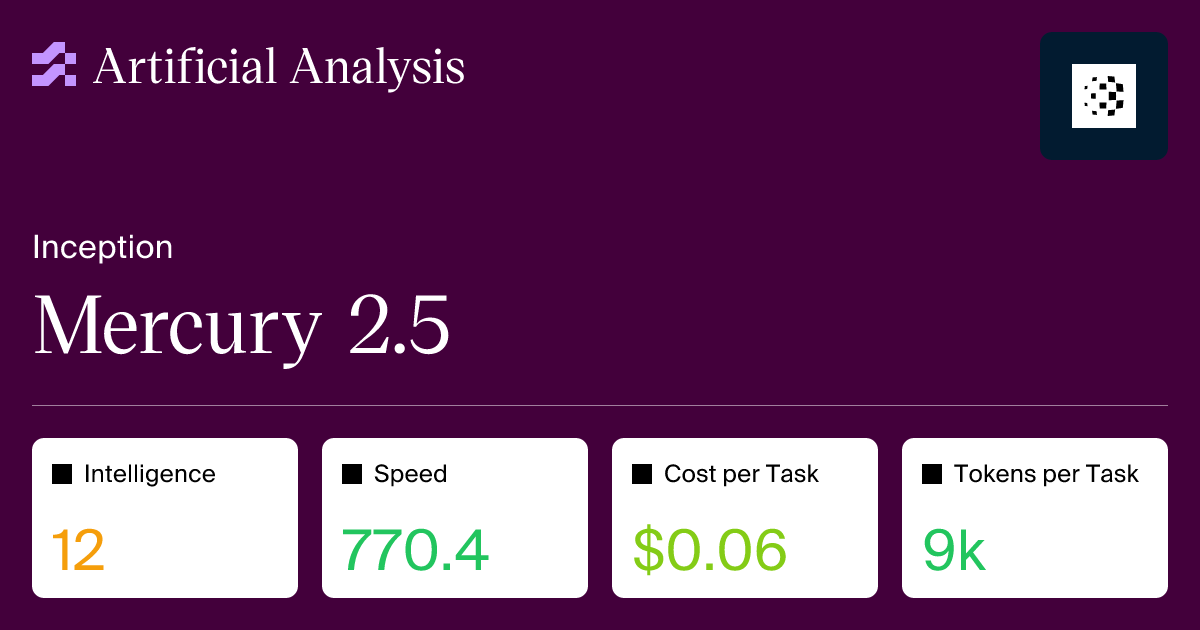
The artificial intelligence landscape is in constant flux, with new models and optimizations emerging at an unprecedented pace. Today, a significant advancement comes from the release of Mercury 2.5, a large language model (LLM) that has demonstrated an impressive inference speed of 770 tokens per second. This figure represents a substantial leap forward, potentially impacting how developers and researchers deploy and utilize LLMs for real-time applications.
Achieving such high throughput is not merely an incremental improvement; it signifies a fundamental shift in what is computationally feasible for complex AI models. For context, many contemporary LLMs operate in the tens or low hundreds of tokens per second during inference. Mercury 2.5's performance places it in a new tier, enabling applications that were previously constrained by latency and processing power.
The implications of this speed are far-reaching. Consider applications like real-time conversational agents, dynamic content generation for interactive experiences, or even sophisticated code completion tools. Historically, these have been hampered by the time it takes for an LLM to process a request and generate a response. A model that can output 770 tokens per second can provide near-instantaneous feedback, dramatically enhancing user experience and opening doors for new interaction paradigms.
This leap in performance is likely the result of a combination of architectural innovations and highly optimized inference techniques. While specific details regarding the model's architecture and training methodologies are not fully disclosed in the initial announcement, the achieved throughput suggests a deep understanding of transformer model efficiency, quantization, and potentially specialized hardware acceleration. The team behind Mercury 2.5 has clearly prioritized inference speed, a critical factor for production-ready AI deployments.
Benchmarking and Comparison
To truly appreciate the significance of 770 tokens per second, it's essential to place it within the current LLM performance spectrum. Many popular open-source models, when run on comparable hardware configurations without aggressive optimization, might achieve anywhere from 20 to 150 tokens per second. Even highly optimized versions of well-known models often top out in the low hundreds. Mercury 2.5's figure is therefore several times faster than many existing benchmarks.
This performance jump is akin to going from a dial-up modem to fiber optic internet for AI communication. The difference isn't just faster data transfer; it's the ability to perform tasks that were simply not practical before. Imagine a customer service chatbot that can access and synthesize information from a vast knowledge base and respond coherently in milliseconds. Or a creative writing assistant that can generate multiple narrative branches for a user to explore in real-time, making the creative process feel fluid and responsive.
The specific hardware used for this benchmark is a crucial piece of information that will be keenly scrutinized by the community. Achieving 770 tokens per second on consumer-grade hardware would be earth-shattering. More likely, this performance was achieved on high-end server-grade GPUs, possibly with specialized configurations or distributed computing setups. Nevertheless, the raw capability of the model itself, independent of the precise hardware, is a significant indicator of its efficiency and design.
Potential Applications and Future Implications
The most immediate beneficiaries of Mercury 2.5's speed will be developers building latency-sensitive applications. This includes:
- Real-time Chatbots and Virtual Assistants: Enabling natural, fluid conversations without noticeable delays.
- Interactive Storytelling and Gaming: Generating dynamic narratives and in-game content on the fly.
- Live Translation Services: Providing near-instantaneous translation for spoken or written language.
- Code Generation and Assistance: Offering developers faster, more responsive code suggestions and autocompletion.
- On-device AI: Potentially enabling more powerful LLM capabilities on edge devices if the model can be further optimized for size and power efficiency.
The increased speed also has profound implications for research. Faster inference means researchers can iterate more quickly on experiments, test more hypotheses, and explore larger parameter spaces within reasonable timeframes. This could accelerate the discovery of new AI techniques and applications. It also lowers the barrier to entry for deploying advanced AI, as the cost per token processed may decrease significantly with such high throughput.
However, the question remains: what is the trade-off? High speed often comes at a cost, whether it's reduced accuracy, a smaller context window, or increased computational requirements for training. Without further details on Mercury 2.5's performance across a broader range of metrics, it's difficult to fully assess its viability for all use cases. The surprising detail here is not just the headline speed, but how this speed is maintained across diverse tasks and with what level of fidelity. We are still awaiting a comprehensive report that details its performance on standard benchmarks like MMLU, HellaSwag, and others, alongside its actual token generation rate.
If Mercury 2.5 can maintain its impressive speed without significant compromises in accuracy or capability, it could become the go-to model for a wide array of applications. It represents a significant step toward making powerful AI more accessible and practical for everyday use. The challenge now lies in understanding the full picture of its capabilities and limitations, and for the community to explore its potential in novel applications.