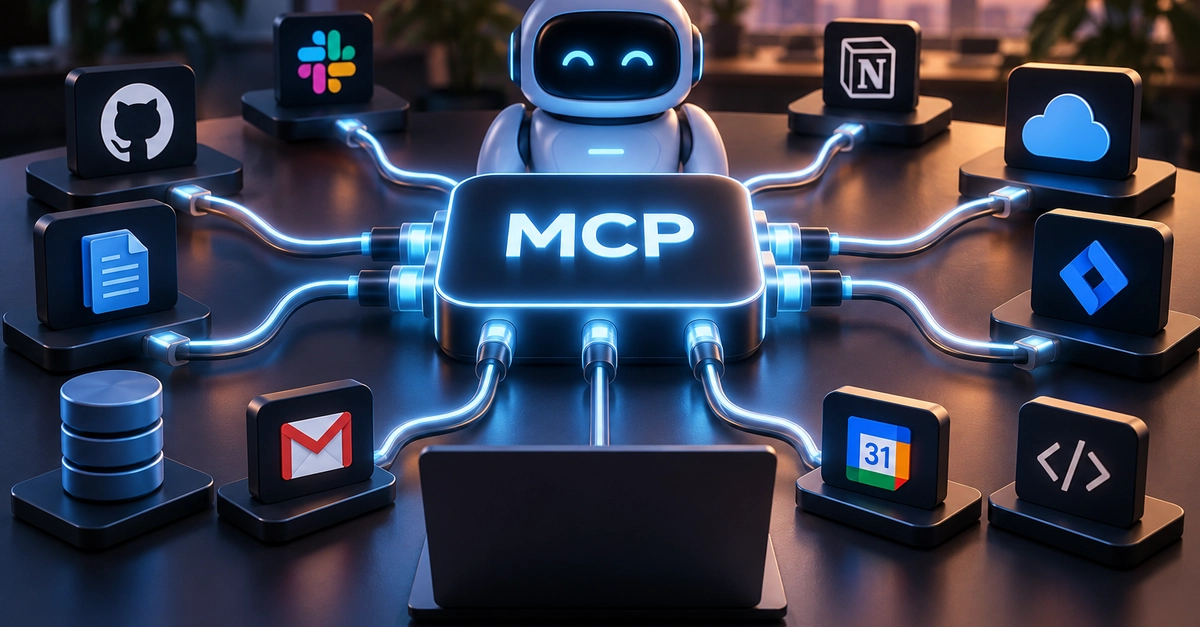
The N×M Problem in AI Integration
Building AI-powered features often hits a roadblock: intelligent models are disconnected from the real-world data and systems they need to act upon. Traditionally, connecting an AI to a new file system, ticketing platform, or internal API meant writing custom integration code for each specific pairing. This is commonly known as the N×M problem, where N represents AI applications and M represents external tools or data sources. Each of the N×M potential connections requires a unique integration, leading to significant development overhead and complexity.
The Model Context Protocol (MCP) emerges as a solution to this pervasive challenge. It's an open standard designed to simplify how AI applications interact with the vast ecosystem of external tools and data. Instead of building a bespoke connector for every AI-tool combination, MCP provides a single, shared protocol that enables AI applications to discover and invoke these external resources. This drastically reduces the engineering effort required to embed AI capabilities into existing workflows and systems.

What is the Model Context Protocol (MCP)?
At its core, MCP is an open standard that defines a universal language for AI applications to communicate with external tools and data sources. It allows AI agents to dynamically discover available tools, understand their capabilities, and invoke them programmatically. This eliminates the need for developers to write and maintain separate integration layers for each AI model and each external service.
Think of MCP less like a direct API call and more like a universal remote control for your AI. Instead of learning a new button layout for every TV, every streaming box, and every soundbar, the MCP-enabled AI knows how to find the right 'channel' or 'function' on any connected device through a standardized interface. This abstraction layer is key to its power.
The protocol specifies how AI applications can:
- Discover Tools: Identify available external tools and their functionalities.
- Describe Capabilities: Understand what each tool can do, its inputs, and its outputs.
- Invoke Tools: Send requests to tools with the correct parameters.
- Receive Results: Process the responses from invoked tools.
This structured approach ensures that AI models can access and utilize a wide range of functionalities without needing explicit, hardcoded knowledge of each individual tool's API. The protocol standardizes the interaction, making integrations more robust and easier to manage.
Connecting Your First AI Tool with MCP
Getting started with MCP involves setting up an MCP server that acts as an intermediary between your AI application and the external tool. This server exposes the tool's functionality via the MCP standard.
Setting Up an MCP Server
The process typically begins with defining the schema for your tool. This schema describes the tool's capabilities, including the functions it offers, the parameters each function accepts, and the type of data it returns. Many MCP server implementations provide frameworks or libraries to help generate this schema based on your existing code or definitions.
For instance, if you have a Python function that reads a PDF file, your MCP server schema would define a `read_pdf` function, specifying that it takes a `file_path` string as input and returns `file_content` as a string. The MCP server then translates these schema definitions into the protocol's communication format.
Once the schema is defined, you implement the server-side logic. This involves writing code that receives MCP requests, parses them, calls the actual underlying tool function (e.g., your Python PDF reader), and formats the results back into an MCP-compliant response. Libraries and SDKs are available for various programming languages to simplify this server implementation.
Integrating with an AI Application
With the MCP server running and exposing your tool, the next step is to connect an AI application. An AI application that is MCP-aware can query the MCP server to discover available tools. Upon discovering your PDF reader, the AI can then formulate a request to read a specific PDF file.
The AI sends a request to the MCP server, specifying the tool and function to call, along with the necessary arguments (the file path). The MCP server receives this request, executes the `read_pdf` function on the server, and returns the PDF content to the AI. This content can then be used by the AI for further processing, analysis, or action.
The beauty of this architecture is that the AI doesn't need to know the intricacies of how the PDF is read or where the file is stored. It only needs to know that an MCP-compliant tool exists and what its interface looks like. This decoupling is what makes MCP so powerful for scaling AI integrations.
The Future of AI Tool Integration
MCP represents a significant step towards a more interconnected AI ecosystem. By providing a standardized protocol for tool discovery and invocation, it lowers the barrier to entry for integrating AI into a wider array of applications and workflows. This standardization promises to accelerate AI development and adoption, allowing developers to focus more on building intelligent features rather than wrestling with integration complexities.
The open-standard nature of MCP means it can evolve with the needs of the AI community. As new types of tools and data sources emerge, MCP can be extended to accommodate them, ensuring its continued relevance. For businesses and developers alike, embracing MCP means building more adaptable, scalable, and powerful AI solutions. The days of writing custom glue code for every new AI integration are numbered.