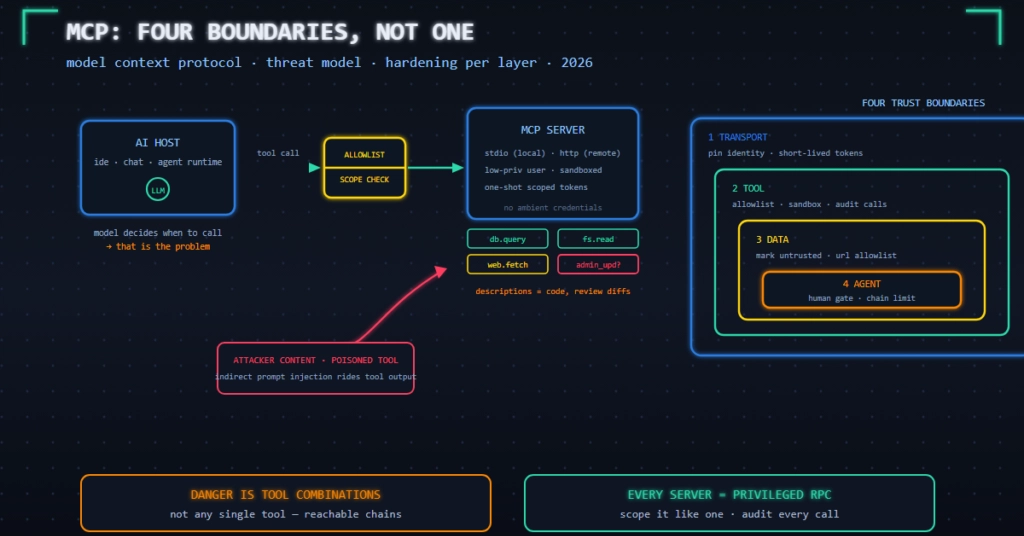
The MCP Attack Surface: Beyond a Single Boundary
The Model Context Protocol (MCP) has become the de facto standard for AI applications to interact with external tools and data. Despite its ubiquity, MCP is often the least-audited component in an AI stack, presenting significant security risks. This guide breaks down MCP's attack surface, revealing it not as a single trust boundary, but as four distinct layers that require individual attention and hardening.
Understanding these boundaries is critical for anyone deploying AI applications. The core insight is that MCP's security is not a monolithic problem. Instead, it's a distributed challenge across different interaction points. Ignoring any one of these can leave your AI application vulnerable to unauthorized access, data exfiltration, or malicious code execution.
The Four Trust Boundaries of MCP
MCP's attack surface can be precisely mapped into four critical areas:
1. Transport (Host ↔ Server)
This boundary concerns the communication channel between the host system running the AI model and the server hosting the tools or data it needs to access. It encompasses network security, authentication, and data encryption during transit. Vulnerabilities here can lead to man-in-the-middle attacks, eavesdropping, or unauthorized access to the tool server.
2. Tool Surface (Model ↔ Capability)
This is the interface through which the AI model invokes specific capabilities or tools. It involves how the model's requests are parsed, validated, and executed by the tool. A common attack vector is prompt injection, where malicious input tricks the model into executing unintended commands or revealing sensitive information about the tool's functionality.
3. Data Path (Tool Output ↔ Model Context)
This boundary relates to how the output from a tool is processed and integrated back into the model's context. This is a crucial point for data poisoning or leakage. If tool outputs are not sanitized, they could contain malicious payloads or sensitive data that the model then processes, potentially leading to further compromise or exposure.
4. Agent Loop (Planner ↔ Side Effects)
The agent loop involves the AI's ability to plan actions and execute them, often with side effects. This includes the model's understanding of its own capabilities and the potential consequences of its actions. Attacks here can exploit the model's reasoning or planning process to cause unintended side effects, such as deleting data, making unauthorized changes, or initiating malicious operations.
Practical Hardening Checklist for Each Layer
Securing MCP requires a layered approach. Here’s a practical checklist for hardening each boundary:
Hardening the Transport Layer
The most impactful immediate fix is to eliminate ambient credentials on stdio servers. Every server should run as a dedicated, low-privilege identity with scoped, short-lived tokens. This principle minimizes the blast radius if a transport-level compromise occurs. Implement mutual TLS (mTLS) for all communication between the host and the tool server. Regularly rotate credentials and access keys. Use network segmentation to isolate AI components and tool servers.
Hardening the Tool Surface
Input validation is paramount. Sanitize all inputs from the model before they are passed to the tool. Implement strict allow-lists for tool arguments and parameters. Avoid directly executing user-provided code or commands. For complex interactions, consider using a sandboxed execution environment for tools. Regularly review and update the OpenAPI specifications or tool definitions to ensure they accurately reflect intended functionality and security constraints.
Hardening the Data Path
All data flowing from tool outputs back into the model's context must be rigorously validated and sanitized. Implement content filtering to detect and block malicious payloads or sensitive data patterns. Consider using schema validation for tool outputs to ensure they conform to expected structures. Avoid passing raw, untrusted output directly into the model's prompt or context window without processing.
Hardening the Agent Loop
Implement robust guardrails and safety mechanisms to prevent unintended side effects. This includes limiting the scope of actions the agent can perform and requiring explicit confirmation for high-impact operations. Monitor agent behavior for anomalies and deviations from expected patterns. Regularly test the agent's response to adversarial prompts designed to trigger undesirable side effects. Consider implementing a human-in-the-loop for critical decision-making processes.
The Surprising Simplicity of High-Impact Fixes
What is surprising is that the single highest-impact fix for MCP security—killing ambient credentials on stdio servers—is also one of the most straightforward to implement. Running each server as a dedicated low-privilege identity with scoped, short-lived tokens fundamentally reduces the attack surface. This approach, often overlooked in favor of more complex solutions, offers a disproportionately large security benefit by adhering to the principle of least privilege at the network and service level.
Unanswered Questions on Future MCP Security
While this guide provides a solid foundation for hardening current MCP deployments, significant questions remain. What happens to the vast number of existing AI applications that have already adopted MCP without these security considerations? How will future iterations of MCP evolve to incorporate security by design, rather than treating it as an add-on? The ongoing development of AI security best practices will need to address these challenges proactively.