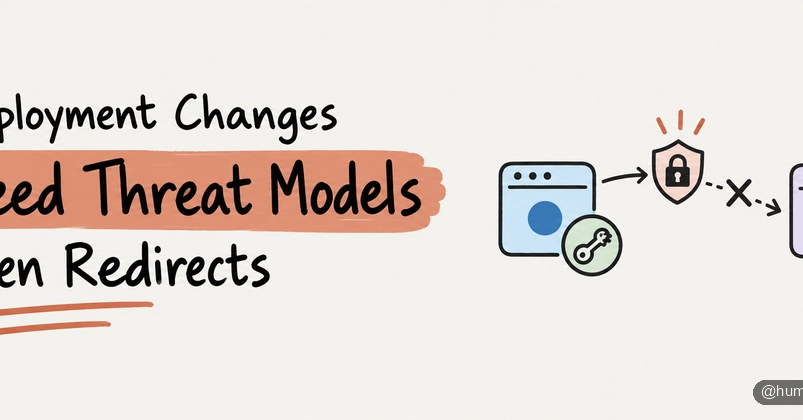
Hardening the MCP Client: A Critical Security Update
The recent release notes for the MCP Python SDK introduced a change that warrants a closer look: clients on version 2.x now restrict HTTP redirects. Specifically, these redirects are only followed when they remain within the endpoint’s origin. This is not a minor tweak; it’s a deliberate hardening of the client’s threat model, addressing a subtle yet significant attack vector.
Historically, HTTP redirects have been a convenient feature, allowing servers to gracefully guide clients to new locations. However, this convenience comes with inherent risks, particularly in security-sensitive contexts like client-server communication for sensitive data or authenticated sessions. A redirect can, in essence, trick a client into communicating with a server it was not initially configured to trust. If a client blindly follows a redirect, it might inadvertently expose authenticated session data, OAuth state parameters, or critical tool-discovery requests to a malicious server masquerading as a legitimate one.
The Redirect Vulnerability Explained
Consider a scenario where a client application communicates with a trusted API endpoint. This API might, for various legitimate reasons, issue an HTTP redirect (e.g., a 301 Moved Permanently or 302 Found). Without proper safeguards, a compromised or malicious server could craft a redirect response pointing to an entirely different domain or subdomain. If the client blindly follows this redirect, it could then transmit sensitive information – such as API keys, session tokens, or user credentials embedded in subsequent requests – to this untrusted destination. This is akin to a trusted courier being subtly rerouted by a con artist to deliver a valuable package to a fake address.
The MCP (Message Communication Protocol) is often used in environments where secure and reliable communication is paramount, such as financial services or critical infrastructure. The potential for a redirect to be exploited means that an attacker could potentially intercept or manipulate data flows, leading to unauthorized access, data exfiltration, or service disruption. The previous behavior, which allowed clients to follow redirects to any origin, presented a latent risk that has now been proactively addressed.
Understanding the New Default Behavior
The MCP Python SDK version 2.x introduces a more secure default: redirects are only permitted if the new location specified in the `Location` header falls within the same origin as the original URL. An origin is defined by the combination of scheme (e.g., `http`, `https`), host (e.g., `example.com`), and port (e.g., `80`, `443`). If a redirect attempts to change any of these components, the MCP client will now refuse to follow it.
This change significantly reduces the attack surface. By enforcing that redirects stay within the established origin, the SDK ensures that the client continues to communicate with the server it was initially configured to trust. This prevents attackers from diverting traffic to malicious servers, even if they can influence the redirect response. It’s a robust defense-in-depth measure that aligns with secure coding practices.
Implications for Developers and Users
For developers currently using or planning to use the MCP Python SDK, this update is largely beneficial. The default behavior is now more secure, requiring no immediate action for most use cases. However, it’s crucial to understand this change, especially if your application relies on legitimate cross-origin redirects.
If your existing architecture involves legitimate cross-origin redirects that are essential for your application’s functionality, you will need to adapt. The SDK likely provides configuration options to override this default behavior or to explicitly allow specific redirects. Developers should consult the updated SDK documentation to understand how to manage these scenarios. This might involve configuring a list of allowed redirect targets or implementing custom logic to validate redirects before allowing the client to follow them. The key takeaway is that while the default is safer, it might require explicit configuration for specific, legitimate workflows.
This shift in the MCP SDK’s redirect handling is a clear signal of the evolving threat landscape and the increasing importance of considering even seemingly innocuous HTTP features as potential attack vectors. By treating redirects as an integral part of the threat model, the SDK maintainers have taken a proactive step to protect their users.
Beyond the SDK: A Broader Security Context
The decision to harden redirect handling in the MCP Python SDK is part of a broader trend in the software development community to adopt more secure defaults and to meticulously analyze the threat models of common protocols and features. Features that were once considered convenient building blocks can, with time and evolving attack techniques, become significant security liabilities. This is particularly true in distributed systems and microservices architectures where inter-service communication is common and can be complex.
The principle extends beyond just HTTP redirects. Developers must constantly be aware of how different components of their systems interact and where potential vulnerabilities might lie. This includes understanding the implications of network protocols, authentication mechanisms, and data serialization formats. The MCP SDK’s update serves as a valuable reminder that security is not a static state but an ongoing process of evaluation and adaptation.
What remains to be seen is how other SDKs and libraries that handle network communication will evolve their default redirect policies. As the benefits of stricter redirect policies become clearer, it is likely that similar changes will be adopted across the ecosystem, further enhancing the overall security posture of networked applications.