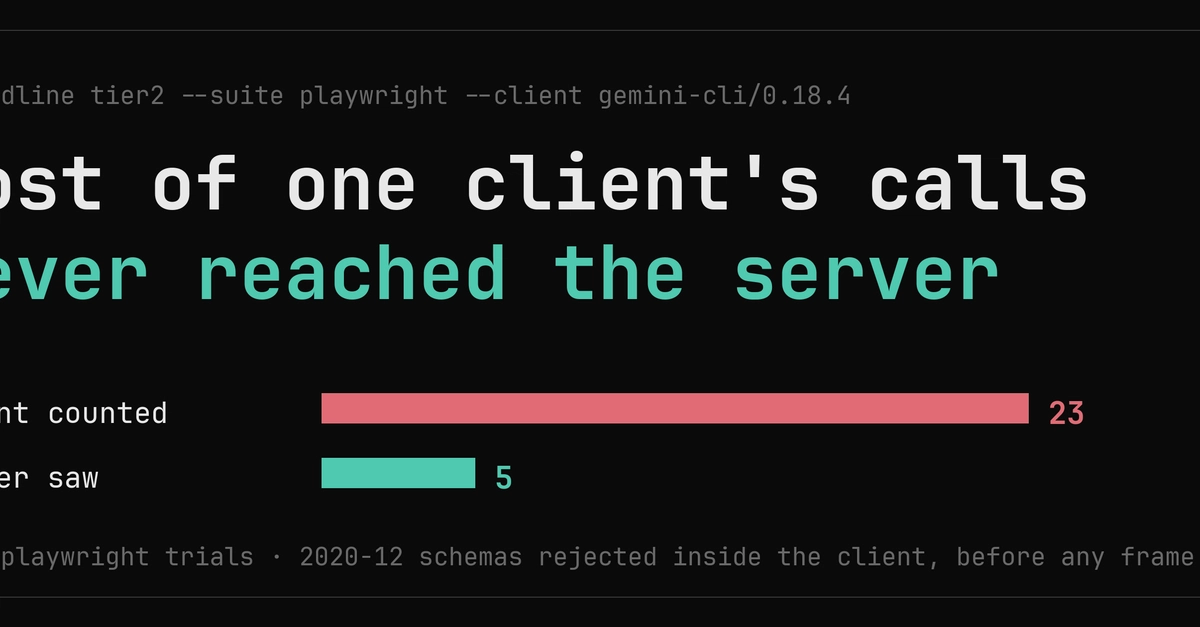
Unexpected Client-Side Failures Masked as Server Issues
In a recent series of tests designed to evaluate the performance and cost of Multiple Context Processing (MCP) servers under real-world client loads, a surprising discovery emerged. The initial goal was to log every frame of 90 trials involving three servers and two clients executing fifteen scripted tasks. However, during the shakedown phase, hours before the main run, a critical client-side issue was identified. One of the clients was failing calls internally, before any data even reached the MCP server. This internal failure mode mimicked the appearance of a model that performed poorly due to low usage or incorrect responses, effectively masking underlying server performance problems.
The setup involved placing a proxy directly on the MCP stdio pipe. This allowed for granular logging and observation of the communication flow between the client and the server. The proxy acted as a silent observer, capturing all interactions and noting where failures occurred. The previous post on August 18, 2026, detailed the cost analysis of MCP servers before agent work, establishing a baseline for this subsequent, more practical test. This new phase aimed to introduce the complexity of actual client interactions and real tasks to gauge performance under more realistic conditions.
The problem surfaced when one client’s calls were not reaching the server at all. From the server's perspective, it appeared as if the client was either not sending requests or was sending faulty ones that were immediately rejected. This behavior could easily lead to misinterpretations about the server’s capacity or responsiveness. Without the proxy, diagnosing such an issue would be significantly more challenging, likely involving extensive server-side logging and network traffic analysis, potentially leading to wasted effort investigating server configurations when the root cause lay elsewhere.
Trial Completion and Failure Analysis
Out of the 90 trials conducted, 87 completed successfully. The three trials that failed did so in distinct ways, highlighting the varied failure modes that can occur even in a seemingly stable system. This suggests that while the core MCP infrastructure might be robust, the integration points and client implementations introduce significant variability.
The specific failure modes observed in the three non-completed trials were:
- Failure Mode 1: A complete breakdown in communication, where the client ceased sending any data, and the proxy logged no outbound traffic for that session. This could indicate a client-side crash or a deadlock scenario.
- Failure Mode 2: The client initiated calls, but the proxy detected malformed requests or incomplete data packets, suggesting an issue with the client’s data serialization or network stack.
- Failure Mode 3: The client sent data, but it never appeared to be processed by the server. This could point to an issue with the proxy itself, the MCP pipe, or a server-side rejection that wasn't properly logged or communicated back to the client.
The matrix of tests included different configurations, utilizing filesystem and playwright, suggesting that the observed failures were not tied to a specific task type but potentially to broader client-server communication protocols or resource management within the client application.
Implications for Performance Testing and Debugging
This finding has significant implications for how performance and reliability are tested in distributed systems, particularly those involving complex client-server interactions like MCP. Relying solely on server-side metrics can be dangerously misleading. When a client fails to transmit a request, it looks like a server problem. This is akin to a restaurant blaming its kitchen staff because a customer never placed an order at the counter. The problem isn't the food preparation; it's the customer interaction itself.
The use of a proxy on the stdio pipe proved invaluable. It acted as an independent arbiter, providing a neutral ground to observe the true state of the communication. Without this middle layer, developers might spend days optimizing server configurations, scaling resources, or debugging complex server-side logic, only to find the bottleneck was a simple failure in the client's outbound request handling.
For developers working with MCP or similar architectures, this underscores the importance of implementing comprehensive client-side logging and error handling. Every stage of the request lifecycle, from initiation to successful transmission, should be meticulously tracked. Furthermore, end-to-end testing frameworks that can simulate client behavior and verify successful server communication are essential. The ability to differentiate between a server that cannot handle a request and a client that cannot send one is paramount for efficient debugging and system optimization.
The specific client that exhibited these internal failures is now a focal point for investigation. Understanding the exact point of failure within its internal processes—whether it's a threading issue, a memory leak causing a crash, a bug in the network library, or a flawed request-building logic—will be key to resolving this. The fact that it appeared to be