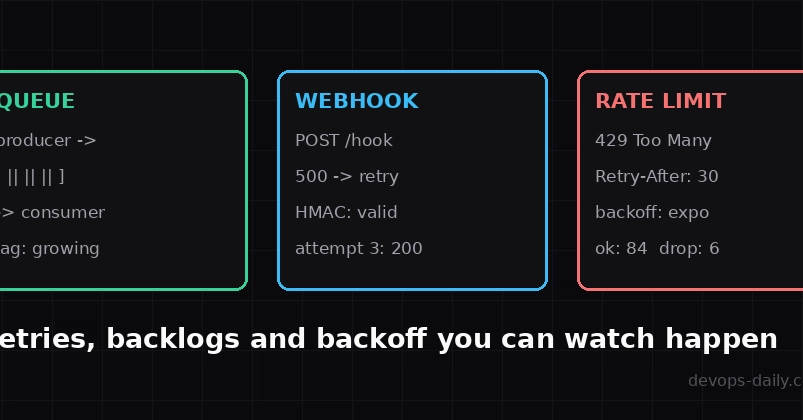
Simulating Asynchronous Delivery Failures
Terms like "at-least-once delivery," "consumer lag," "dead letter queue," and "exponential backoff" are more than just vocabulary; they represent the hidden complexities that lead to production incidents. True mastery comes not just from reading definitions, but from observing these mechanisms in action. Understanding how these systems fail, and more importantly, how they recover, is crucial for engineers aiming for calm during stressful incidents.
Watching these systems fail doesn't require intentionally breaking production. Several free browser-based simulators allow engineers to deliberately induce specific failures and observe the outcomes in a controlled environment. These tools cover three critical legs of asynchronous communication: message passing between services, webhook delivery to external systems, and the ubiquitous rate limits that govern all interactions.
Leg 1: The Message Queue Between Services
The first simulator focuses on the message queues that form the backbone of inter-service communication. This tool models two primary architectural patterns:
- Kafka-style Topics: These support partitioned topics, allowing for high throughput and parallel processing. Understanding how messages are distributed across partitions and how consumers interact with them is key to diagnosing lag and ensuring ordered processing where necessary.
- RabbitMQ-style Exchanges with Queues: This pattern uses exchanges to route messages to specific queues based on routing keys or patterns. It highlights scenarios like message acknowledgment failures, queue overflow, and the behavior of durable vs. non-durable queues.
By simulating failures such as message producer errors, consumer acknowledgment timeouts, or broker unavailability, engineers can observe the formation of backlogs and the eventual behavior of dead-letter queues. This hands-on experience demystifies concepts like consumer lag, which is essentially the growing gap between messages produced and messages processed.
Leg 2: Webhooks and External Integrations
Webhooks are essential for real-time event-driven architectures, allowing services to notify external applications about changes. However, their asynchronous nature and reliance on external systems introduce unique failure modes. The second simulator models the challenges of sending webhooks reliably.
Key failure scenarios include:
- Network Errors: Simulating DNS resolution failures, connection timeouts, or outright network partitions between the webhook sender and receiver.
- Receiver Errors: Mimicking scenarios where the receiving endpoint returns HTTP error codes (e.g., 5xx server errors, 4xx client errors), indicating the webhook could not be processed.
- Throttling: Simulating situations where the receiving service is overwhelmed and responds with rate-limiting headers (e.g., 429 Too Many Requests).
Observing these failures helps engineers understand the necessity of retry mechanisms, the impact of different retry strategies (like exponential backoff), and the importance of idempotency on the receiving end to prevent duplicate processing during retries. The concept of "at-least-once delivery" becomes tangible when you see messages being resent due to transient network issues or processing errors on the other side.
Leg 3: Navigating Rate Limits
Every API, whether internal or external, eventually encounters rate limits. These are designed to protect services from being overwhelmed, but they can become a significant bottleneck if not managed properly. The third simulator focuses specifically on the impact of rate limiting.
This simulator allows users to configure rate limits on an API endpoint and then simulate a high volume of requests from a client. Engineers can observe:
- Throttling Behavior: How the API responds when limits are hit, typically with 429 errors and potentially `Retry-After` headers.
- Client-Side Backoff: The effectiveness of exponential backoff strategies implemented by the client. Observing how a client gracefully backs off its request rate, waits, and then retries can prevent cascading failures.
- Queueing at the Limit: Understanding that even with backoff, requests might still queue up on the server-side or be dropped entirely if there's no buffering mechanism.
This leg of the simulation is critical for anyone building or consuming APIs. It highlights that simply retrying requests immediately after a 429 error is often counterproductive. Instead, a well-implemented backoff strategy, combined with an understanding of the rate limit's parameters (e.g., requests per second, per minute), is essential for maintaining service availability and performance.
Why Watching is Better Than Reading
The true value of these simulators lies in their ability to make abstract concepts concrete. An engineer who has personally configured a retry policy and watched their simulated webhook delivery fail, then succeed after exponential backoff, gains a deeper, intuitive understanding than one who has only read about it. This experiential learning builds confidence and preparedness for real-world incidents.
These simulations are not just for junior engineers. They provide a safe space for experienced developers and operations teams to test their assumptions, validate their retry logic, and benchmark their understanding of distributed system behaviors. By proactively exploring failure modes, teams can build more resilient systems and reduce the time spent firefighting production issues.