The Problem: LLMs Forget, and So Do We
Developers working with large language models (LLMs) frequently encounter a frustrating limitation: context loss. After stepping away from a project for even a few weeks, the intricate reasoning behind architectural decisions or complex code implementations becomes hazy. This isn't solely an LLM problem; it's a human one. When switching between different LLM interfaces like Claude, ChatGPT, or Gemini, the need to re-explain project history and context from scratch is a significant productivity drain. Furthermore, the internal context-compaction mechanisms of these platforms can silently erase details that are crucial for ongoing development, effectively creating a knowledge black hole.
The core issue, as identified by developer etkaozer, is not the capability of the LLMs themselves, but the ephemeral nature of knowledge stored solely within a specific chat session or a proprietary platform. This knowledge remains siloed, failing to persist as a coherent, accessible record that travels with the developer across projects and tools.
Introducing Nexus: An LLM-Agnostic Memory Layer
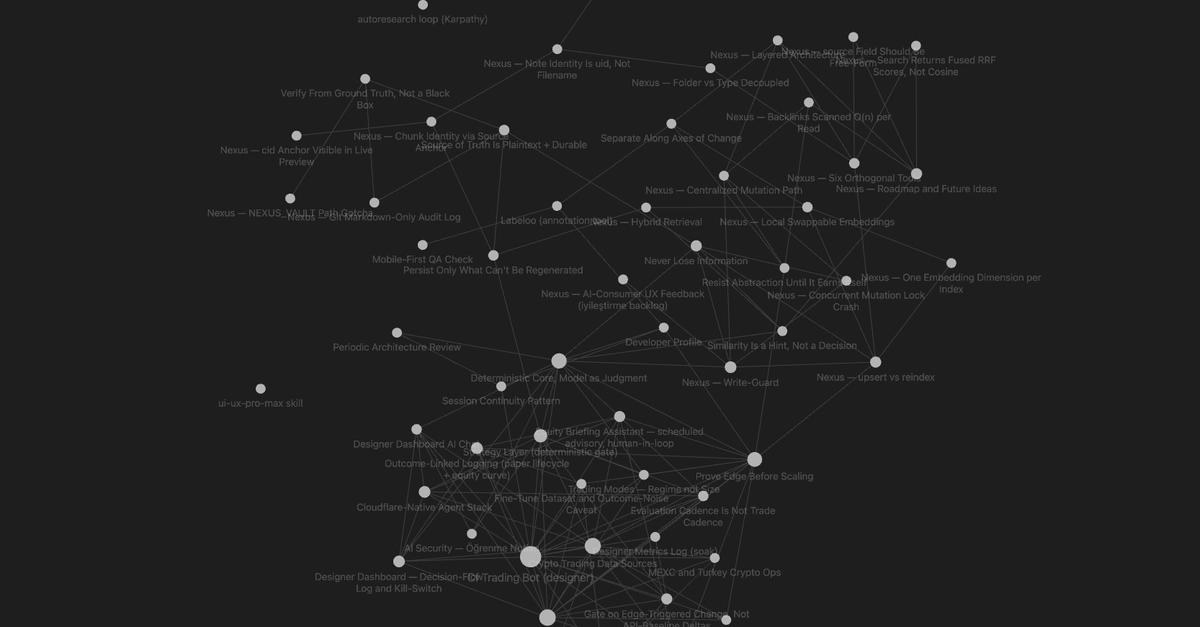
To combat this pervasive context loss, etkaozer developed Nexus, a local, LLM-agnostic memory layer. The fundamental design principle of Nexus is to leverage plain Markdown files as the single source of truth for project knowledge. This approach deliberately decouples the stored information from any single LLM or proprietary note-taking application. The intention is to create a persistent, portable knowledge base that can be rebuilt and referenced by any LLM, ensuring that critical project details are never lost.
Existing solutions, often found as plugins within specific ecosystems like Obsidian, typically suffer from platform lock-in. They might require the host application to be running or are intrinsically tied to that particular tool's architecture. Nexus bypasses these limitations by focusing on a universally compatible format: Markdown. The vision is that the core Markdown files are sufficient to regenerate any necessary indexing or embedding structures, making the entire knowledge system auditable, portable, and future-proof.

Design Principles and Implementation Details
The design of Nexus hinges on several key principles:
- Markdown as the Foundation: All project-specific knowledge, decisions, and rationales are stored in plain text Markdown files. This ensures maximum compatibility and longevity.
- LLM Agnosticism: The system is designed to work with any LLM. The Markdown files serve as the universal input, and the LLM is merely a tool to process, query, or augment this knowledge.
- Rebuildable Indexing: Any auxiliary structures, such as search indexes or vector embeddings, must be derivable directly from the Markdown source. This prevents data loss if these auxiliary structures become corrupted or obsolete.
- Local First: Nexus operates locally, giving users full control over their data and ensuring privacy.
- Simplicity and Extensibility: The goal is a straightforward system that is easy to understand and can be extended with custom tooling as needed.
The implementation strategy involves treating project documentation, architectural diagrams (described in text or linked), meeting notes, and even snippets of code discussions as entries in a growing Markdown repository. This repository then serves as the comprehensive context for any LLM interaction. When a developer returns to a project, they can simply point their chosen LLM to this repository, effectively bringing months or years of project history into the current session.
The Benefits of a Persistent Knowledge Layer
The implications of a system like Nexus extend beyond mere convenience. For individual developers, it means a significantly reduced cognitive load and faster onboarding when returning to past work. The ability to instantly recall the rationale behind decisions eliminates hours of debugging or re-analysis. This persistent memory layer acts as a personalized, intelligent assistant that remembers the project's journey, not just the last few conversation turns.
For teams, Nexus can foster better knowledge sharing and continuity. By establishing a central, accessible repository of project knowledge in Markdown, team members can more easily understand past decisions, onboard new contributors, and maintain a consistent understanding of the project's evolution. This mitigates the risk of knowledge silos forming around individual team members or specific LLM chat histories.
The choice of Markdown is particularly astute. It's a format that is human-readable, easily version-controlled using standard tools like Git, and supports basic formatting that can help structure information logically. This makes the knowledge base not only functional for LLMs but also maintainable and auditable by humans.
Unanswered Questions and Future Directions
While Nexus addresses a critical pain point, several questions emerge regarding its broader adoption and potential evolution. How will such systems scale for very large, complex projects with thousands of Markdown files? What are the most effective strategies for automatically updating and maintaining these Markdown knowledge bases as projects evolve? Furthermore, as LLMs become more sophisticated, will there be a need for richer semantic linking or metadata embedded within the Markdown to optimize context retrieval, or will plain text suffice?
The success of Nexus, and similar approaches, will likely depend on the development of robust tooling that can manage, index, and query these Markdown repositories efficiently. The current implementation, as described, is a foundational step. Future iterations might explore automated summarization, intelligent linking of related Markdown documents, and seamless integration with IDEs and version control systems. The portability and LLM-agnostic nature of the approach, however, position it as a compelling solution for developers seeking to build lasting, accessible knowledge bases in the age of rapidly evolving AI assistants.