Securing Search Infrastructure as an API

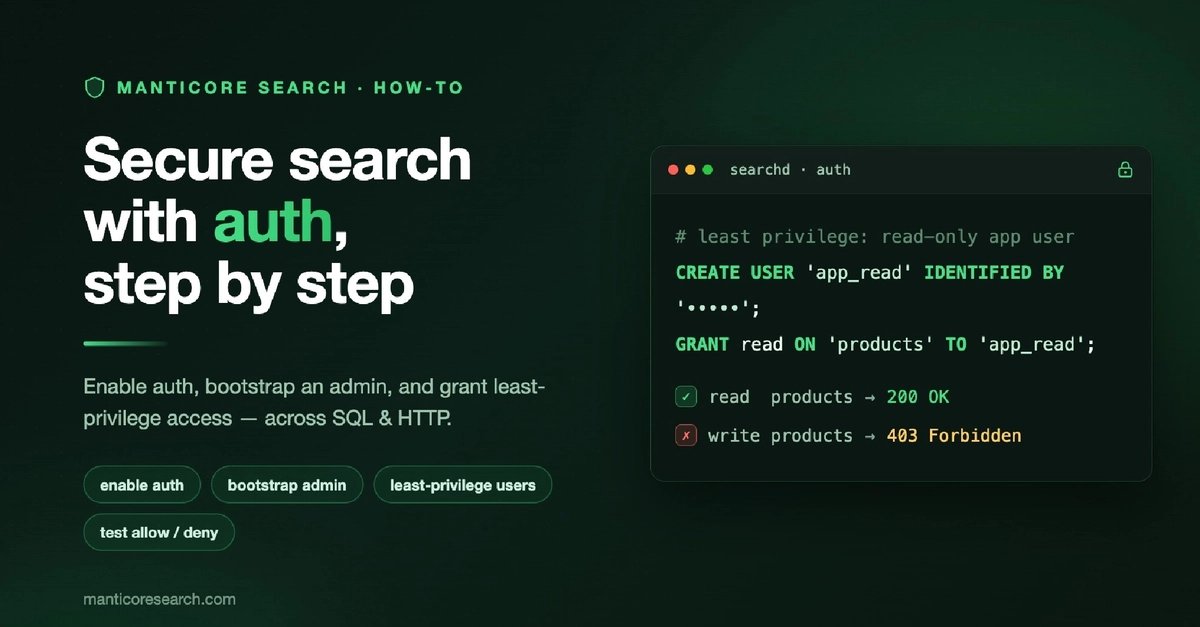
Manticore Search, a popular full-text search engine, has long been a powerful tool for developers. Traditionally, search infrastructure has been treated as a background service, akin to a database. However, as search engines increasingly power user-facing features, handle sensitive data, and integrate directly into application workflows, they demand the security posture of an application API. Manticore Search's latest release, version 27.1.5, directly addresses this need by introducing robust built-in authentication and authorization mechanisms for its SQL, HTTP/HTTPS, and replication interfaces. Authentication addresses the fundamental question: "Who is calling?" It verifies the identity of the user or application attempting to access the search cluster. Authorization, on the other hand, answers: "What is this verified user allowed to do?" This allows for granular control over data access and operational permissions, ensuring that only legitimate users with appropriate privileges can perform specific actions. The significance of this update lies in its ability to provide enterprise-grade security without forcing users into complex external proxy setups or drastically altering their existing workflows. Developers can leverage familiar Manticore Search functionalities and connection patterns with minimal application-side modifications. This approach democratizes access control, making it more accessible for a wider range of Manticore Search deployments, from small projects to large-scale production environments.

Authentication Options for SQL and HTTP

Manticore Search now supports SQL/MySQL password authentication using the widely adopted mysql_native_password mechanism. This means that existing SQL clients and applications configured to use this standard authentication method can connect to Manticore Search securely by providing valid credentials. For HTTP/HTTPS endpoints, the engine supports HTTP Basic Authentication. This common authentication scheme involves sending credentials (username and password) encoded in the HTTP headers, providing a straightforward way to secure API requests.
Manticore Search configuration example for SQL authentication credentials
These built-in authentication methods simplify the security setup considerably. Instead of deploying separate authentication proxies or managing complex network access controls, administrators can configure user credentials directly within Manticore Search. This reduces the attack surface and centralizes security management for the search cluster.

Granular Authorization for Roles and Permissions

Beyond authentication, Manticore Search introduces a role-based access control (RBAC) system. This system allows administrators to define roles, assign specific privileges to these roles, and then assign users to those roles. This is a critical step in moving Manticore Search from a simple data store to a secure, application-like service. Privileges can be granularly defined to control access to specific operations. For instance, a role might be granted the permission to perform read-only queries on a particular index, while another role could have the ability to create and drop indexes, or even manage cluster configurations. This level of control is essential for environments where different teams or applications require varying levels of access to the search data and cluster management functions. The authorization model is designed to be flexible. Administrators can create custom roles tailored to the specific needs of their applications and users. This prevents the over-provisioning of permissions, adhering to the principle of least privilege, which is a cornerstone of robust security practices. For example, a dashboard application might only need read access to aggregated data, while a content management system might require read and write access to specific document types.

Securing Replication and Internal Operations

Security extends to internal Manticore Search operations as well, particularly replication. Replication ensures data redundancy and high availability, but it also involves data transfer between nodes. Manticore Search now allows for the authentication of replication connections. This means that only authorized nodes within the cluster can participate in replication, preventing unauthorized nodes from joining the cluster or intercepting replicated data. This capability is vital for maintaining data integrity and preventing data exfiltration or manipulation through compromised replica nodes. By requiring authentication for replication, Manticore Search ensures that the internal communication channels are as secure as the external API endpoints.

Implications for Developers and Administrators

The introduction of built-in authentication and authorization in Manticore Search 27.1.5 has significant implications. For administrators, it simplifies the deployment and management of secure search clusters. They can now rely on Manticore's native features for access control, reducing the complexity and cost associated with external security solutions. For developers, this means they can integrate Manticore Search into their applications with greater confidence. The ability to define specific permissions for different users or services interacting with the search engine helps in building more secure and compliant applications. Minimal changes are required for existing applications, making the adoption of these new security features relatively seamless. The engine now behaves more predictably and safely, much like any other critical application API. This move positions Manticore Search as a more mature and enterprise-ready search solution, capable of handling sensitive data and complex access control requirements. The focus on providing these features natively, rather than relying on external tools, highlights Manticore's commitment to simplifying the developer experience while enhancing security. If you run a search-intensive application, reviewing your Manticore Search security configuration is now a priority, especially if you are on a version prior to 27.1.5.