The Promise and Peril of Automation
The search for mainframe migration tools often begins with a vendor demonstration that looks, and often is, remarkably convincing. A few thousand lines of COBOL go in, readable Java comes out, the test suite passes, and the slide deck promises 70-80% automation. These demonstrations are usually honest, but they are almost always run against code that behaves nothing like your actual production workload. This disconnect is the first major hurdle in mainframe modernization.
The reality is that mainframe migration tools perform a range of useful functions. They are particularly strong in areas like code analysis, data movement, and mechanical translation. However, their fundamental limitation lies in their inability to understand and replicate the intricate business rules embedded within legacy applications. This is not a minor oversight; it is the core reason why fully automated, 'lights-out' migrations are largely a myth.
Think of it this way: a tool can meticulously translate a recipe from French to English, listing every ingredient and instruction. But it cannot tell you *why* a specific spice is used, or how to adjust the cooking time based on the altitude of your kitchen. That deeper understanding of context and intent is what's missing in automated code conversion.
Categories of Mainframe Migration Tools
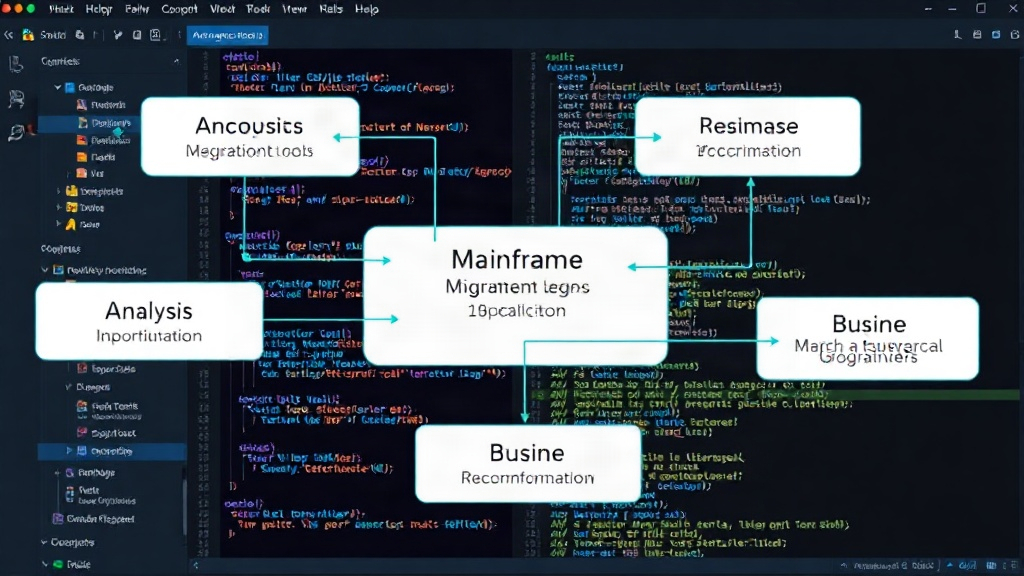
To navigate the landscape effectively, it's crucial to understand the distinct categories of tools available and their respective strengths and weaknesses:
1. Analysis Tools
These tools are invaluable for understanding the existing mainframe environment. They can:
- Inventory Code: Identify all programs, copybooks, JCL, and other artifacts.
- Map Dependencies: Visualize how different programs and modules interact.
- Analyze Complexity: Quantify code size, cyclomatic complexity, and identify dead code.
- Extract Data Structures: Understand the layout and relationships within mainframe databases (e.g., VSAM, IMS, DB2).
Where they excel: Analysis tools provide the essential blueprint for any migration. They offer a clear, data-driven view of the monolithic application, revealing interdependencies that are often opaque to human developers who have only worked with parts of the system.
Where they fail: They cannot interpret the *purpose* of the code. They can identify a calculation, but not the business logic that dictates that calculation. They can map a data call, but not the business decision that triggers it.
2. Data Migration Tools
Moving data from mainframe storage (like VSAM, IMS, DB2) to modern relational databases or cloud storage is a critical, often complex, step. These tools can:
- Extract Data: Pull data from legacy formats.
- Transform Data: Convert EBCDIC to ASCII, handle packed decimals, and adjust data types.
- Load Data: Ingest data into target databases (e.g., SQL Server, Oracle, PostgreSQL, cloud data warehouses).
Where they excel: Data migration tools are highly effective at handling the mechanical aspects of data transformation. They can manage large volumes of data and perform complex format conversions reliably, saving significant manual effort.
Where they fail: They struggle with implicit data relationships or business rules that are encoded in application logic rather than explicit database constraints. Data integrity issues can arise if the tool doesn't correctly infer or handle these nuances.
3. Mechanical Translation Tools (Code Converters)
These are often the stars of vendor demonstrations. They take legacy code (COBOL, PL/I, Assembler) and attempt to rewrite it into a modern language like Java or C#. They perform tasks such as:
- Syntax Conversion: Translating language constructs.
- Code Restructuring: Attempting to convert GOTO statements and procedural logic into object-oriented structures.
- API Emulation: Mimicking mainframe services (e.g., CICS, IMS TM) in the target environment.
Where they excel: For straightforward, procedural code with minimal business logic, these tools can achieve high rates of automated conversion. They can quickly generate a large volume of target code, which can be a significant time-saver for the initial rewrite phase.
Where they fail: This is where the most significant failures occur. They cannot understand the business intent behind complex algorithms, intricate error handling, or non-standard programming patterns common in legacy systems. The generated code is often verbose, difficult to maintain, and requires extensive manual refactoring to become truly functional and idiomatic in the target language. Performance can also be a major issue.
4. Modernization Platforms
These are more comprehensive suites that often combine elements of the above, along with capabilities for testing, deployment, and sometimes even application rationalization. They aim to provide an end-to-end solution.
Where they excel: They offer a more integrated approach and can streamline the overall migration process by providing a single vendor interface and workflow.
Where they fail: They are still subject to the same fundamental limitations regarding business rule understanding. The 'automation' they promise typically applies to the mechanical aspects, not the intelligent redesign or re-architecting that is often necessary for true modernization.
The Critical Gap: Business Rules
The most significant failure point for all automated mainframe migration tools is their inability to interpret and correctly translate business rules. These rules are the implicit logic, the 'why' behind the code. They are often deeply embedded, sometimes undocumented, and rarely explicit in a way that a machine can reliably parse.
Consider a simple COBOL program that calculates loan interest. A translation tool can convert the arithmetic operations and variable assignments. But it cannot understand if the interest rate calculation must account for leap years according to a specific regulatory standard, or if there's a tiered discount applied based on customer tenure that is hardcoded in a non-obvious way. The tool might produce syntactically correct Java, but it could be financially incorrect.
This is why a '70-80% automation' figure is often misleading. It typically refers to the percentage of lines of code translated, not the percentage of business functionality that is correctly and efficiently replicated. The remaining 20-30% often requires the most expertise and is the most time-consuming to fix.
What Works and What Fails in Practice
What Works:
- Analysis and Discovery: Essential for understanding the scope and complexity.
- Data Extraction and Transformation: Highly effective for moving data between formats.
- Mechanical Code Translation (for simple modules): Can accelerate the initial rewrite of straightforward programs.
- Test Automation Support: Tools that help generate test cases or compare outputs can be beneficial.
What Fails:
- Full Business Logic Replication: No tool can reliably automate the understanding and translation of complex, implicit business rules.
- Performance Optimization: Automatically converted code is rarely performant without significant manual tuning.
- Application Modernization (beyond re-hosting/re-platforming): Tools don't typically redesign architectures or refactor for cloud-native principles.
- Replacing Human Expertise: They are assistants, not replacements, for experienced mainframe and modern application developers.
The Path Forward
For organizations embarking on mainframe migration, a realistic approach is crucial. Tools are powerful enablers, but they must be used judiciously and with a clear understanding of their limitations. The 'business case' for migration should not hinge on a promise of 80% automation; it should focus on the tangible benefits of reduced TCO, increased agility, and access to modern talent pools, acknowledging that significant human effort and expertise will be required for the critical business logic aspects. The most successful migrations combine robust tooling for analysis and translation with deep domain expertise and a phased approach that iteratively addresses the core business functions.