Introduction
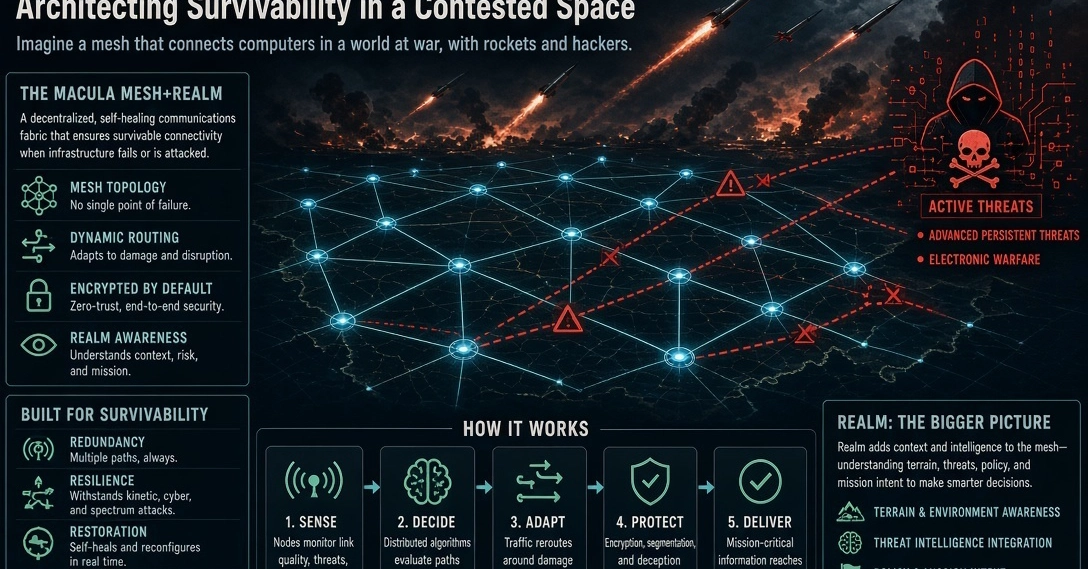
Macula Mesh+Realm introduces a novel approach to network security, architecting a sovereign network substrate designed for survivability in contested digital spaces. Unlike conventional Virtual Private Networks (VPNs) that extend existing networks by creating secure tunnels, Macula establishes a distributed fabric. In this fabric, identity and routing are intrinsically linked and cryptographically secured, providing a fundamentally different model for connectivity.
The Technical Foundation: Beyond the Tunnel
Macula eschews legacy tunneling protocols, opting instead for a modern, high-performance technology stack engineered for resilience and speed. This foundation is critical for its ability to function reliably even when underlying network conditions are hostile or untrusted.
Sovereign IPv6 Addressing
A cornerstone of Macula's design is its sovereign IPv6 substrate. Instead of relying on arbitrary IP addresses assigned from private pools, Macula derives node addresses cryptographically. These addresses are directly linked to the node's unique identity and its associated Realm ID. This cryptographic derivation eliminates the need for centralized IP address management systems. Crucially, an IP address within Macula becomes a verifiable proof of identity rather than merely a network location. This approach enhances security by making IP spoofing significantly more difficult and by ensuring that network presence is tied to authenticated identity.
QUIC & Connection Migration
Macula leverages the QUIC transport protocol, a modern successor to TCP designed for the internet's complexities. QUIC's inherent features, such as stream multiplexing and head-of-line blocking mitigation, provide performance benefits. More importantly for survivability, QUIC supports seamless connection migration. This means that a node's network connection can survive underlying IP address or port changes without interrupting the data flow. For instance, if a user moves from Wi-Fi to cellular, or if their public IP address changes due to network re-assignment, the QUIC connection can persist. This is a critical feature for maintaining uptime and availability in dynamic or unreliable network environments.
Identity-Centric Routing
At the heart of Macula's mesh network is its identity-centric routing mechanism. Instead of routing based solely on destination IP addresses, Macula routes based on the authenticated identity of the destination node. Each node in the mesh possesses a unique cryptographic identity. When a packet is sent, it is addressed to the recipient's identity. The network fabric then uses this identity to find the most secure and available path to the destination. This contrasts sharply with traditional routing, which is purely location-based and vulnerable to attacks that manipulate network topology or IP assignments. By anchoring routing to identity, Macula ensures that communication remains secure and verifiable, even if the underlying network infrastructure is compromised or changing.
Architecting for Survivability
The combination of sovereign addressing, QUIC, and identity-centric routing forms the basis of Macula's survivability architecture. This design aims to create a network that can withstand various forms of disruption, from network outages to targeted attacks.
Distributed Fabric, No Central Points of Failure
Macula operates as a distributed mesh, meaning there is no single central server or controller whose failure would bring down the entire network. Each node participates in maintaining the network's state and routing information. This decentralized nature inherently enhances resilience. If one node or a group of nodes becomes unavailable, the network can automatically reconfigure itself, finding alternative paths for communication through the remaining active nodes. This peer-to-peer architecture is a key differentiator from traditional VPNs, which often rely on centralized servers that can become bottlenecks or single points of failure.
Cryptographic Integration
Every aspect of Macula's operation is underpinned by strong cryptography. Node identities are established using public-key cryptography. Communication between nodes is end-to-end encrypted. Routing decisions are authenticated and validated cryptographically. This deep integration of cryptography ensures that the network's integrity is maintained even in untrusted environments. It provides assurance that data is being sent to and received from the intended parties, and that the routing information itself has not been tampered with. This creates a secure communication channel that is resilient to eavesdropping, man-in-the-middle attacks, and other common network threats.
Use Cases and Implications
The design of Macula Mesh+Realm suggests a broad range of applications where secure, resilient connectivity is paramount. Its ability to function across untrusted networks makes it suitable for scenarios where traditional network security models fall short.
Secure Communication in Hostile Environments
For organizations operating in regions with unstable internet infrastructure or facing sophisticated state-sponsored network interference, Macula offers a robust alternative. It allows for secure, persistent communication channels that are difficult to disrupt or surveil. This could include secure command and control for distributed systems, confidential data exchange between remote outposts, or secure communication for journalists and activists operating in oppressive regimes.
Decentralized Systems and IoT
The decentralized and identity-centric nature of Macula makes it an ideal substrate for emerging decentralized applications and the Internet of Things (IoT). For IoT deployments, where devices may have limited processing power and unreliable connectivity, Macula's efficient routing and connection persistence are beneficial. It can provide secure, manageable connectivity for fleets of devices without requiring complex centralized management infrastructure. For decentralized systems, it offers a secure networking layer that aligns with the principles of distributed trust and control.
Beyond Traditional VPNs
Macula represents a paradigm shift from VPNs, which are primarily designed to extend trusted networks into untrusted ones. Macula, by contrast, builds a trusted network fabric *within* untrusted environments. This is achieved by making identity the fundamental primitive, rather than network location or a pre-established tunnel. This approach is more akin to building a self-sovereign digital space where participants can communicate securely and reliably, irrespective of the underlying network's trustworthiness. The architectural choices—sovereign IPv6, QUIC, and identity-centric routing—collectively create a system that is not just secure, but inherently survivable.