The Monday Morning AI Mandate
Your director has read in Forbes that AI reduces development times by 70%. It's Monday, 9 AM, and they want it by Friday. This scene has played out in so many companies it's developed a recognizable pattern: the curve of expectation grows exponentially, while actual engineering capacity grows linearly. The gap between perception and reality often fuels these rapid, sometimes unrealistic, AI integration demands.
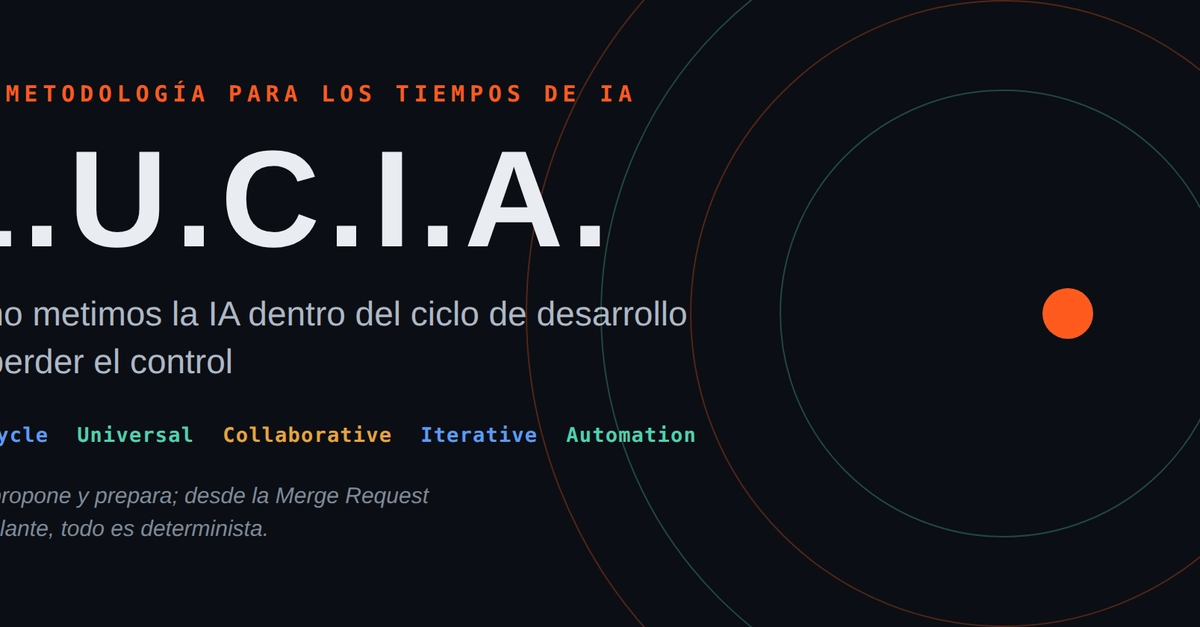
L.U.C.I.A. (Language Understanding and Code Intelligence Assistant) emerged from such pressures. It’s not a magic bullet, but a carefully engineered system aimed at bridging that gap. This article delves into the technical details, design decisions, and implementation strategies behind L.U.C.I.A., offering a blueprint for those looking to build similar AI-assisted development tools. The code snippets provided are illustrative, reflecting the design choices and implementation approach rather than a direct repository dump. The goal is to enable you to reconstruct a similar framework, not to copy ours verbatim.

Architecting L.U.C.I.A.
At its core, L.U.C.I.A. is a sophisticated language model fine-tuned for code comprehension and generation. The system integrates several key components to achieve its functionality:
1. Code Parsing and Abstract Syntax Tree (AST) Generation
Before any AI can understand code, it needs to parse it. L.U.C.I.A. employs robust parsers tailored for various programming languages (initially focusing on Python, JavaScript, and Java). These parsers transform raw source code into Abstract Syntax Trees (ASTs). An AST is a tree representation of the abstract syntactic structure of source code; each node in the tree denotes a construct occurring in the source code. This structured representation is crucial because it abstracts away superficial syntactic variations (like whitespace or comments) and provides a standardized, machine-readable format for the AI to process.
Think of it like this: instead of reading a novel word-for-word, you're given a detailed outline of the plot, character relationships, and thematic elements. The AST provides that high-level, structural understanding of the code. This allows L.U.C.I.A. to identify functions, classes, variables, control flow structures, and their relationships, regardless of the specific syntax used.
2. Contextual Embedding and Knowledge Graph
Raw ASTs, while structured, lack semantic understanding. To imbue L.U.C.I.A. with deeper comprehension, we generate contextual embeddings for code elements. This involves using transformer-based models (similar to those powering large language models) that are trained on massive code corpora. These models learn to represent code snippets, functions, or even entire files as dense vectors in a high-dimensional space, where proximity in this space signifies semantic similarity. Similar functions, even if written differently, will have vectors that are close together.
Furthermore, L.U.C.I.A. builds and maintains a dynamic knowledge graph. This graph connects code elements (functions, classes, variables) with their definitions, usages, dependencies, and even relevant documentation or issue tracker tickets. This graph acts as a long-term memory and reasoning engine, allowing L.U.C.I.A. to understand not just isolated code blocks but how they fit into the larger project ecosystem. It helps in tracing the impact of a change, identifying potential conflicts, or finding relevant code for a new feature.
3. Prompt Engineering and Generation Strategies
The effectiveness of any AI model hinges on how it's prompted. For L.U.C.I.A., prompt engineering is an art and science. When a developer requests assistance—be it for generating boilerplate code, refactoring a function, or writing unit tests—the system constructs a highly specific prompt. This prompt typically includes:
- A natural language description of the desired outcome.
- Relevant code snippets from the current context (e.g., the function being edited, related functions).
- Information extracted from the knowledge graph about dependencies and conventions.
- Specific constraints or requirements (e.g., performance targets, style guides).
The AI model then uses this comprehensive prompt to generate code. We employ a multi-stage generation process. Initially, a draft is produced. This draft is then passed through a series of validation and refinement steps. This includes static analysis checks, adherence to the AST structure, and even self-critique prompts to identify potential flaws before presenting the output to the developer.
Integration and Workflow
A powerful AI model is useless if it doesn't seamlessly integrate into a developer's workflow. L.U.C.I.A. is designed to be non-intrusive, acting as an intelligent assistant rather than a replacement.
IDE Integration
The primary interface is through IDE extensions (VS Code, JetBrains IDEs). These extensions provide features like:
- Code Completion: Beyond simple token prediction, L.U.C.I.A. offers context-aware, multi-line code suggestions.
- Code Generation: Generate entire functions, classes, or test suites based on natural language descriptions or function signatures.
- Refactoring Assistance: Suggest improvements, identify dead code, or help in restructuring complex logic.
- Bug Detection and Explanation: Highlight potential issues and provide explanations rooted in semantic understanding and common error patterns.
- Documentation Generation: Automatically generate docstrings or comments based on code logic.
The integration ensures that developers can access L.U.C.I.A.'s capabilities without leaving their primary development environment. This minimizes context switching and maintains productivity.
Feedback Loop
Crucially, L.U.C.I.A. incorporates a continuous learning mechanism. Every interaction—accepted suggestions, rejected code, explicit feedback—is used to refine the underlying models and prompt strategies. Developers can flag incorrect or suboptimal suggestions, providing valuable data that helps improve the system for everyone. This feedback loop is essential for adapting to evolving coding practices, new libraries, and project-specific nuances.
The Human Element: Collaboration, Not Replacement
It’s vital to understand that L.U.C.I.A. is intended to augment human developers, not replace them. The system excels at repetitive tasks, boilerplate code, and identifying common patterns. However, complex problem-solving, architectural design, and understanding business context still require human ingenuity. L.U.C.I.A. frees up developers from the drudgery, allowing them to focus on the more creative and challenging aspects of software engineering.
The surprising detail here is not the AI's ability to generate code, but its capacity to understand the *intent* behind the code and its integration into the broader project context. This goes beyond simple pattern matching; it involves a form of computational empathy for the developer's task.
Future Directions
The journey with L.U.C.I.A. is ongoing. Future development will focus on expanding language support, improving real-time collaborative coding assistance, and enhancing its ability to understand and adhere to complex project-specific architectural guidelines. We are also exploring deeper integration with CI/CD pipelines for automated code reviews and vulnerability scanning powered by L.U.C.I.A.'s understanding.