The Problem with Simple Polling
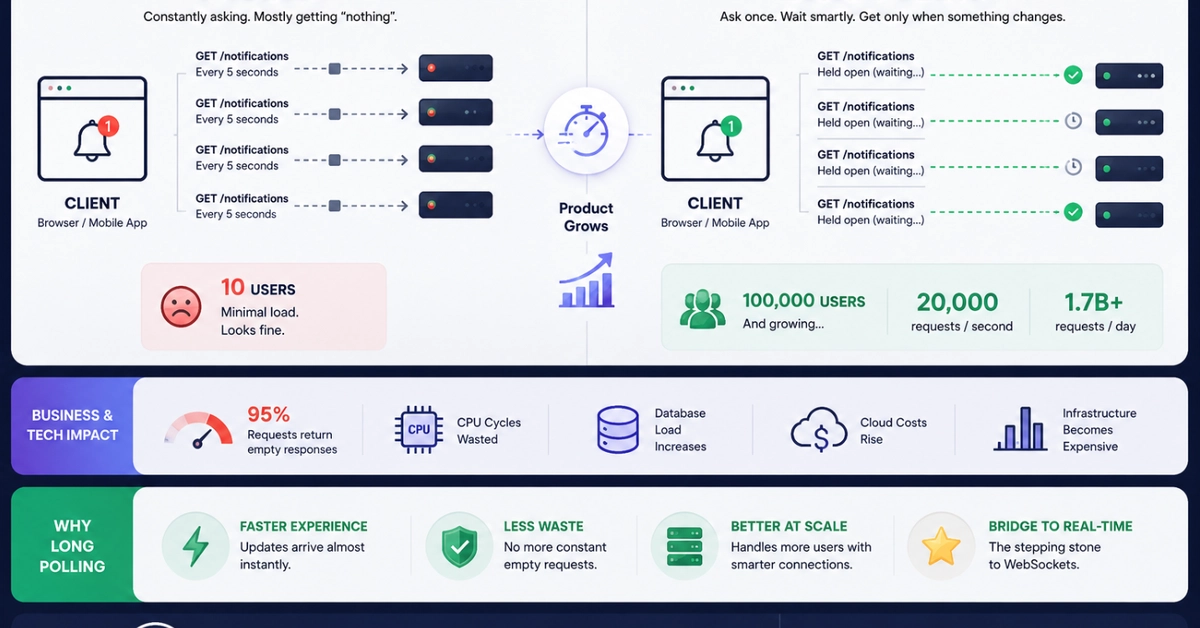
Traditional polling, where a browser repeatedly asks a server for updates, feels simple and predictable. For small-scale applications, it works fine. The browser sends a request, like asking, "Anything new?" If the server has nothing, it responds with an empty update, perhaps a JSON object like {"updates": []}. The browser then waits a set interval, say a few seconds, and asks again. This cycle is easy to implement and manage when user bases are small and data change rates are low.
But the web evolved. User expectations shifted. Applications demanded more responsiveness. Suddenly, this simple, predictable polling mechanism became a significant bottleneck. Every request, even one yielding no new information, consumes server resources and network bandwidth. For applications with many users or frequent data updates, this inefficiency quickly scaled into a business problem. Imagine a chat application where users expect to see messages appear almost instantly. With traditional polling, messages could be delayed by seconds, leading to a frustrating user experience. The server would be flooded with requests, most of them returning nothing, while critical updates might still be waiting for the next polling interval.
Introducing Long Polling: The Server Holds the Line
Long polling emerged as a clever workaround. Instead of the browser asking the server "Anything new?" and the server immediately responding, long polling flipped the script. The browser would send a request to the server, asking for updates. However, the server wouldn't respond immediately if there were no new data. Instead, it would hold the connection open. The server would only send a response when either new data became available, or a predetermined timeout was reached. If the timeout occurred without any new data, the server would send an empty response, and the browser would immediately re-establish a new connection. This process is akin to a customer waiting at a shop counter. Instead of leaving and coming back every minute to check if their order is ready, they tell the shopkeeper to call them as soon as it is. The shopkeeper holds onto their request and only calls when the order is fulfilled, or after a reasonable waiting period.
This approach significantly reduced the number of empty requests. The server wasn't bombarded with constant "Are we there yet?" pings. It could efficiently manage its resources, only responding when there was actual information to convey. This made web applications feel much more responsive. Real-time features like live notifications, dynamic dashboards, and instant messaging became more feasible without overwhelming the server infrastructure. The key innovation was shifting the burden of immediacy from the client to the server, allowing for a more efficient use of network and processing resources.
The Trade-offs and Limitations
Despite its advantages, long polling wasn't a perfect solution. While it drastically cut down on empty requests compared to traditional polling, it still maintained a constant, albeit less frequent, connection. Each connection, even if idle, consumes server resources, such as memory and file descriptors. For applications with tens of thousands of concurrent users, managing these persistent connections could still strain server capacity. Furthermore, the latency, while reduced, wasn't truly instantaneous. There was always a delay between data becoming available on the server and the client receiving it, dictated by the server's processing time and the network round trip. The timeout mechanism, while necessary to prevent indefinite connections, introduced a worst-case latency scenario. If a timeout occurred, the client had to wait for a new connection to be established before receiving any potential updates, adding a small but noticeable delay.
Complexity also increased. Implementing and managing long polling required more sophisticated server-side logic to handle open connections, timeouts, and data broadcasting. Debugging these connections could be more challenging than with simple request-response cycles. Network intermediaries, like firewalls or load balancers, sometimes had trouble with long-held connections, leading to dropped connections or unexpected behavior. These limitations meant that long polling, while a significant improvement, was often seen as a stepping stone rather than the ultimate solution for real-time web communication.
Long Polling's Legacy and the Dawn of Modern Real-Time
Long polling represented a crucial evolutionary step in how the web handled real-time data. It demonstrated that the browser didn't have to be the passive entity constantly asking for information. By allowing the server to push data when it was ready, long polling brought a new level of interactivity to web applications. It paved the way for richer user experiences, making features that felt almost magical at the time – like instant chat updates or live stock tickers – a reality for many users.
The techniques and lessons learned from long polling were instrumental in the development of more advanced real-time communication protocols. While technologies like WebSockets have largely supplanted long polling for true bidirectional, low-latency communication, the underlying principle of efficient server-initiated data transfer remains vital. Many modern systems still use variations of long polling or fallback mechanisms when WebSockets are not available or feasible. It was the first time the web truly felt alive, breathing data back and forth with a responsiveness that was previously unimaginable. It taught developers and users alike what was possible when the web could react in near real-time, setting the stage for the always-connected, dynamic applications we rely on today.