Coding by voice offers significant convenience, but the traditional approach of sending dictation to cloud-based AI services like OpenAI's ChatGPT presents a critical barrier for developers working with sensitive client code. The risk of data exfiltration, however inadvertent, makes cloud-dependent voice coding a non-starter for many professional environments. A new local-first pipeline addresses this by keeping all voice, context, and generated code entirely on the user's machine.
The Need for Local Control
The distinction between conversational AI and a code generation agent is crucial. While ChatGPT's voice mode is designed for dialogue, with its inherent temporization and reformulation, it's not optimized for the precise, rapid-fire nature of dictating code. When code accuracy and client confidentiality are paramount, relying on a service that transmits every spoken word to a third-party server is untenable. This is precisely the problem the new local pipeline aims to solve, offering the benefits of voice coding without compromising data security or privacy.
Building the Local Pipeline
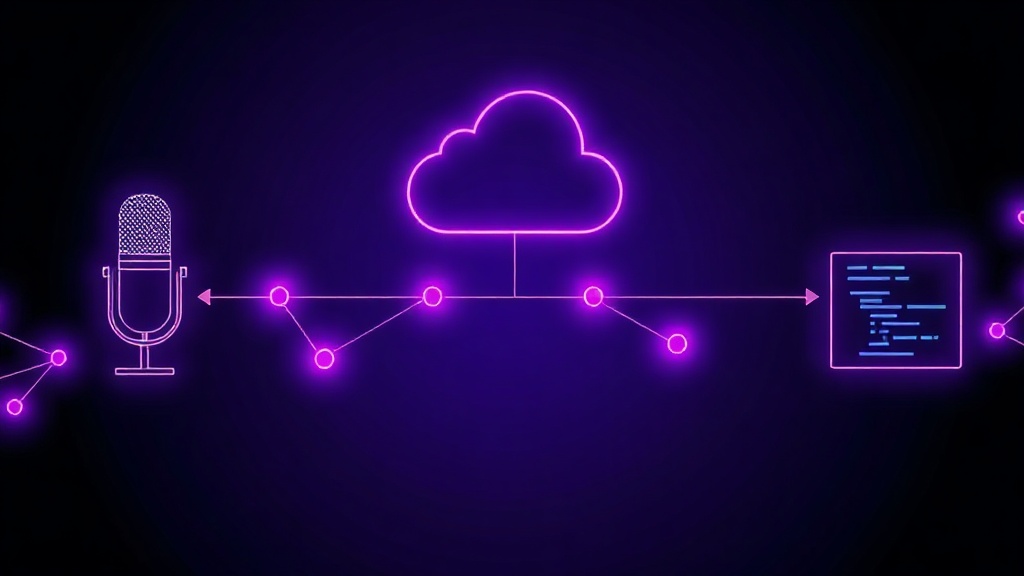
The solution is a multi-component system that replaces cloud services with local alternatives. For speech-to-text transcription, the pipeline leverages faster-whisper, a highly efficient implementation of OpenAI's Whisper model optimized for local execution. This ensures that the conversion of spoken words into text happens entirely offline. The transcribed text is then fed into an AI agent capable of understanding and acting upon coding-related instructions. For this role, the system utilizes Claude Code, specifically its /voice command functionality, which allows for direct interaction and code generation based on the transcribed input.
The core principle is that absolutely nothing leaves the local machine. This includes the raw audio input, the intermediate text transcriptions, any contextual information about the project, and the resulting generated code. This end-to-end local processing provides a robust security posture, making it suitable for environments with strict data handling policies.
Performance and Latency on M2 Hardware
A significant concern with local AI processing is latency. Running complex models like Whisper and Claude locally can introduce delays that negate the speed advantages of voice input. Initial tests on an M2 chip, however, show promising results. The combination of faster-whisper and Claude Code's local command execution achieves a level of responsiveness that makes voice coding a practical reality. While specific latency figures will vary based on the M2 chip variant (e.g., M2 Pro, M2 Max) and the complexity of the transcription and code generation tasks, the setup demonstrates that a fluid, near real-time experience is achievable without cloud reliance.
The efficiency of faster-whisper is a key contributor. By optimizing the Whisper model for local inference, it significantly reduces the computational overhead compared to running the standard model. This allows for quicker transcription, which is the first critical step in the pipeline. Claude Code, when integrated via its /voice command, processes the transcribed instructions and generates code or performs other development tasks without requiring external API calls. This direct local processing minimizes network latency and eliminates the variable delays associated with cloud server responses.
Encountered Bugs and Solutions
The development of this local pipeline was not without its challenges. The team reported encountering two specific bugs that consumed approximately half a day to resolve. While the exact technical details of these bugs are not fully elaborated in the provided excerpt, their existence highlights the complexities inherent in integrating multiple local AI models and custom scripting. Such issues often stem from:
- Inter-process communication: Ensuring smooth data flow between faster-whisper and Claude Code's command interface.
- Environment configuration: Managing dependencies, model versions, and system settings for local execution.
- Prompt engineering for local agents: Adapting instructions for Claude Code to effectively leverage its local capabilities, which may differ from its cloud-based API behavior.
- Input/Output handling: Correctly parsing transcribed text and feeding it into the agent, and then processing the agent's output (e.g., code snippets) for use in an editor.
The fact that these bugs were identified and overcome underscores the practical engineering effort involved. Debugging local AI pipelines requires a deep understanding of both the AI models themselves and the underlying system architecture. The resolution of these issues means the pipeline is more robust and reliable for developers seeking a private, local voice-coding solution.
Broader Implications for Development Workflows
This local voice-to-code system represents a significant step towards more private and secure developer tooling. By decoupling voice coding from cloud dependency, it opens up possibilities for its use in highly regulated industries, corporate environments with stringent security protocols, and for individual developers who simply prefer to keep their work offline. The ability to dictate code, navigate projects, and even initiate pull requests or debug issues using voice commands, all while maintaining complete data sovereignty, could fundamentally alter how developers interact with their tools.
The success of this pipeline also suggests a broader trend towards more capable and accessible local AI models. As models like Whisper and Claude become more efficient and easier to deploy locally, we can expect to see a proliferation of similar tools that prioritize privacy and offline functionality. This shift empowers developers with greater control over their data and workflows, fostering innovation without compromising security.