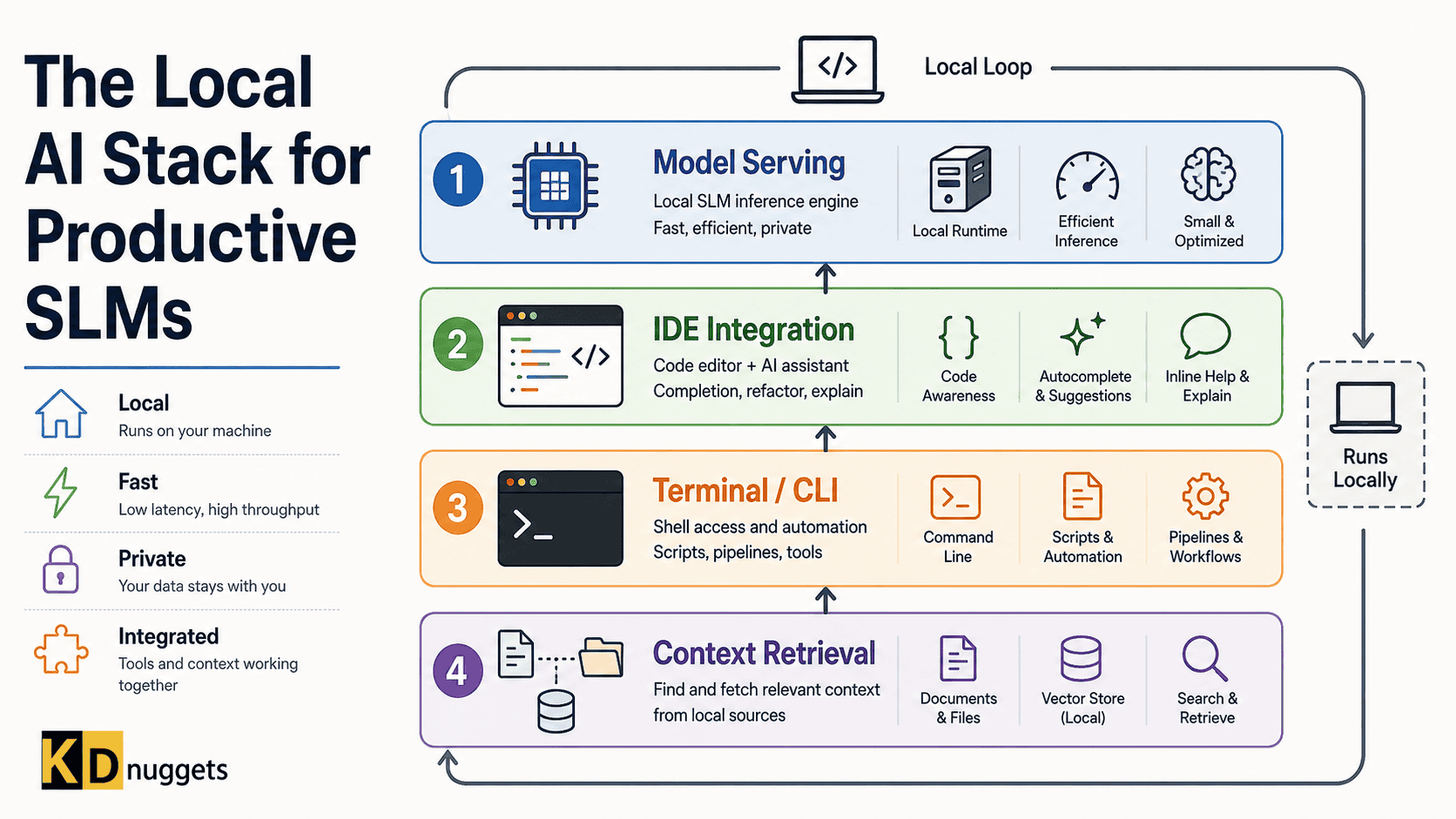
The Rise of the Local AI Stack
The push towards local AI, particularly for Small Language Models (SLMs), is driven by a confluence of factors: data privacy, cost efficiency, and the desire for greater control over AI deployments. Unlike massive, cloud-based Large Language Models (LLMs), SLMs offer a more manageable footprint, making them ideal candidates for on-premise or edge deployments. However, building a productive local AI stack requires careful consideration of each component, from the foundational model serving infrastructure to the sophisticated mechanisms for retrieving relevant context. This framework outlines a practical approach to selecting tools for each layer of your local AI setup. It's not about finding a single, all-encompassing solution, but rather about composing a tailored stack that meets specific needs. Think of it less like buying a pre-built PC and more like assembling a custom rig: you pick the motherboard, CPU, RAM, and GPU that work best together for your specific workload.Foundational Layer: Model Serving
At the base of any local AI stack lies model serving. This component is responsible for efficiently loading and running your chosen SLM, making its inference capabilities accessible via an API. Key considerations here include performance, resource utilization (CPU, GPU, RAM), and ease of integration. Several robust options exist. For Python-based environments, frameworks like **vLLM** and **Text Generation Inference (TGI)** by Hugging Face are leading contenders. vLLM, for instance, excels with its PagedAttention mechanism, which significantly optimizes memory usage and throughput for LLMs and SLMs alike. TGI offers a production-ready solution with features like quantization support and continuous batching, designed for high-performance serving. For developers looking for a more lightweight, potentially cross-language solution, **Ollama** has rapidly gained traction. Ollama simplifies the process of downloading, setting up, and running LLMs and SLMs locally with just a few commands. Its ease of use makes it an excellent starting point for experimentation and development, though for demanding production workloads, vLLM or TGI might offer superior performance and control.