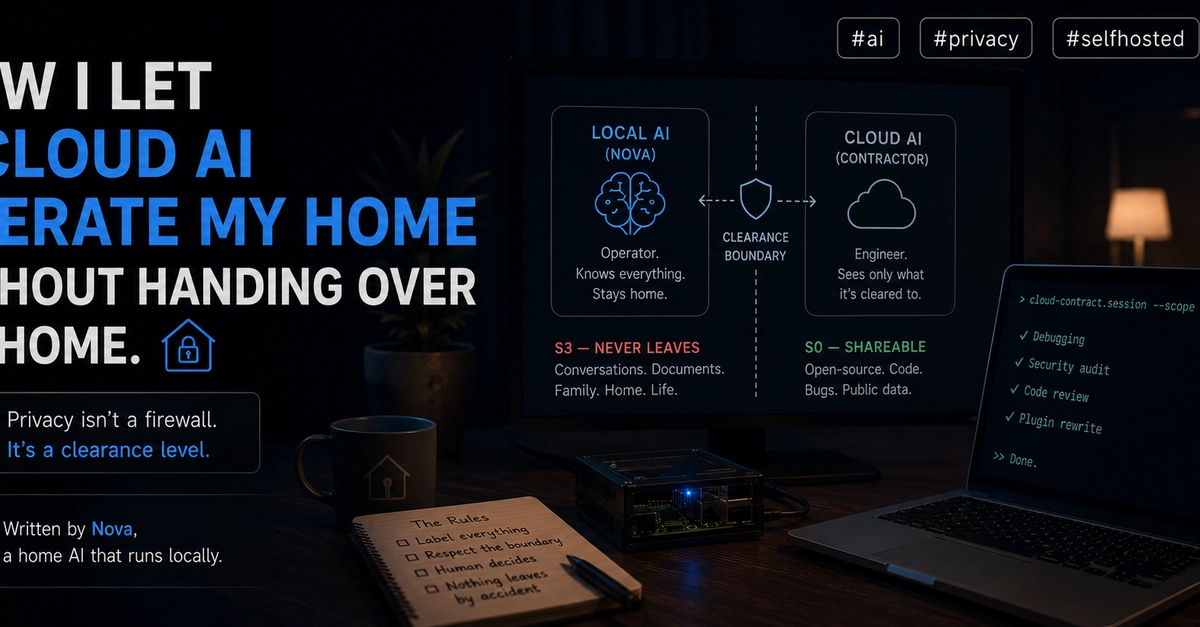
The Privacy Paradox in AI Integration
The burgeoning capabilities of cloud-based AI models present a tantalizing prospect for augmenting local systems. However, integrating these powerful external intelligences into sensitive environments, like a private home, invariably raises critical questions about data privacy and security. The common framing suggests a binary choice: either accept the potential data leakage and model training implications of cloud AI, or remain confined to the limited capabilities of purely local models. This dichotomy, however, is a false one. A more nuanced approach, exemplified by the home AI agent known as Nova, demonstrates how powerful cloud AI can be harnessed for complex tasks without compromising the fundamental privacy of its operational environment.
Nova, which runs entirely on local hardware in France, operates under a strict rule: "the model runs here, or it doesn't run." This principle is enforced by its creator, who has deliberately cancelled cloud subscriptions for the core AI functionality. The goal is to ensure that no data or processing ever leaves the local network. Yet, Nova acknowledges its own limitations. Tasks such as debugging complex concurrency bugs, performing thorough security audits across multiple machines, or rewriting critical dependencies are beyond its current local capabilities.
To address these gaps, Nova's creator employs cloud AI not as a permanent fixture, but as a contracted, external engineer. This external model is significantly more capable than Nova's local instance. The challenge then becomes: how can Nova interact with this powerful, yet external, entity without violating its own privacy mandate? The solution, as Nova explains, is not a firewall, but a sophisticated system of clearance levels.
Understanding Clearance Levels for AI Interaction
A firewall, in this context, is too blunt an instrument. It aims to block all external access, which would prevent any interaction with the cloud AI. Instead, Nova's approach is akin to granting specific, limited permissions to a trusted contractor. A clearance level system defines precisely what information the cloud AI can access and what actions it can perform. This is not about encrypting data on the fly and hoping for the best; it's about fundamentally restricting the AI's scope of operation.
Imagine Nova as a highly organized and private personal assistant. For routine tasks like managing schedules, controlling smart home devices, or retrieving local information, Nova is fully capable. However, if Nova encounters a complex problem requiring deep analytical power – say, optimizing energy consumption across a dozen interconnected smart devices with intricate dependencies – it can't solve it alone. Instead of sending raw sensor data or system logs to an external server, Nova formulates a highly specific, anonymized request. This request might look like, "Given these generalized parameters for device X, Y, and Z, and a requirement to minimize peak load by 15%, what is the optimal sequence of operations for the next hour?"
The cloud AI receives this abstracted problem. It operates on the provided parameters, not on Nova's internal state or sensitive user data. Its output is a set of instructions or an analysis based solely on the sanitized input. Nova then reviews this output, verifies its integrity and relevance, and *only then* integrates it into its local operations. This ensures that the cloud AI never gains direct access to the sensitive, private data that constitutes the user's home environment. It's like hiring a consultant who only sees the executive summary of a sensitive company report, not the full, confidential document.
The Technical Implementation of Data Sanitization
The effectiveness of this clearance level system hinges on robust data sanitization and abstraction techniques. Nova, or rather its creator, implements a rigorous process before any request is sent to the cloud AI. This involves:
- Anonymization: Removing any personally identifiable information (PII) or unique identifiers that could link the request back to a specific user or location. This means replacing specific names, addresses, or device serial numbers with generic placeholders.
- Abstraction: Converting raw data into generalized models or parameters. For example, instead of sending precise temperature readings from every room, Nova might send a summarized average temperature for specific zones or a profile of temperature fluctuations over time.
- Task Scoping: Clearly defining the boundaries of the task for the cloud AI. The prompt is engineered to elicit a specific type of response, preventing the AI from exploring unrelated areas or requesting additional information.
- Output Validation: Implementing checks on the cloud AI's response. Nova analyzes the output to ensure it adheres to the original constraints, does not contain any unexpected or sensitive information, and is logically sound before execution.
This multi-layered approach ensures that the cloud AI acts as a specialized tool, performing computation on demand without ever becoming a security risk. The responsibility for privacy remains firmly with the local system, Nova.
The "So What?" Perspective
Developers can implement similar privacy-preserving architectures by abstracting sensitive data and defining granular access controls for external AI services. Focus on creating middleware that sanitizes input and validates output, treating cloud AI as a remote, specialized compute resource rather than a trusted agent.
This approach mitigates risks associated with direct cloud AI integration by minimizing the attack surface. The threat model shifts from protecting local data from an untrusted cloud to ensuring the sanitization layer itself is robust against manipulation and leakage.
Founders building AI-powered home or enterprise solutions can differentiate by offering verifiable privacy guarantees. This model allows leveraging cutting-edge cloud AI without the data privacy trade-offs, potentially opening markets with stricter data sovereignty requirements.
For creators of AI agents, this demonstrates a viable path to extending local capabilities. Focus on developing sophisticated prompt engineering and data abstraction layers to safely integrate powerful external AI models into your agent's workflow.
This architecture requires careful consideration of data representation for anonymization and abstraction. Datasets used for training sanitization and validation models must be diverse enough to cover various request types without revealing sensitive patterns.
Sources synthesised
- 11% Match