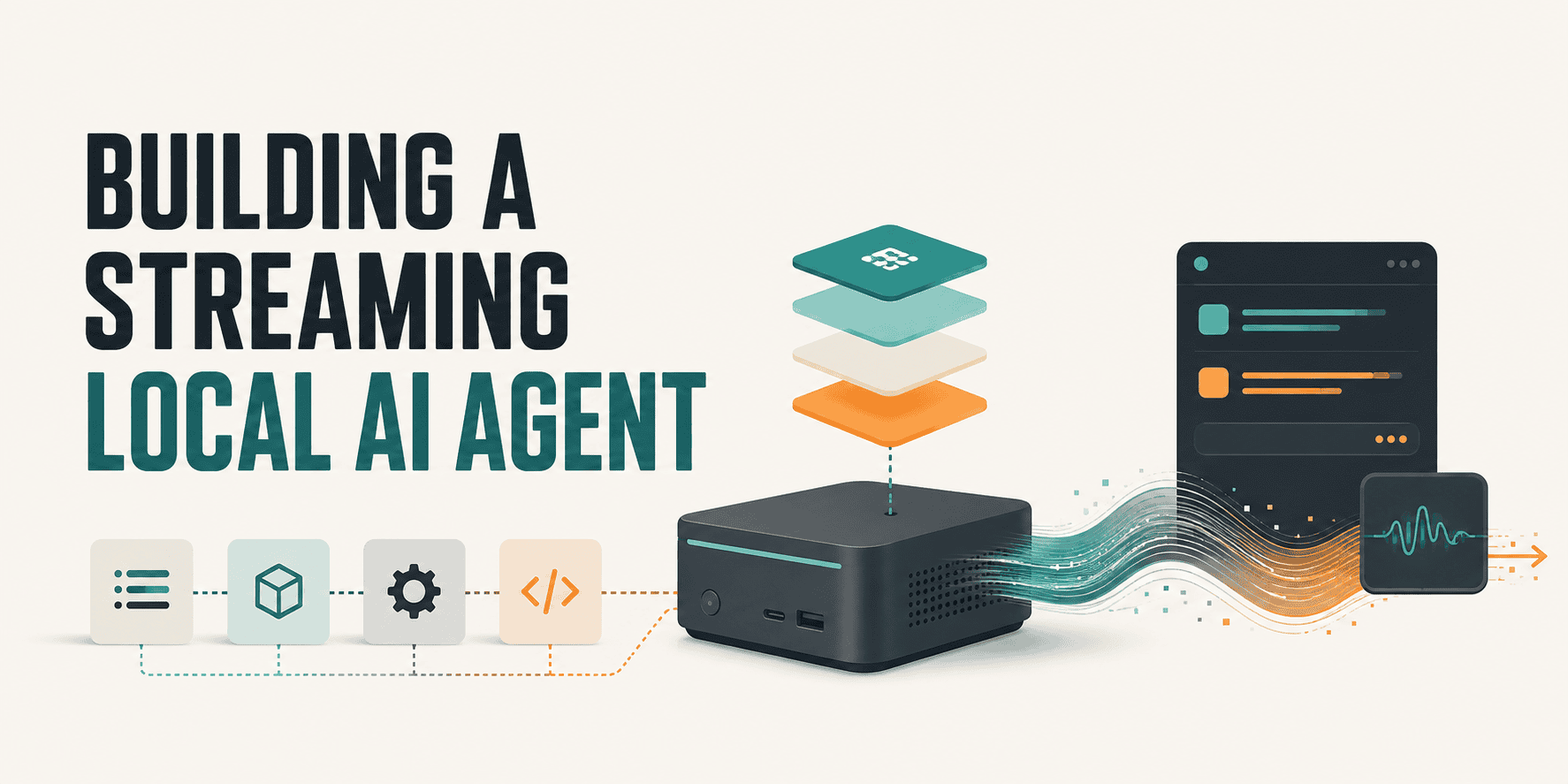
The Two Faces of Streaming in Local AI Agents
The term "streaming" when applied to local AI agents can be confusing. It’s not a single concept but rather refers to two fundamentally different architectural patterns, each serving distinct purposes in how AI models interact with data and users. Understanding these distinctions is crucial for developers aiming to build efficient, responsive, and powerful local AI applications. This piece aims to untangle these concepts, providing clarity for those working at the cutting edge of on-device AI.
The first, and perhaps more intuitive, meaning of streaming relates to the output of the AI model. Here, "streaming" refers to the process of delivering the model's generated text or other output piece by piece, rather than waiting for the entire response to be completed. Think of it less like waiting for a complete letter to arrive, and more like watching a live news broadcast where information unfolds in real-time. This approach is particularly valuable for large language models (LLMs) that can take significant time to generate lengthy responses. By streaming the output, the user experiences a much more interactive and engaging session. The agent doesn't appear to freeze; instead, it provides immediate feedback, word by word, or token by token. This creates a perception of speed and responsiveness, even if the total generation time remains the same. For developers, implementing this involves setting up a system that can capture and display tokens as they are produced by the model, often through an API that supports streaming responses.
This output streaming is critical for user experience, especially in conversational AI applications. Imagine a chatbot that takes 30 seconds to generate a full paragraph. If the user sees nothing for 30 seconds, they might assume the application has crashed or is unresponsive. However, if that same paragraph is streamed, character by character, the user sees progress immediately. This immediate feedback loop drastically improves perceived performance and user satisfaction. It’s a technique borrowed from web development, where asynchronous operations often stream data back to the client to keep the interface alive and interactive.
Streaming as Input: Processing Continuous Data
The second, and often more technically complex, meaning of streaming pertains to the input of data to the AI model. In this context, streaming refers to the continuous flow of data that the agent processes. This isn't about a single prompt or a static dataset; it's about handling data that arrives over time, such as sensor readings, audio feeds, video streams, or real-time text input from a user. For a local AI agent, this means the architecture must be designed to ingest and process these continuous data streams efficiently without overwhelming the system's resources.
Consider an agent designed to monitor local network traffic for security anomalies. The network traffic is a continuous stream of packets. The agent needs to process these packets in near real-time, applying AI models to detect suspicious patterns. It cannot afford to wait for a large batch of packets to accumulate before analysis; by then, a threat might have already bypassed the system. This requires a robust data pipeline capable of handling high-throughput, low-latency data ingestion and processing. Libraries and frameworks that support asynchronous I/O and efficient memory management are essential here. The agent must be able to parse, transform, and feed data into the AI model as it arrives, all while potentially managing other tasks.
This input streaming is also relevant for agents that interact with real-world environments through sensors. An agent controlling a local robot might receive continuous data from cameras, lidar, and joint encoders. It needs to process this information concurrently to navigate and perform tasks. Similarly, a voice assistant running locally would stream audio input from a microphone to a speech-to-text model, then stream the resulting text to an LLM for understanding and response generation. The agent acts as a real-time processing hub, constantly consuming and acting upon incoming data.
Architectural Implications for Local Agents
The choice between these streaming paradigms, or often a combination of both, dictates the underlying architecture of a local AI agent. For output streaming, the focus is on the inference pipeline and how results are delivered. This typically involves asynchronous programming, message queues, and efficient rendering of generated content on the user interface. Libraries like LangChain or LlamaIndex often provide abstractions that facilitate this, allowing developers to easily integrate streaming capabilities into their agent workflows.
For input streaming, the architectural challenges are centered around data ingestion, preprocessing, and efficient model inference on dynamic data. This might involve using specialized libraries for stream processing, such as Apache Flink or Kafka (though often lighter, local alternatives are preferred for edge deployments), or implementing custom data buffers and processing loops. The agent needs to maintain a state that can be updated by incoming data, enabling it to make decisions or predictions based on the historical context of the stream. This is a significant departure from stateless, single-prompt inference.
A truly sophisticated local AI agent might employ both forms of streaming. For instance, a personal assistant agent could stream audio input from your microphone (input streaming) to an LLM, process your request, and then stream the generated text response back to you token by token (output streaming) while simultaneously updating its internal state based on the conversation's context (another form of input streaming).
Navigating the Trade-offs
Implementing streaming, especially input streaming, introduces complexity. Developers must carefully consider the computational resources available on the local device. High-throughput data streams can consume significant CPU and memory, potentially impacting the performance of the AI model itself. Optimizing the data pipeline, choosing efficient models, and employing techniques like quantization or model pruning become critical. The trade-off is between real-time responsiveness and resource utilization. For output streaming, the primary challenge is managing the state of the generation process and ensuring smooth delivery to the user interface, which is generally less resource-intensive but still requires careful asynchronous handling.
What nobody has addressed yet is the fragmentation of tooling and best practices for these distinct streaming patterns in the local AI agent ecosystem. Developers often encounter documentation or examples that conflate the two, leading to implementation errors or suboptimal architectures. A clear, unified understanding of these concepts is vital for the maturation of local AI agent development.
Ultimately, whether you are concerned with how your agent speaks to the user or how it listens to the world, understanding the specific meaning of "streaming" in your context is the first step towards building more effective and user-friendly local AI applications. Developers must be precise in their architectural choices, aligning their implementation with the intended behavior and resource constraints of the local environment.