Beyond the Demo: Production AI Demands Robust Orchestration
Integrating large language models (LLMs) into applications has never been easier. With a few lines of code and a single SDK, developers can connect to services from OpenAI, DeepSeek, and a growing list of other providers. However, the transition from a functional demo to a production-ready AI application exposes a host of challenges that simple API calls cannot address. These include managing upstream rate limits, handling intermittent timeouts, controlling escalating costs, gracefully switching providers when a service becomes unavailable, and maintaining consistent quota and health states across multiple application instances.
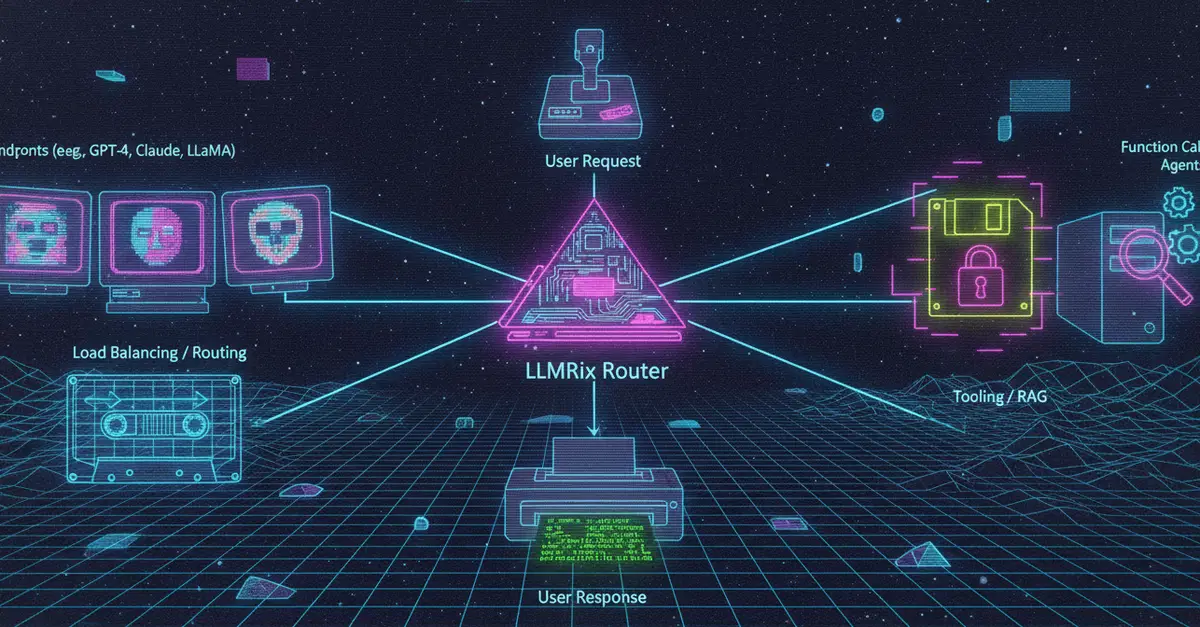
LLMRix Model Router emerges as an open-source solution designed to package these critical production concerns into a robust routing runtime specifically for Java applications. It aims to abstract away the complexities of multi-model interaction, allowing developers to focus on business logic rather than operational minutiae.
Core Functionality: Dynamic Routing and Fallbacks
At its heart, the LLMRix Model Router acts as an intelligent intermediary between your application's AI requests and the various LLM endpoints it can access. Instead of hardcoding a specific model or provider into your business logic, you configure the router with a set of potential models and their associated parameters. The router then dynamically selects the best model for each incoming request based on predefined strategies and real-time conditions.
Consider a scenario where your application needs to generate a customer support response. You might configure the LLMRix router with a primary, high-performance model. If that model experiences a rate limit or a timeout, the router can automatically fall back to a secondary, perhaps more cost-effective or regionally available model, ensuring that the user request is still processed without interruption. This fallback mechanism is crucial for maintaining application uptime and user experience, especially in high-traffic environments.
Strategies for Model Selection and Management
The router supports various strategies for selecting the optimal model. These can include:
- Load Balancing: Distributing requests across multiple model instances or providers to prevent any single endpoint from becoming overloaded.
- Cost Optimization: Prioritizing cheaper models for less critical tasks or when budget constraints are a concern.
- Performance-Based Routing: Selecting models based on their historical response times or latency metrics.
- Provider Fallback: Automatically switching to an alternative provider if the primary choice is unavailable or unresponsive.
- Regional Routing: Directing requests to models hosted in specific geographic regions for compliance or latency benefits.
This flexibility allows developers to tailor the routing behavior to their specific application needs. For instance, a content generation service might prioritize creative models with higher quality outputs, while a data summarization tool might opt for faster, more cost-efficient models.
Addressing Production Pain Points
The LLMRix Model Router directly tackles several common production headaches for AI-powered Java applications:
- Rate Limit Management: The router can track API usage against provider rate limits and intelligently pause or reroute requests to avoid hitting these ceilings.
- Cost Control: By enabling explicit cost-aware routing strategies, developers can prevent unexpected spikes in AI service bills. The router can be configured to use cheaper models for bulk tasks or to alert when spending thresholds are approached.
- Provider Agnosticism: Applications become less dependent on a single LLM provider. If a provider changes its API, pricing, or terms of service, the impact on the application can be minimized by reconfiguring the router rather than refactoring core application code.
- High Availability: The built-in fallback mechanisms ensure that requests are fulfilled even if one or more model endpoints experience downtime. This resilience is paramount for mission-critical applications.
- State Consistency: For applications running multiple instances, the router can help manage shared state regarding quotas and model health, ensuring a unified approach to interacting with AI services.
Developer Experience and Integration
LLMRix is designed to be integrated into existing Java applications with minimal friction. It provides a declarative configuration approach, allowing developers to define their routing rules and model endpoints in configuration files (e.g., YAML or JSON) rather than embedding them directly in Java code. This separation of concerns makes the system more maintainable and adaptable as AI models and providers evolve.
The framework exposes a clean API that abstracts the underlying model interactions. Developers interact with the router, which then handles the complexities of selecting, calling, and managing responses from the various LLMs. This abstraction not only simplifies development but also provides a consistent interface, regardless of which LLM provider is ultimately serving the request. The surprising detail here is not the existence of such a router, but its open-source nature and specific focus on the Java ecosystem, which has historically seen less tooling for this level of dynamic AI orchestration compared to Python.
The Future of AI Orchestration in Java
As AI integration deepens across enterprise software, the need for sophisticated orchestration tools will only grow. LLMRix Model Router addresses a clear gap in the Java landscape, providing developers with the necessary tools to build reliable, scalable, and cost-effective AI applications. By abstracting the complexities of multi-model interaction, the framework empowers development teams to deploy AI features with greater confidence, knowing that their applications can adapt to the dynamic nature of the AI model ecosystem.
What remains to be seen is how the community will contribute to and extend LLMRix, particularly in terms of supporting a wider array of LLM providers and offering more advanced, fine-grained control over routing strategies. The open-source nature suggests a collaborative path forward, promising continuous improvement and adaptation to the rapidly evolving field of artificial intelligence.