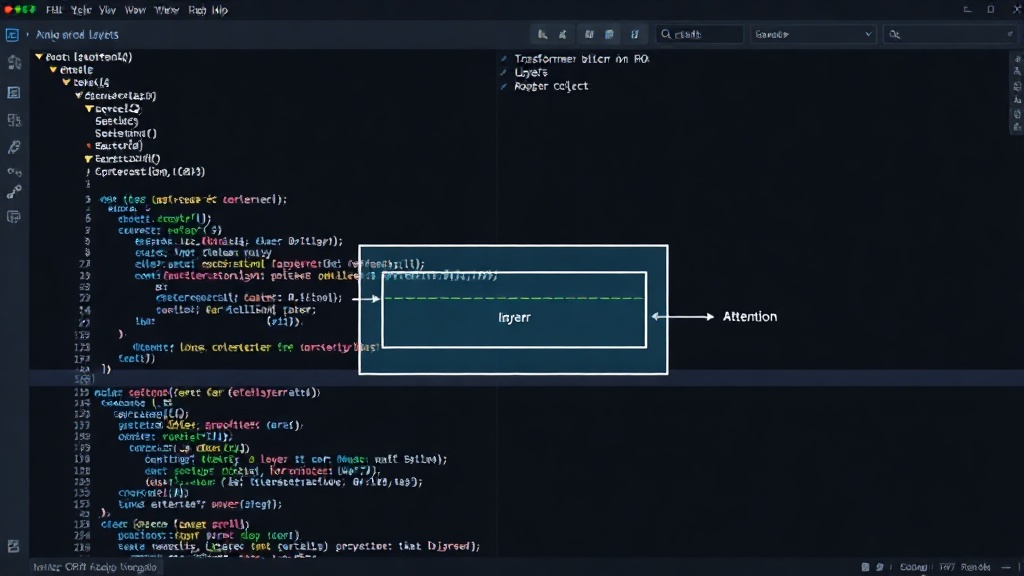
Gradient Computation for LLM Layers
Building on Part 1's forward pass implementation, this installment dives into the crucial backward pass, the engine of LLM training. We'll detail gradient computation for core components like Linear layers, Softmax, and Layer Normalization. This involves deriving and implementing the mathematical operations that propagate error signals back through the network, enabling weight adjustments. For a Linear layer, the backward pass computes gradients with respect to the input activations and the weights. This is typically achieved through matrix multiplications involving the incoming gradient and the transposed weights, and the incoming gradient and the transposed input activations, respectively. Softmax gradients are particularly interesting as they depend on the output probabilities, often involving subtractions between the gradient and the diagonal of the output probability matrix. Layer Normalization gradients require careful handling of the mean and variance computations performed during the forward pass, ensuring that the gradient signal correctly reflects the impact of each element on the normalized output.
Fused AdamW Optimizer Implementation
Training LLMs necessitates sophisticated optimizers to navigate the high-dimensional loss landscape efficiently. We focus on AdamW, a popular choice that combines adaptive learning rates with weight decay. Implementing AdamW directly on the GPU offers significant performance benefits by fusing multiple operations into single kernels. This reduces memory bandwidth bottlenecks and kernel launch overheads. A fused AdamW kernel typically combines the gradient clipping, momentum update (first moment), RMSprop update (second moment), and the final weight update step. This fusion requires careful management of intermediate states (momentum and variance estimates) and precise application of hyperparameters like learning rate, beta1, beta2, and epsilon. By performing these operations in lockstep with the gradient computation, we ensure that weight updates are applied promptly and efficiently, accelerating the overall training process. The goal is to execute these steps with minimal data movement between global memory and on-chip caches, maximizing computational throughput.
Memory Optimization with Activation Checkpointing
LLMs, with their billions of parameters, push the limits of GPU VRAM. To train larger models or use larger batch sizes, memory optimization is paramount. Activation checkpointing is a powerful technique that trades compute for memory. Instead of storing all intermediate activations from the forward pass for use in the backward pass, checkpointing selectively stores only a subset. During the backward pass, when a previously un-stored activation is needed, it is recomputed from the nearest available checkpoint. This drastically reduces the memory footprint required for activations, allowing for larger models. The trade-off is increased computation, as parts of the forward pass are executed twice. The optimal checkpointing strategy depends on the model architecture and available GPU memory. Implementing this involves identifying strategic points in the network to place checkpoints, typically at the boundaries of major sub-modules like Transformer blocks. The backward pass then needs to be modified to trigger these recomputations as necessary, ensuring the correct gradient flow without excessive memory usage.
The Full Training Iteration Loop
Bringing all these components together, we construct a complete training iteration. This loop orchestrates the forward pass, loss computation, backward pass (gradient calculation), and the optimizer's weight update step. For mixed-precision training, we incorporate FP16 or BF16 formats. This involves casting model weights and activations to lower precision during the forward pass to reduce memory usage and potentially speed up computation on hardware with specialized tensor cores. Gradients are typically computed in FP32 for numerical stability, and then the optimizer applies updates using a combination of FP32 and potentially lower precision values. The loss function, often cross-entropy for language modeling, is calculated based on the model's output and the ground truth labels. The backward pass then propagates gradients through the network, and the fused optimizer updates the model weights. This entire sequence, repeated for thousands or millions of steps, is what enables LLMs to learn from data. Managing data loading, device synchronization, and logging are also critical aspects of a robust training loop. The ability to seamlessly integrate these advanced techniques – gradient computation, fused optimization, and memory-saving strategies – is key to successfully training large-scale language models on modern GPU hardware.