
The Blind Spots of Traditional Testing
Traditional software testing, like unit tests, excels at verifying deterministic logic. If a function is supposed to return `2` for an input of `1+1`, a unit test can confirm that. However, Large Language Models (LLMs) operate in a fundamentally different domain. Their outputs are often non-deterministic due to parameters like temperature, meaning the same input can yield different, yet valid, outputs. This inherent variability breaks static equality checks.
Furthermore, semantic equivalence poses a significant challenge. "Paris is the capital of France" and "The capital of France is Paris" convey the same meaning but are textually different. Simple string matching fails to recognize this. Models and prompts evolve incrementally; small changes can lead to gradual quality drift that only becomes apparent at scale, often manifesting as subtle inaccuracies or off-putting tones. These are semantic failures – the core of what makes LLM output unreliable without specialized evaluation – that basic assertions simply cannot encode.
LLM applications fail silently at the semantic level. Standard unit tests verify that functions return values, but they cannot detect if the output is factually wrong, off-tone, or missing steps. Evals fix this by running a prompt, inspecting the output, and programmatically or judgmentally deciding its quality.
The Three Pillars of LLM Evaluation
To address these challenges, a robust evaluation pipeline is essential. This pipeline moves beyond simple input-output validation to assess the nuanced quality of LLM-generated content. Three primary types of evaluations form the backbone of such a system: Heuristic Evals, Model-Based Evals, and Human Evals.
1. Heuristic Evals: The First Line of Defense
Heuristic evaluations are the fastest and most objective form of LLM testing. They focus on measurable, quantifiable properties of the output, acting as an initial filter for common issues. These evals are ideal for regression testing because they catch immediate breaks in expected output structure or format.
Examples include:
- JSON Validity: Ensuring that if an LLM is expected to return JSON, the output is indeed valid JSON.
- Word Counts: Checking if the output falls within a specified length range.
- PII Presence: Detecting if Personally Identifiable Information (PII) has been inadvertently leaked.
- Format Adherence: Verifying that the output follows a specific template or structure (e.g., bullet points, numbered lists).
These checks are computationally inexpensive and provide immediate feedback, making them perfect for catching obvious regressions introduced by prompt or model updates. They don't assess the *quality* of the content, but they ensure the *form* is correct.
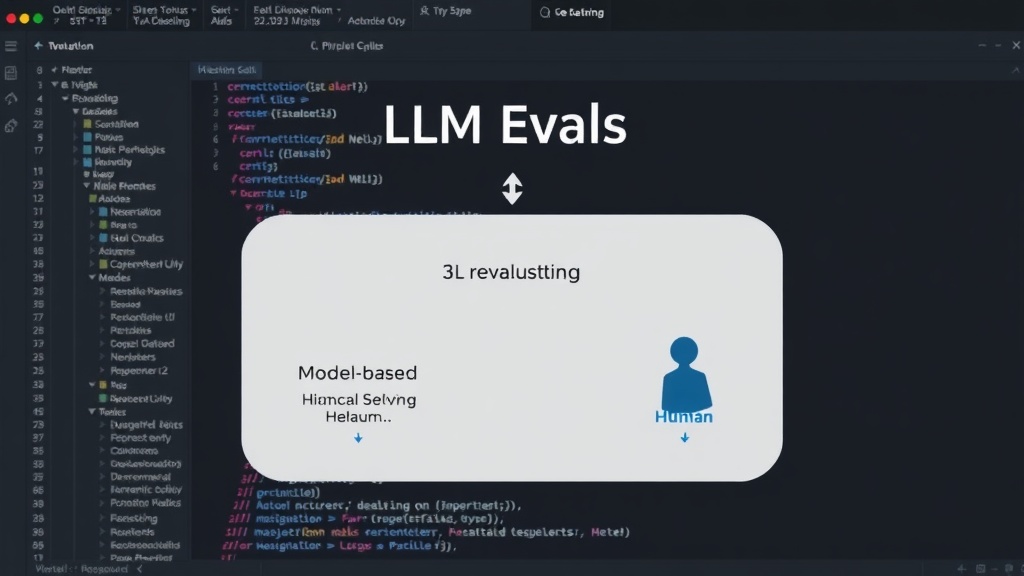
2. Model-Based Evals: Automated Quality Assessment
When heuristic checks aren't enough, model-based evaluations leverage another LLM (or a specialized model) to assess the quality of the target LLM's output. This approach automates the judgment process, offering a scalable way to evaluate aspects like factual accuracy, tone, and relevance.
The core idea is to design prompts for an evaluator LLM that can judge the output of another LLM based on specific criteria. For instance, you might prompt an evaluator LLM with:
- The original user query.
- The response from the LLM being tested.
- A set of criteria (e.g., "Is the response factually accurate?", "Is the tone appropriate for a customer service interaction?").
- A request for a score or a binary judgment (pass/fail).
This method is particularly useful for evaluating complex attributes that are hard to define with simple heuristics. However, it's crucial to remember that the evaluator LLM itself can be prone to errors or biases. The quality of model-based evals depends heavily on the prompt engineering and the capabilities of the evaluator model.
3. Human Evals: The Gold Standard for Nuance
For the most critical and nuanced aspects of LLM performance, human evaluation remains indispensable. Humans can assess subjective qualities like creativity, empathy, and subtle biases in ways that automated systems currently struggle with. This is especially important for generative tasks where the definition of a "correct" answer is fluid.
Human evals involve presenting LLM outputs to human reviewers who then rate them based on predefined rubrics. This could involve:
- Fact-Checking: Verifying claims against trusted sources.
- Tone and Style Assessment: Judging if the output matches the desired brand voice or emotional register.
- Usefulness and Relevance: Determining if the answer directly addresses the user's intent.
- Completeness: Checking if all necessary information or steps are included.
While human evaluations provide the highest quality signal, they are expensive and slow. Therefore, they are typically used sparingly, often to validate the effectiveness of heuristic and model-based evals, or for evaluating the most critical user journeys and edge cases. A common strategy is to use human evals to create a ground truth dataset that can then be used to train or fine-tune automated model-based evals.
Building Your LLM Evaluation Pipeline
Constructing an effective LLM evaluation pipeline involves integrating these three types of evals into a cohesive workflow. The process typically starts with defining clear evaluation metrics aligned with your application's goals. What does success look like for your LLM? Is it accuracy, creativity, conciseness, or a combination?
Next, you need to establish a process for generating test cases. These should cover a wide range of scenarios, including typical user inputs, edge cases, adversarial prompts, and prompts designed to test specific functionalities or knowledge domains.
The pipeline then executes these test cases through your LLM application. The outputs are then subjected to the evaluation types in sequence:
- Heuristic Evals run first to catch immediate structural or formatting errors. Any outputs failing these checks are flagged and do not proceed further.
- Model-Based Evals are applied to the outputs that pass heuristic checks. These provide automated scores for semantic quality.
- Human Evals are used selectively on a subset of outputs, particularly those flagged by model-based evals as borderline or critical. This subset can also include random samples to ensure ongoing alignment and to identify new failure modes.
The results from these evaluations should be aggregated and visualized to provide insights into model performance, identify areas for improvement, and track progress over time. This data-driven approach allows teams to iterate rapidly on prompts and models, ensuring that their AI applications remain reliable and effective as they evolve.
The Unanswered Question: Scalability of Human Oversight
While the framework for LLM evaluation is becoming clearer, a persistent challenge remains: how to scale human oversight effectively. As LLM applications become more complex and integrated into user workflows, the need for nuanced human judgment increases. However, the cost and time associated with human evaluation present a significant bottleneck. Developing more efficient methods for human-in-the-loop evaluation, or creating AI systems that can reliably mimic human judgment for a broader range of tasks, will be critical for the widespread adoption of sophisticated LLM-powered applications.